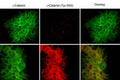
Anti-γ-Catenin (Tyr-550), Phosphospecific Antibody
Our γ-Catenin (Tyr-550) rabbit polyclonal phosphospecific primary antibody from PhosphoSolutions is produced in-house. It detects human, mouse, and rat γ-Catenin (Tyr-550) and is antigen affinity purified. It is great for use in WB, ICC.
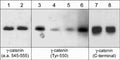
Western blot analysis of anti-γ-Catenin (C-terminal) immunoprecipitates from pervanadate-treated A431. The immunoprecipitates were untreated (lanes 1,3,7) or treated with alkaline phosphatase (lanes 2,4,8). The blots were probed with γ-Catenin (a.a. 545-555), γ-Catenin (Tyr-550) or γ-Catenin (C-terminal) antibodies. The anti-γ-Catenin (Tyr-550) was used in the presence of γ-Catenin (Tyr-550) (lane 5) or γ-Catenin (Tyr-644) (lane 6) peptides.
Click on image to zoom

SKU: CP1121
Ships: 1-2 business days
Product Details
γ-Catenin (Tyr-550)
Plakoglobin (γ-Catenin) is a catenin family member identified as a component of desmosomes. γ-Catenin has high homology to β-catenin and, like β-catenin, it can associate with the cadherins, E-cadherin and N-cadherin. One molecule of α-catenin and at least one molecule of β-catenin and γ-Catenin simultaneously bind to a single cadherin molecule. A 19-amino acid sequence of desmoglein was found to be critical for binding of γ-Catenin. Similar catenin-binding domains found in cadherins, suggest a common mechanism for γ-Catenin localization to both adherens junctions and desmosomes. Phosphorylation of tyrosine residues in γ-Catenin can modify its interactions with other proteins. Phosphorylation of tyrosine 644 decreases γ-Catenin association with α-catenin, but increases binding to desmoplakin. Fer kinase can phosphorylate tyrosine 550, which increases γ-Catenin binding to α-catenin. Thus, tyrosine phosphorylation may be important for regulation of γ-Catenin protein-protein interactions within desmosomal complexes.
Antigen Affinity Purified
Polyclonal
IgG
ELISA, ICC, WB
Rabbit
JUP
84
Phospho-γ-Catenin (Tyr-550) synthetic peptide (coupled to KLH) corresponding to amino acid residues around tyrosine 550 of human γ-Catenin. This peptide sequence is highly conserved in rat and mouse γ-Catenin.
Human
Human, Mouse, Rat
Storage at -20°C is recommended, as aliquots may be taken without freeze/thawing due to presence of 50% glycerol. Stable for at least 1 year at -20°C.
Liquid
PBS + 1 mg/ml BSA, 0.05% NaN3 and 50% glycerol
WB: 1:1000
ICC: 1:50
ICC: 1:50
Unconjugated
This antibody was cross-adsorbed to both phospho-tyrosine coupled to agarose and to dephosphorylated γ-Catenin (Tyr-550) peptide before affinity purification using phospho-γ-Catenin (Tyr-550) peptide (without carrier). The antibody detects an 84kDa* protein corresponding to the molecular mass of γ-Catenin on SDS-PAGE immunoblots of A431 and Hct116 src transformed cells treated with pervanadate (1 mM for 30 min), but not in control cells.
Phosphorylated
Tyr-550
Western blots performed on each lot.
For research use only. Not intended for therapeutic or diagnostic use. Use of all products is subject to our terms and conditions, which can be viewed on our website.
United States
After date of receipt, stable for at least 1 year at -20°C.
CTNNG; Plakoglobin; DPIII; PDGB; PKGB; junction plakoglobin; catenin (cadherin-associated protein; gamma 80kDa; desmoplakin III; desmoplakin-3; JUP; catenin gamma1
P14923
UniProt Summary: Common junctional plaque protein. The membrane-associated plaques are architectural elements in an important strategic position to influence the arrangement and function of both the cytoskeleton and the cells within the tissue. The presence of plakoglobin in both the desmosomes and in the intermediate junctions suggests that it plays a central role in the structure and function of submembranous plaques. Acts as a substrate for VE-PTP and is required by it to stimulate VE-cadherin function in endothelial cells. Can replace beta-catenin in E-cadherin/catenin adhesion complexes which are proposed to couple cadherins to the actin cytoskeleton. May promote axon outgrowth and motor fiber repair via DSP-mediated recruitment to outgrowth tips.
3728
Blue Ice