
Anti-FAK (Tyr-397), Phosphospecific Antibody (M121)
Our FAK (Tyr-397) mouse monoclonal phosphospecific primary antibody from PhosphoSolutions is produced in-house. It detects human, mouse, and rat, rabbit FAK (Tyr-397) and is Protein A purified. It is great for use in WB.
SKU: FM1211
Ships: 1-2 business days
Product Details
FAK (Tyr-397)
Focal adhesion kinase (FAK) is a widely expressed cytoplasmic protein tyrosine kinase involved in signal transduction pathways important for cell spreading, migration and survival. Activation of FAK by integrin clustering leads to autophosphorylation at Tyr-397, which is a binding site for Src family kinases, PI3-Kinase, and PLCγ. The recruitment of Src family kinases results in the phosphorylation of tyrosine 407, 576, and 577 in the catalytic domain, and tyrosine 871 and 925 in the carboxy-terminal region of FAK. Thus, the phosphorylation of Tyr-397 is a critical step in the activation of FAK.
Protein A Purified
Monoclonal
M121
IgG1
ELISA, WB
Mouse
PTK2
125
Clone (M121) was generated from a synthetic peptide (coupled to KLH) corresponding to amino acid residues around tyrosine 397 of human FAK. This peptide sequence has high homology to the conserved tyrosine site in rat and mouse FAK.
Human
Human, Mouse, Rat
Storage at -20°C is recommended, as aliquots may be taken without freeze/thawing due to presence of 50% glycerol. Stable for at least 1 year at -20°C.
Liquid
PBS + 1 mg/ml BSA, 0.05% NaN3 and 50% glycerol
WB: 1:500
Unconjugated
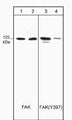
The antibody detects a 125 kDa* protein on SDS-PAGE immunoblots of untreated HUVEC cells. This phosphorylated band is greatly reduced after treatment with alkaline phosphatase.
Phosphorylated
Tyr-397
Western blots performed on each lot.
For research use only. Not intended for therapeutic or diagnostic use. Use of all products is subject to our terms and conditions, which can be viewed on our website.
United States
After date of receipt, stable for at least 1 year at -20°C.
FADK; PTK2; FAK1; FRNK; PPP1R71; p125FAK; pp125FAK; focal adhesion kinase 1; FADK 1; FAK-related non-kinase polypeptide; PTK2 protein tyrosine kinase 2; focal adhesion kinase isoform FAK-Del33; focal adhesion kinase-related nonkinase; protein phosphatase 1 regulatory subunit 71
Q05397
UniProt Summary: Non-receptor protein-tyrosine kinase that plays an essential role in regulating cell migration, adhesion, spreading, reorganization of the actin cytoskeleton, formation and disassembly of focal adhesions and cell protrusions, cell cycle progression, cell proliferation and apoptosis. Required for early embryonic development and placenta development. Required for embryonic angiogenesis, normal cardiomyocyte migration and proliferation, and normal heart development. Regulates axon growth and neuronal cell migration, axon branching and synapse formation; required for normal development of the nervous system. Plays a role in osteogenesis and differentiation of osteoblasts. Functions in integrin signal transduction, but also in signaling downstream of numerous growth factor receptors, G-protein coupled receptors (GPCR), EPHA2, netrin receptors and LDL receptors. Forms multisubunit signaling complexes with SRC and SRC family members upon activation; this leads to the phosphorylation of additional tyrosine residues, creating binding sites for scaffold proteins, effectors and substrates. Regulates numerous signaling pathways. Promotes activation of phosphatidylinositol 3-kinase and the AKT1 signaling cascade. Promotes activation of MAPK1/ERK2, MAPK3/ERK1 and the MAP kinase signaling cascade. Promotes localized and transient activation of guanine nucleotide exchange factors (GEFs) and GTPase-activating proteins (GAPs), and thereby modulates the activity of Rho family GTPases. Signaling via CAS family members mediates activation of RAC1. Phosphorylates NEDD9 following integrin stimulation. Recruits the ubiquitin ligase MDM2 to P53/TP53 in the nucleus, and thereby regulates P53/TP53 activity, P53/TP53 ubiquitination and proteasomal degradation. Phosphorylates SRC; this increases SRC kinase activity. Phosphorylates ACTN1, ARHGEF7, GRB7, RET and WASL. Promotes phosphorylation of PXN and STAT1; most likely PXN and STAT1 are phosphorylated by a SRC family kinase that is recruited to autophosphorylated PTK2/FAK1, rather than by PTK2/FAK1 itself. Promotes phosphorylation of BCAR1; GIT2 and SHC1; this requires both SRC and PTK2/FAK1. Promotes phosphorylation of BMX and PIK3R1. Isoform 6 (FRNK) does not contain a kinase domain and inhibits PTK2/FAK1 phosphorylation and signaling. Its enhanced expression can attenuate the nuclear accumulation of LPXN and limit its ability to enhance serum response factor (SRF)-dependent gene transcription.
5747
Blue Ice

