Anti-Estrogen Receptor α (C-terminus) Antibody
Our Estrogen Receptor α (C-terminus) primary antibody from PhosphoSolutions is rabbit polyclonal. It detects human, mouse, and rat Estrogen Receptor α (C-terminus) and is antigen affinity purified. It is great for use in WB, ICC, IP.
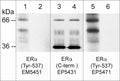
Western blot image of human MCF-7 cells treated with pervanadate (1 mM) for 30 min. (lanes 1-6). Some lanes of the blot were then treated with alkaline phosphatase (lanes 2, 4, & 6). The blot was probed with mouse monoclonal anti-ERα (Tyr-537) phospho-specific (lanes 1 & 2), rabbit polyclonal anti-ERα (C-terminus) (lanes 3 & 4), and rabbit polyclonal anti-ERα (Tyr-537) phospho-specific (lanes 5 & 6).
Click on image to zoom

SKU: EP5431
Ships: 1-2 business days
Product Details
Estrogen Receptor α (C-terminus)
Estrogen receptor α (ERα) is a member of the steroid receptor superfamily and its structure includes an N-terminal ligand-independent transactivation domain (AF-1), a highly conserved DNA binding domain, and a C-terminal ligand-dependent transactivation domain (AF-2). AF-1 and AF-2 activate transcription independently and synergistically, and act in a promoter- and cell-specific manner. Phosphorylation at multiple sites provides an important mechanism to regulate ERα activity. Ser-104, Ser-106, Ser-118, and Ser-167 are located in the amino-terminal transcription activation function domain AF-1, and phosphorylation of these serine residues plays an important role in regulating ERα activity. In addition to these sites, phosphorylation of Tyr-537 has been implicated in maximal hormone binding, dimerization, and transcriptional activity. Tyr-537, located in the AF-2 domain, is phosphorylated by c-Src leading to nuclear export of ERα and degradation. Thus, a variety of phosphorylation events control ERα activity.
Antigen Affinity Purified
Polyclonal
IgG
ELISA, ICC, IP, WB
Rabbit
ESR1
35-66
ERα (C-terminus) synthetic peptide (coupled to carrier protein) corresponds to amino acids in the C-terminus of human ERα. This sequence is well conserved in rat and mouse ERα, but is not found in ERβ
Human
Human, Mouse, Rat
Storage at -20°C is recommended, as aliquots may be taken without freeze/thawing due to presence of 50% glycerol. Stable for at least 1 year at -20°C.
Liquid
PBS + 1 mg/ml BSA, 0.05% NaN3 and 50% glycerol
WB: 1:500
ICC: 1:100
IP: 1:50
ICC: 1:100
IP: 1:50
Unconjugated
This antibody detects several forms of ERα ranging from 66 to 35 kDa* on SDS-PAGE immunoblots of MCF-7 cells treated with pervanadate, and MDA-MB-231 cells.
Western blots performed on each lot.
For research use only. Not intended for therapeutic or diagnostic use. Use of all products is subject to our terms and conditions, which can be viewed on our website.
United States
After date of receipt, stable for at least 1 year at -20°C.
ER; ESRA; ESR; ESTRR; Era; NR3A1; estrogen receptor; E2 receptor alpha; ER-alpha; estradiol receptor; estrogen nuclear receptor alpha; estrogen receptor alpha E1-E2-1-2; estrogen receptor alpha E1-N2-E2-1-2; nuclear receptor subfamily 3 group A member 1; oestrogen receptor alpha; ESR1; Eralpha
P03372
UniProt Summary: Nuclear hormone receptor. The steroid hormones and their receptors are involved in the regulation of eukaryotic gene expression and affect cellular proliferation and differentiation in target tissues. Ligand-dependent nuclear transactivation involves either direct homodimer binding to a palindromic estrogen response element (ERE) sequence or association with other DNA-binding transcription factors, such as AP-1/c-Jun, c-Fos, ATF-2, Sp1 and Sp3, to mediate ERE-independent signaling. Ligand binding induces a conformational change allowing subsequent or combinatorial association with multiprotein coactivator complexes through LXXLL motifs of their respective components. Mutual transrepression occurs between the estrogen receptor (ER) and NF-kappa-B in a cell-type specific manner. Decreases NF-kappa-B DNA-binding activity and inhibits NF-kappa-B-mediated transcription from the IL6 promoter and displace RELA/p65 and associated coregulators from the promoter. Recruited to the NF-kappa-B response element of the CCL2 and IL8 promoters and can displace CREBBP. Present with NF-kappa-B components RELA/p65 and NFKB1/p50 on ERE sequences. Can also act synergistically with NF-kappa-B to activate transcription involving respective recruitment adjacent response elements; the function involves CREBBP. Can activate the transcriptional activity of TFF1. Also mediates membrane-initiated estrogen signaling involving various kinase cascades. Essential for MTA1-mediated transcriptional regulation of BRCA1 and BCAS3. Maintains neuronal survival in response to ischemic reperfusion injury when in the presence of circulating estradiol (17-beta-estradiol/E2).
2099
Blue Ice