
Anti-EB3 (Ser-162), Phosphospecific Antibody
Our EB3 (Ser-162) rabbit polyclonal phosphospecific primary antibody from PhosphoSolutions is produced in-house. It detects human, mouse, and rat EB3 (Ser-162) and is antigen affinity purified. It is great for use in WB.
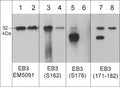
Western blot analysis of adult mouse brain untreated (lanes 1, 3, 5, & 7) or treated with lambda phosphatase (lanes 2, 4, 6, & 8). The blots were probed with rat monoclonal anti-EB3 (EM5091) (lanes 1 & 2), and rabbit polyclonals anti-EB3 (Ser-162) (lanes 3 & 4), anti-EB3 (Ser-176) (lanes 5 & 6), and anti-EB3 (a.a. 171-182) (lanes 7 & 8).
Click on image to zoom

SKU: EP4981
Ships: 1-2 business days
Product Details
EB3 (Ser-162)
Microtubles (MTs) are oriented with a fast growing plus-end and a slower growing minus-end. The MT plus-end is a crucial site for the regulation of MT dynamics and MT association with different cellular organelles by several groups of plus-end tracking proteins (+TIPs). These +TIPs form comet-like accumulations at the plus ends of MTs to regulate MT dynamics and interactions. The End-Binding (EB) family of +TIPs includes EB1 (MAPRE1), EB2 (MAPRE2, RP1), and EB3 (MAPRE3, EBF3). EB proteins are ubiquitiously expressed +TIPs that can dimerize through a coiled-coil C-terminal region, and bind MTs through an N-terminal calponin homology domain. EB proteins can stabilize MTs, increase MT dynamics, and suppress MT pauses. Site specific phosphorylation may regulate EB activity. EB3 Ser-162 phosphorylation destabilizes EB3 dimer and reduces MT growth, while aurora-kinase induced Ser-176 phosphorylation regulates EB3 protein stability during mitosis.
Antigen Affinity Purified
Polyclonal
IgG
ELISA, WB
Rabbit
MAPRE3
32
Phospho-EB3 (Ser-162) synthetic peptide (coupled to KLH) corresponding to amino acid residues surrounding serine 162 in human EB3. This peptide sequence is highly conserved in mouse and rat EB3, and is not conserved in EB1 and EB2.
Human
Human, Mouse, Rat
Storage at -20°C is recommended, as aliquots may be taken without freeze/thawing due to presence of 50% glycerol. Stable for at least 1 year at -20°C.
Liquid
PBS + 1 mg/ml BSA, 0.05% NaN3 and 50% glycerol
WB: 1:1000
Unconjugated
The antibody detects a 32 kDa* protein corresponding to the apparent molecular mass of phosphorylated EB3 on SDS-PAGE immunoblots of mouse brain. This reactivity is significantly reduced after lambda phosphatase treatment.
Phosphorylated
Ser-162
Western blots performed on each lot.
For research use only. Not intended for therapeutic or diagnostic use. Use of all products is subject to our terms and conditions, which can be viewed on our website.
United States
After date of receipt, stable for at least 1 year at -20°C.
EB3; Microtubule RP/EB; EBF3-S; RP3; APC binding protein; EB1 protein family member 3; end-binding protein 3; MAPRE3; APC; End-binding. RP3
Q9UPY8
UniProt Summary: Plus-end tracking protein (+TIP) that binds to the plus-end of microtubules and regulates the dynamics of the microtubule cytoskeleton. Promotes microtubule growth. May be involved in spindle function by stabilizing microtubules and anchoring them at centrosomes. Also acts as a regulator of minus-end microtubule organization: interacts with the complex formed by AKAP9 and PDE4DIP, leading to recruit CAMSAP2 to the Golgi apparatus, thereby tethering non-centrosomal minus-end microtubules to the Golgi, an important step for polarized cell movement. Promotes elongation of CAMSAP2-decorated microtubule stretches on the minus-end of microtubules.
22924
Blue Ice

