
Anti-EAPII Antibody
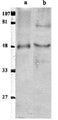
Our EAPII rabbit polyclonal primary antibody from PhosphoSolutions is produced in-house. It detects human EAPII and is antigen affinity purified. It is great for use in WB.
SKU: 24393
Ships: 1-2 business days
Product Details
EAPII
Ets proteins constitute a family of conserved sequence-specific DNA-binding proteins and function as transcription factors with roles in differentiation, lymphoid cell development, invasiveness and angiogenesis. A novel ETS1 interacting protein designated as ETS1-associated protein II (EAPII) interacts with ETS1 and other Ets proteins (ETS2 and FLI1) and is a novel ETS1 modulator.
Antigen Affinity Purified
Polyclonal
IgG
ELISA, WB
Rabbit
TDP2
Synthetic peptide corresponding to amino acids from the N-terminal region of human EAPII protein
Human
Human
Recommended that the undiluted antibody be aliquoted into smaller working volumes (10-30 uL/vial depending on usage) upon arrival and stored long term at -20° C or -80° C, while keeping a working aliquot stored at 4° C for short term. Avoid freeze/thaw cycles. Stable for at least 1 year.
Liquid
PBS + 0.02% NaN3
WB: 1:500-1:1000
WB Brain: 1:500-1:1000
Reacts with the N-terminal region of human EAPII protein.
Western blots performed on each lot.
For research use only. Not intended for therapeutic or diagnostic use. Use of all products is subject to our terms and conditions, which can be viewed on our website.
United States
After date of receipt, stable for at least 1 year at -20°C.
AD022; ETS1-associated protein 2; EAPII; TTRAP; dJ30M3.3; hTDP2; tyrosyl-DNA phosphodiesterase 2; 5'-Tyr-DNA phosphodiesterase; 5'-tyrosyl-DNA phosphodiesterase; ETS1-associated protein II; TRAF and TNF receptor-associated protein; VPg unlinkase; tyr-DNA phosphodiesterase 2; tyrosyl-RNA phosphodiesterase; TDP2
O95551
UniProt Summary: DNA repair enzyme that can remove a variety of covalent adducts from DNA through hydrolysis of a 5'-phosphodiester bond, giving rise to DNA with a free 5' phosphate. Catalyzes the hydrolysis of dead-end complexes between DNA and the topoisomerase 2 (TOP2) active site tyrosine residue. The 5'-tyrosyl DNA phosphodiesterase activity can enable the repair of TOP2-induced DNA double-strand breaks/DSBs without the need for nuclease activity, creating a 'clean' DSB with 5'-phosphate termini that are ready for ligation. Thereby, protects the transcription of many genes involved in neurological development and maintenance from the abortive activity of TOP2. Hydrolyzes 5'-phosphoglycolates on protruding 5' ends on DSBs due to DNA damage by radiation and free radicals. Has preference for single-stranded DNA or duplex DNA with a 4 base pair overhang as substrate. Acts as a regulator of ribosome biogenesis following stress. Also has 3'-tyrosyl DNA phosphodiesterase activity, but less efficiently and much slower than TDP1. Constitutes the major if not only 5'-tyrosyl-DNA phosphodiesterase in cells. Also acts as an adapter by participating in the specific activation of MAP3K7/TAK1 in response to TGF-beta: associates with components of the TGF-beta receptor-TRAF6-TAK1 signaling module and promotes their ubiquitination dependent complex formation. Involved in non-canonical TGF-beta induced signaling routes. May also act as a negative regulator of ETS1 and may inhibit NF-kappa-B activation.
51567
Blue Ice

