
Anti-E-Cadherin (C-terminal region) Antibody
Our E-Cadherin (C-terminal region) rabbit polyclonal primary antibody from PhosphoSolutions is produced in-house. It detects human, mouse, and rat E-Cadherin (C-terminal region) and is antigen affinity purified. It is great for use in WB.
SKU: CP1921
Ships: 1-2 business days
Product Details
E-Cadherin (C-terminal region)
Cadherins are transmembrane glycoproteins vital in calcium-dependent cell-cell adhesion during tissue differentiation. Cadherins cluster to form foci of homophilic binding units. A key determinant to the strength of the cadherin-mediated adhesion may be by the juxtamembrane region in cadherins. This region induces clustering and also binds to the protein p120 catenin. The cytoplasmic region is highly conserved in sequence and has been shown experimentally to regulate the cell-cell binding function of the extracellular domain of E-cadherin, possibly through interaction with the cytoskeleton. Many cadherins are regulated by phosphorylation, including N-cadherin and E-cadherin. N-cadherin is phosphorylated by c-Src at Tyr-820, Tyr-853, Tyr-860, Tyr-884, and Tyr-886. Phosphorylation of Tyr-860 can disrupt cadherin binding to β-catenin. Since many of these tyrosine sites are conserved in the cadherin family, phosphorylation of these sites may be critical for cadherin function.
Antigen Affinity Purified
Polyclonal
IgG
ELISA, WB
Rabbit
CDH1
120
E-cadherin synthetic peptide corresponding to amino acids in the C-terminal region in human E-cadherin. This sequence is conserved in rat and mouse E-cadherin, and has low homology to other cadherin family members.
Human
Human, Mouse, Rat
Storage at -20°C is recommended, as aliquots may be taken without freeze/thawing due to presence of 50% glycerol. Stable for at least 1 year at -20°C.
Liquid
PBS + 1 mg/ml BSA, 0.05% NaN3 and 50% glycerol
WB: 1:1000
Unconjugated
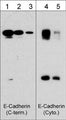
In western blots, the antibody detects a 120 kDa band corresponding to E-cadherin in human A431 cells, and does not detect VE-cadherin or N-Cadherin.
Western blots performed on each lot.
For research use only. Not intended for therapeutic or diagnostic use. Use of all products is subject to our terms and conditions, which can be viewed on our website.
United States
After date of receipt, stable for at least 1 year at -20°C.
Arc-1; Uvomorulin; CD324; CDHE; LCAM; CAM 120/80; E-cadherin 1; cadherin 1; E-cadherin (epithelial; type 1; calcium-dependent adhesion protein; epithelial; cell-CAM 120/80; cadherin-1; ECAD; epithelial cadherin; UVO; CTF1; CTF2; CTF3
P12830
UniProt Summary: Cadherins are calcium-dependent cell adhesion proteins. They preferentially interact with themselves in a homophilic manner in connecting cells; cadherins may thus contribute to the sorting of heterogeneous cell types. CDH1 is involved in mechanisms regulating cell-cell adhesions, mobility and proliferation of epithelial cells. Promotes organization of radial actin fiber structure and cellular response to contractile forces, via its interaction with AMOTL2 which facilitates anchoring of radial actin fibers to CDH1 junction complexes at the cell membrane. Plays a role in the early stages of desmosome cell-cell junction formation via facilitating the recruitment of DSG2 and DSP to desmosome plaques. Has a potent invasive suppressor role. It is a ligand for integrin alpha-E/beta-7.
999
Blue Ice

