Anti-DJ-1/PARK7 Antibody
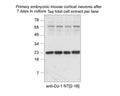
Our Anti-DJ-1/PARK7 rabbit polyclonal primary antibody detects human and mouse DJ-1/PARK7, and is IgG. It is validated for use in WB.
SKU: R-1682-500
Ships: 1-2 business days
Product Details
DJ-1/PARK7
Autosomal recessive mutations in DJ-1 cause early-onset familial Parkinson's disease. DJ-1 is considered a redox-sensitive cytoplasmic protein found in brain as well as other cell types.
IgG
Polyclonal
IgG
WB
Rabbit
23 kDa
A synthetic peptide (ASKRALVILAKGAEE-C) corresponding to human DJ-1 [2-16] in the N-terminal domain conjugated via additional C-terminal Cys to Diphtheria toxoid.
Human
Human, Mouse
Spin vial briefly before opening. Reconstitute in 500 µL sterile-filtered 1X PBS, pH 7.2-7.6. Centrifuge to remove any insoluble material. Short term storage at 2-8°C for one week. At -20°C as an undiluted liquid for up to 12 months.
Lyophilized
Protein G purified IgG
Lyophilized from PBS, pH 7.4. Contains no preservative.
WB: 1:5000
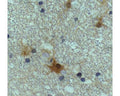
IHC: 1:100
IHC: 1:100
Unconjugated
Confirmed by WB using soluble mouse and human brain extracts, reactivity for major product diminished by peptide absorption.
For research use only.
United States
12 months after date of receipt (unopened vial).
CAP1; PARK7; DJ-1; DJ1; DJ1 protein; Epididymis secretory sperm binding protein Li 67p; FLJ27376; FLJ34360; FLJ92274; HEL S 67p; Oncogene DJ1; OTTHUMP00000001348; OTTHUMP00000001349; OTTHUMP00000001350; OTTHUMP00000001351; PARK7; PARK7_HUMAN; Parkinson disease (autosomal recessive; early onset 7; Parkinson disease protein 7; Parkinson protein 7; Protein DJ-1; SP22
Q99497
UniProt Summary: Multifunctional protein with controversial molecular function which plays an important role in cell protection against oxidative stress and cell death acting as oxidative stress sensor and redox-sensitive chaperone and protease. It is involved in neuroprotective mechanisms like the stabilization of NFE2L2 and PINK1 proteins, male fertility as a positive regulator of androgen signaling pathway as well as cell growth and transformation through, for instance, the modulation of NF-kappa-B signaling pathway. Has been described as a protein and nucleotide deglycase that catalyzes the deglycation of the Maillard adducts formed between amino groups of proteins or nucleotides and reactive carbonyl groups of glyoxals. But this function is rebuted by other works. As a protein deglycase, repairs methylglyoxal- and glyoxal-glycated proteins, and releases repaired proteins and lactate or glycolate, respectively. Deglycates cysteine, arginine and lysine residues in proteins, and thus reactivates these proteins by reversing glycation by glyoxals. Acts on early glycation intermediates (hemithioacetals and aminocarbinols), preventing the formation of advanced glycation endproducts (AGE) that cause irreversible damage. Also functions as a nucleotide deglycase able to repair glycated guanine in the free nucleotide pool (GTP, GDP, GMP, dGTP) and in DNA and RNA. Is thus involved in a major nucleotide repair system named guanine glycation repair (GG repair), dedicated to reversing methylglyoxal and glyoxal damage via nucleotide sanitization and direct nucleic acid repair. Protects histones from adduction by methylglyoxal, controls the levels of methylglyoxal-derived argininine modifications on chromatin. Able to remove the glycations and restore histone 3, histone glycation disrupts both local and global chromatin architecture by altering histone-DNA interactions as well as histone acetylation and ubiquitination levels. Displays a very low glyoxalase activity that may reflect its deglycase activity. Eliminates hydrogen peroxide and protects cells against hydrogen peroxide-induced cell death. Required for correct mitochondrial morphology and function as well as for autophagy of dysfunctional mitochondria. Plays a role in regulating expression or stability of the mitochondrial uncoupling proteins SLC25A14 and SLC25A27 in dopaminergic neurons of the substantia nigra pars compacta and attenuates the oxidative stress induced by calcium entry into the neurons via L-type channels during pacemaking. Regulates astrocyte inflammatory responses, may modulate lipid rafts-dependent endocytosis in astrocytes and neuronal cells. In pancreatic islets, involved in the maintenance of mitochondrial reactive oxygen species (ROS) levels and glucose homeostasis in an age- and diet dependent manner. Protects pancreatic beta cells from cell death induced by inflammatory and cytotoxic setting. Binds to a number of mRNAs containing multiple copies of GG or CC motifs and partially inhibits their translation but dissociates following oxidative stress. Metal-binding protein able to bind copper as well as toxic mercury ions, enhances the cell protection mechanism against induced metal toxicity. In macrophages, interacts with the NADPH oxidase subunit NCF1 to direct NADPH oxidase-dependent ROS production, and protects against sepsis.
11315
25°C (ambient)