
Anti-CIDE3 Antibody
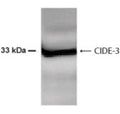
Our CIDE3 rabbit polyclonal primary antibody from PhosphoSolutions is produced in-house. It detects human and mouse CIDE3 and is antigen affinity purified. It is great for use in WB.
SKU: 24316
Ships: 1-2 business days
Product Details
CIDE3
DNA fragmentation is one of the critical steps in apoptosis, which is induced by DNA fragmentation factor (DFF). DFF is composed of two subunits, a 40 kDa caspase-activated nuclease (DFF40) and a 45 kDa inhibitor (DFF45). Recently a novel family of cell-death-inducing DFF45-like effectors (CIDEs) has been identified. Human CIDE-3 is a novel member of CIDEs. There are 2 transcripts, CIDE-3 and CIDE-3alpha, were present in HepG2 and A375 cells. Consistent with its chromosome localization at 3p25, a region associated with high frequency loss of heterozygosity in many tumours, CIDE-3 may play an important role in prevention of tumorigenesis.
Antigen Affinity Purified
Polyclonal
IgG
ELISA, WB
Rabbit
CIDEC
Synthetic peptide corresponding to amino acids from the N-terminal region of human CIDE3 protein
Human
Human, Mouse
Recommended that the undiluted antibody be aliquoted into smaller working volumes (10-30 uL/vial depending on usage) upon arrival and stored long term at -20° C or -80° C, while keeping a working aliquot stored at 4° C for short term. Avoid freeze/thaw cycles. Stable for at least 1 year.
Liquid
PBS + 0.02% NaN3
WB: 1:500-1:1000
WB Brain: 1:500-1:1000
Reacts with the N-terminal region of human and mouse CIDE3 protein
Western blots performed on each lot.
For research use only. Not intended for therapeutic or diagnostic use. Use of all products is subject to our terms and conditions, which can be viewed on our website.
United States
After date of receipt, stable for at least 1 year at -20°C.
CIDE-3; CIDEC; FPLD5; FSP27; cell death activator CIDE-3; fat specific protein 27; Cell death-inducing DFFA-like effector protein C; Fat-specific protein FSP27 homolog; Lipid transferase CIDEC
Q96AQ7
UniProt Summary: Lipid transferase specifically expressed in white adipose tissue, which promotes unilocular lipid droplet formation by mediating lipid droplet fusion. Lipid droplet fusion promotes their enlargement, restricting lipolysis and favoring lipid storage. Localizes on the lipid droplet surface, at focal contact sites between lipid droplets, and mediates atypical lipid droplet fusion by undergoing liquid-liquid phase separation (LLPS) and promoting directional net neutral lipid transfer from the smaller to larger lipid droplets. The transfer direction may be driven by the internal pressure difference between the contacting lipid droplet pair. Its role in neutral lipid transfer and lipid droplet enlargement is activated by the interaction with PLIN1. May also act as a CEBPB coactivator in the white adipose tissue to control the expression of a subset of CEBPB downstream target genes, including SOCS1, SOCS3, TGFB1, TGFBR1, ID2 and XDH. When overexpressed in preadipocytes, induces apoptosis or increases cell susceptibility to apoptosis induced by serum deprivation or TGFB treatment.
63924
Blue Ice

