
Anti-CD44 (Extracellular region) Antibody (M010)
Our CD44 (Extracellular region) mouse monoclonal primary antibody from PhosphoSolutions is produced in-house. It detects human CD44 (Extracellular region) and is Protein G purified. It is great for use in WB, ICC, IP.
SKU: CM0101
Ships: 1-2 business days
Product Details
CD44 (Extracellular region)
Cell surface adhesion protein CD44 is a ubiquitously expressed type I transmembrane protein that has important functions related to cell-cell adhesion and extracellular matrix interactions. The transmembrane protein is post-translationally modified at multiple sites by glycosylation and phosphorylation. CD44 ligands include hyaluronic acid, collagens, laminins, osteopontin, serglycin, and fibronectin. CD44 has been implicated in inflammatory cell functions as well as in tumor growth and metastasis. CD44 is overexpressed in many types of cancer; the interaction between CD44 and HER2 has been linked to an increase in ovarian carcinoma cell growth. CD44 interacts with ezrin, radixin, and moesin to link the actin cytoskeleton to the plasma membrane and the extracellular matrix. These interactions are critical for CD44 function in cell-cell adhesion and cell motility.
Protein G Purified
Monoclonal
M010
IgG2b
ELISA, ICC, IP, WB
Mouse
CD44
80-130
Clone M010 was generated from a proprietary antigen related to the extracellular region of human CD44.from the A431 epidermoid carcinoma cell line.
Human
Human
Storage at -20°C is recommended, as aliquots may be taken without freeze/thawing due to presence of 50% glycerol. Stable for at least 1 year at -20°C.
Liquid
PBS + 1 mg/ml BSA, 0.05% NaN3 and 50% glycerol
WB: 1:1000
ICC: 1:100
IP: 1:50
ICC: 1:100
IP: 1:50
Unconjugated
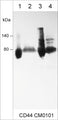
Clone M010 detects 80-130 kDa* bands corresponding to the molecular mass of CD44 on SDS-PAGE immunoblots of native and denaturing human MDA-MB-231, A549, and A431 cell lysates. The antibody can be used for multiple applications including ELISA, western blot, immunocytochemical labeling and immunoprecipitation. In addition, the antibody labels live unfixed A549 and MeWo cells, so the antibody may be useful for isolating CD44+ cells and for CD44 functional assays.
Western blots performed on each lot.
For research use only. Not intended for therapeutic or diagnostic use. Use of all products is subject to our terms and conditions, which can be viewed on our website.
United States
After date of receipt, stable for at least 1 year at -20°C.
CDW44; Epican; ECMR-III; HCELL; HUTCH-I; LHR; MC56; MDU2; MDU3; MIC4; Pgp1; CD44 antigen; GP90 lymphocyte homing/adhesion receptor; Hermes antigen; cell surface glycoprotein CD44; chondroitin sulfate proteoglycan 8; extracellular matrix receptor III; hematopoietic cell E- and L-selectin ligand; heparan sulfate proteoglycan; homing function and Indian blood group system; hyaluronate receptor; phagocytic glycoprotein 1; soluble CD44; PGP-1; MIC4 Heparan sulfate proteoglycan HUTCH-I GP90; CD44
P16070
UniProt Summary: Cell-surface receptor that plays a role in cell-cell interactions, cell adhesion and migration, helping them to sense and respond to changes in the tissue microenvironment. Participates thereby in a wide variety of cellular functions including the activation, recirculation and homing of T-lymphocytes, hematopoiesis, inflammation and response to bacterial infection. Engages, through its ectodomain, extracellular matrix components such as hyaluronan/HA, collagen, growth factors, cytokines or proteases and serves as a platform for signal transduction by assembling, via its cytoplasmic domain, protein complexes containing receptor kinases and membrane proteases. Such effectors include PKN2, the RhoGTPases RAC1 and RHOA, Rho-kinases and phospholipase C that coordinate signaling pathways promoting calcium mobilization and actin-mediated cytoskeleton reorganization essential for cell migration and adhesion. Upon interaction with LGALS9 ligand, activates downstream signaling components including LCK, ERK and MAPK to promotes NK cell activation.
960
Blue Ice

