Anti-CD244/2B4/SLAMF4 (Extracellular region) M053 Antibody (M053)
Our CD244/2B4/SLAMF4 (Extracellular region) M053 Antibody mouse monoclonal primary antibody from PhosphoSolutions is produced in-house. It detects human CD244/2B4/SLAMF4 (Extracellular region) M053 Antibody and is Protein G purified. It is great for use in WB, IP, ICC.
SKU: CM0531
Ships: 1-2 business days
Product Details
CD244/2B4/SLAMF4 (Extracellular region) M053 Antibody
CD244 (Natural killer (NK) cell receptor 2B4/SLAMF4) is an Ig superfamily signaling lymphocyte activation molecule (SLAM) receptor. Like all SLAM family receptors, it has an extracellular segment with two immunoglobulin (Ig)-like domains, and a cytoplasmic domain containing four immunoreceptor tyrosine-based switch motifs. CD244 does not act as a selfligand similar to other SLAM family receptors. It binds CD48, a transmembrane receptor ubiquitously expressed on hematopoietic cells. CD244 activity is controlled by the presence or absence of small cytoplasmic adapter proteins, SH2D1A/SAP and/or SH2D1B/EAT-2. Downstream signaling involves predominantly VAV1, and, to a lesser degree, INPP5D/SHIP1 and CBL. Activation of CD244 stimulates NK cell cytotoxicity, production of IFN-γ and granule exocytosis. CD244 is involved in the regulation of CD8+ T-cell proliferation, and inhibits inflammatory responses in dendritic cells (DCs). In cancers, CD244 shows increased expression in intratumoral DCs and myeloid suppressor cells, and anti-CD244 therapies may increase infiltrating T-cells and impair tumor growth.
Protein G Purified
Monoclonal
M053
IgG1
ELISA, ICC, IP, WB
Mouse
CD244
110
Clone (M053) was generated from a recombinant protein that included the extracellular region of human CD244 protein.
Human
Human
Storage at -20°C is recommended, as aliquots may be taken without freeze/thawing due to presence of 50% glycerol. Stable for at least 1 year at -20°C.
Liquid
PBS + 1 mg/ml BSA, 0.05% NaN3 and 50% glycerol
WB: 1:500
ICC: 1:200
IP: 1:100
ICC: 1:200
IP: 1:100
Unconjugated
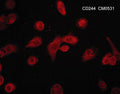
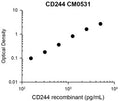
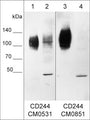
Clone M053 mouse monoclonal antibody detects a 110 kDa* protein on SDS-PAGE "Native" or denatured immunoblots of human THP1 monocytes. The antibody prefers the native CD244 protein, but also detects denatured CD244. The antibody works for western blot, immunoprecipitation, immunocytochemistry, and ELISA capture.
Western blots performed on each lot.
For research use only. Not intended for therapeutic or diagnostic use. Use of all products is subject to our terms and conditions, which can be viewed on our website.
United States
After date of receipt, stable for at least 1 year at -20°C.
2B4; Natural killer cell receptor 2B4; NKR2B4; Nmrk; SLAMF4; CD244 molecule; NK cell activation inducing ligand NAIL; NK cell activation-inducing ligand; NK cell type I receptor protein 2B4; SLAM family member 4; h2B4; signaling lymphocytic activation molecule 4; NAIL NK cell type I receptor protein 2B4; CD244
Q9BZW8
UniProt Summary: Heterophilic receptor of the signaling lymphocytic activation molecule (SLAM) family; its ligand is CD48. SLAM receptors triggered by homo- or heterotypic cell-cell interactions are modulating the activation and differentiation of a wide variety of immune cells and thus are involved in the regulation and interconnection of both innate and adaptive immune response. Activities are controlled by presence or absence of small cytoplasmic adapter proteins, SH2D1A/SAP and/or SH2D1B/EAT-2. Acts as activating natural killer (NK) cell receptor. Activating function implicates association with SH2D1A and FYN. Downstreaming signaling involves predominantly VAV1, and, to a lesser degree, INPP5D/SHIP1 and CBL. Signal attenuation in the absence of SH2D1A is proposed to be dependent on INPP5D and to a lesser extent PTPN6/SHP-1 and PTPN11/SHP-2. Stimulates NK cell cytotoxicity, production of IFN-gamma and granule exocytosis. Optimal expansion and activation of NK cells seems to be dependent on the engagement of CD244 with CD48 expressed on neighboring NK cells. Acts as costimulator in NK activation by enhancing signals by other NK receptors such as NCR3 and NCR1. At early stages of NK cell differentiation may function as an inhibitory receptor possibly ensuring the self-tolerance of developing NK cells. Involved in the regulation of CD8(+) T-cell proliferation; expression on activated T-cells and binding to CD48 provides costimulatory-like function for neighboring T-cells. Inhibits inflammatory responses in dendritic cells (DCs).
51744
Blue Ice