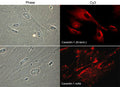
Anti-Caveolin-1 Antibody (M281)
Our Caveolin-1 primary antibody from PhosphoSolutions is mouse monoclonal. It detects chicken, human, mouse, and rat Caveolin-1 and is Protein A purified. It is great for use in WB, ICC.
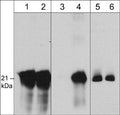
Western blot image of human A431 cells unstimulated (lanes 1, 3, & 5) or stimulated with pervanadate (1 mM) for 30 min (lanes 2, 4, & 6). The blots were probed with rabbit polyclonal caveolin-1 (N-term.) (lanes 1 & 2), mouse monoclonal caveolin-1 (Tyr-14) (lanes 3 & 4) or mouse monoclonal caveolin-1 (lanes 5 & 6).
Click on image to zoom

SKU: CM2811
Ships: 1-2 business days
Product Details
Caveolin-1
Caveolins are the primary structural components of the plasma membrane microdomains, caveolae. Three members of the caveolin family (caveolin-1, -2, and -3) have been identified, and each has distinct expression patterns. Caveolins are involved in diverse biological functions, including vesicular trafficking, cholesterol homeostasis, cell adhesion and apoptosis. Caveolins can interact with various signaling molecules, including G-proteins, receptor tyrosine kinases, PKCs, and Src family kinases. Phosphorylation at Tyr-14 is essential for caveolin association with SH2 or PTB domain-containing adaptor proteins, while phosphorylation at Ser-80 regulates caveolin binding to the ER membrane and entry into the secretory pathway.
Protein A Purified
Monoclonal
M281
IgG1
ELISA, ICC, WB
Mouse
CAV1
21
Clone (M281) was generated from a full length recombinant human Caveolin-1 protein.
Human
Chicken, Human, Mouse, Rat
Storage at -20°C is recommended, as aliquots may be taken without freeze/thawing due to presence of 50% glycerol. Stable for at least 1 year at -20°C.
Liquid
PBS + 1 mg/ml BSA, 0.05% NaN3 and 50% glycerol
WB: 1:500
ICC: 1:50
ICC: 1:50
Unconjugated
This antibody detects a 21 kDa* protein corresponding to the apparent molecular mass of caveolin-1 on SDS-PAGE immunoblots of human A431 cells and rabbit spleen fibroblasts.
Western blots performed on each lot.
For research use only. Not intended for therapeutic or diagnostic use. Use of all products is subject to our terms and conditions, which can be viewed on our website.
United States
After date of receipt, stable for at least 1 year at -20°C.
BSCL3; caveolin1; LCCNS; MSTP085; PPH3; VIP21; caveolin-1; caveolin 1; caveolae protein; 22kDa; cell growth-inhibiting protein 32
Q03135
UniProt Summary: May act as a scaffolding protein within caveolar membranes. Forms a stable heterooligomeric complex with CAV2 that targets to lipid rafts and drives caveolae formation. Mediates the recruitment of CAVIN proteins (CAVIN1/2/3/4) to the caveolae. Interacts directly with G-protein alpha subunits and can functionally regulate their activity. Involved in the costimulatory signal essential for T-cell receptor (TCR)-mediated T-cell activation. Its binding to DPP4 induces T-cell proliferation and NF-kappa-B activation in a T-cell receptor/CD3-dependent manner. Recruits CTNNB1 to caveolar membranes and may regulate CTNNB1-mediated signaling through the Wnt pathway. Negatively regulates TGFB1-mediated activation of SMAD2/3 by mediating the internalization of TGFBR1 from membrane rafts leading to its subsequent degradation. Binds 20(S)-hydroxycholesterol (20(S)-OHC).
857
Blue Ice