
Anti-Caspase-8 (C-terminal region) Antibody (M382)
Our Caspase-8 (C-terminal region) primary antibody from PhosphoSolutions is mouse monoclonal. It detects human Caspase-8 (C-terminal region) and is Protein A purified. It is great for use in WB.
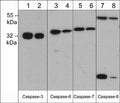
Western blot analysis of Caspase expression in human Jurkat cells. The blot was probed with anti-Caspase-3 at 1:500 (lane 1) and 1:1000 (lane 2), anti-Caspase-6 at 1:250 (lane 3) and 1:500 (lane 4), anti-Caspase-7 at 1:500 (lane 5) and 1:1000 (lane 6), as well as anti-Caspase-8 at 1:250 (lane 7) and 1:500 (lane 8).
Click on image to zoom

SKU: CM3821
Ships: 1-2 business days
Product Details
Caspase-8 (C-terminal region)
The caspases are a group of cysteine enzymes, which cleave proteins in response to intrinsic and extrinsic pathways that cause apoptotic cell death. The caspases can be grouped into two subgroups based on their roles in apoptosis. Initiator caspases (caspases 2, 8, 9, and 10) are activated through the apoptosis-signaling pathways and activate the effector caspases (caspases 3, 6, and 7) which carry out apoptosis. Caspase cascades are initiated through assembly of multiprotein complexes that trigger activation of the initiator caspases, which are then released and are able to activate the downstream effector caspases.
Protein A Purified
Monoclonal
M382
IgG2a
ELISA, WB
Mouse
CASP8
55
Clone (M382) was generated from a recombinant protein containing amino acid residues in the C-terminal region of human Caspase-8.
Human
Human
Storage at -20°C is recommended, as aliquots may be taken without freeze/thawing due to presence of 50% glycerol. Stable for at least 1 year at -20°C.
Liquid
PBS + 1 mg/ml BSA, 0.05% NaN3 and 50% glycerol
WB: 1:500
Unconjugated
The antibody detects a 55 kDa* protein corresponding to the molecular weight of Caspase-8 on SDS-PAGE immunoblots of human Jurkat, K562, and A431 cells.
Western blots performed on each lot.
For research use only. Not intended for therapeutic or diagnostic use. Use of all products is subject to our terms and conditions, which can be viewed on our website.
United States
After date of receipt, stable for at least 1 year at -20°C.
ALPS2B; Caspase-8; Casp-8; FLICE; MACH; MCH5; FADD-homologous ICE/CED-3-like protease; FADD-like ICE; ICE-like apoptotic protease 5; MACH-alpha-1/2/3 protein; MACH-beta-1/2/3/4 protein; MORT1-associated ced-3 homolog; apoptotic cysteine protease; apoptotic protease Mch-5; caspase 8; apoptosis-related cysteine peptidase; apoptosis-related cysteine protease; ced3; NEDD2-like protein,p15; p10
Q14790
UniProt Summary: Thiol protease that plays a key role in programmed cell death by acting as a molecular switch for apoptosis, necroptosis and pyroptosis, and is required to prevent tissue damage during embryonic development and adulthood. Initiator protease that induces extrinsic apoptosis by mediating cleavage and activation of effector caspases responsible for FAS/CD95-mediated and TNFRSF1A-induced cell death. Cleaves and activates effector caspases CASP3, CASP4, CASP6, CASP7, CASP9 and CASP10. Binding to the adapter molecule FADD recruits it to either receptor FAS/TNFRSF6 or TNFRSF1A. The resulting aggregate called the death-inducing signaling complex (DISC) performs CASP8 proteolytic activation. The active dimeric enzyme is then liberated from the DISC and free to activate downstream apoptotic proteases. Proteolytic fragments of the N-terminal propeptide (termed CAP3, CAP5 and CAP6) are likely retained in the DISC. Also cleaves and activates BID, thereby promoting cytochrome C release from mitochrondria. In addition to extrinsic apoptosis, also acts as a negative regulator of necroptosis: acts by cleaving RIPK1 at 'Asp-324', which is crucial to inhibit RIPK1 kinase activity, limiting TNF-induced apoptosis, necroptosis and inflammatory response. Also able to initiate pyroptosis by mediating cleavage and activation of gasdermin-C and -D (GSDMC and GSDMD, respectively): gasdermin cleavage promotes release of the N-terminal moiety that binds to membranes and forms pores, triggering pyroptosis. Initiates pyroptosis following inactivation of MAP3K7/TAK1. Also acts as a regulator of innate immunity by mediating cleavage and inactivation of N4BP1 downstream of TLR3 or TLR4, thereby promoting cytokine production. May participate in the Granzyme B (GZMB) cell death pathways. Cleaves PARP1 and PARP2. Independent of its protease activity, promotes cell migration following phosphorylation at Tyr-380.
841
Blue Ice

