Anti-c-Src (Tyr-530) [conserved site], Phosphospecific Antibody (M261)
Our c-Src (Tyr-530) mouse monoclonal phosphospecific primary antibody from PhosphoSolutions is produced in-house. It detects human, mouse, and rat c-Src (Tyr-530) and is Protein A purified. It is great for use in WB.
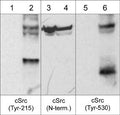
Western blot analysis of mouse SYF cells transformed with c-Src then left untreated (lanes 1, 3, & 5) or treated with pervanadate (1 mM) for 30 minutes (lanes 2, 4, & 6). The blot was probed with anti-c-Src (Tyr-215) (lanes 1 & 2), anti-c-Src (N-terminal region) (lanes 3 & 4), and anti-c-Src (Tyr-530) (lanes 5 & 6).
Click on image to zoom
SKU: SM2611
Ships: 1-2 business days
Product Details
c-Src (Tyr-530)
c-Src was the first proto-oncogenic non-receptor tyrosine kinase characterized in human. The Src family is composed of nine members in vertebrates, including c-Src, Yes, Fgr, Yrk, Fyn, Lyn, Hck, Lck, and Blk. Src-family kinases transduce signals that are involved in the control of a variety of cellular processes, including proliferation, differentiation, motility, and adhesion. Src-family kinases contain an N-terminal cell membrane anchor followed by SH3 and SH2 domains. The activity of c-Src is regulated by tyrosine phosphorylation at multiple sites. Tyrosine 418 is autophosphorylated following c-Src activation. Tyrosine 215 in the SH2 domain of c-Src is phosphorylated following growth factor receptor activation. Both Tyr-215 and Tyr-418 phosphorylation increases tyrosine kinase activity, while phosphorylation of Tyr-530 downregulates c-Src kinase activity. Thus, tyrosine phosphorylation of c-Src is critical for regulating its kinase activity.
Protein A Purified
Monoclonal
M261
IgG1
ELISA, WB
Mouse
SRC
60
Clone (M261) was generated from a phosphopeptide containing amino acid surrounding Tyr-530 at the C-terminus of human c-Src. This sequence has high homology to the conserved site in rat and mouse c-Src, and is conserved in the c-Src family of kinases.
Human
Human, Mouse, Rat
Storage at -20°C is recommended, as aliquots may be taken without freeze/thawing due to presence of 50% glycerol. Stable for at least 1 year at -20°C.
Liquid
PBS + 1 mg/ml BSA, 0.05% NaN3 and 50% glycerol
WB: 1:500
Unconjugated
This antibody detects a 60 kDa* protein corresponding to c-Src on SDS-PAGE immunoblots of mouse SYF cells transformed with c-Src and treated with pervanadate. This antibody also detects the conserved site in Lck (Tyr-505) in human Jurkat cells treated with pervanadate. This antibody may detect several c-Src family members phosphorylated at the conserved site for Tyr-530.
Phosphorylated
Tyr-530
Western blots performed on each lot.
For research use only. Not intended for therapeutic or diagnostic use. Use of all products is subject to our terms and conditions, which can be viewed on our website.
United States
After date of receipt, stable for at least 1 year at -20°C.
ASV; Src; THC6; c-SRC; p60-Src; proto-oncogene tyrosine-protein kinase Src; proto-oncogene c-Src; protooncogene SRC; Rous sarcoma; tyrosine kinase pp60c-src; tyrosine-protein kinase SRC-1
P12931
UniProt Summary: Non-receptor protein tyrosine kinase which is activated following engagement of many different classes of cellular receptors including immune response receptors, integrins and other adhesion receptors, receptor protein tyrosine kinases, G protein-coupled receptors as well as cytokine receptors. Participates in signaling pathways that control a diverse spectrum of biological activities including gene transcription, immune response, cell adhesion, cell cycle progression, apoptosis, migration, and transformation. Due to functional redundancy between members of the SRC kinase family, identification of the specific role of each SRC kinase is very difficult. SRC appears to be one of the primary kinases activated following engagement of receptors and plays a role in the activation of other protein tyrosine kinase (PTK) families. Receptor clustering or dimerization leads to recruitment of SRC to the receptor complexes where it phosphorylates the tyrosine residues within the receptor cytoplasmic domains. Plays an important role in the regulation of cytoskeletal organization through phosphorylation of specific substrates such as AFAP1. Phosphorylation of AFAP1 allows the SRC SH2 domain to bind AFAP1 and to localize to actin filaments. Cytoskeletal reorganization is also controlled through the phosphorylation of cortactin (CTTN) (Probable). When cells adhere via focal adhesions to the extracellular matrix, signals are transmitted by integrins into the cell resulting in tyrosine phosphorylation of a number of focal adhesion proteins, including PTK2/FAK1 and paxillin (PXN). In addition to phosphorylating focal adhesion proteins, SRC is also active at the sites of cell-cell contact adherens junctions and phosphorylates substrates such as beta-catenin (CTNNB1), delta-catenin (CTNND1), and plakoglobin (JUP). Another type of cell-cell junction, the gap junction, is also a target for SRC, which phosphorylates connexin-43 (GJA1). SRC is implicated in regulation of pre-mRNA-processing and phosphorylates RNA-binding proteins such as KHDRBS1 (Probable). Phosphorylates PKP3 at 'Tyr-195' in response to reactive oxygen species, which may cause the release of PKP3 from desmosome cell junctions into the cytoplasm. Also plays a role in PDGF-mediated tyrosine phosphorylation of both STAT1 and STAT3, leading to increased DNA binding activity of these transcription factors. Involved in the RAS pathway through phosphorylation of RASA1 and RASGRF1. Plays a role in EGF-mediated calcium-activated chloride channel activation. Required for epidermal growth factor receptor (EGFR) internalization through phosphorylation of clathrin heavy chain (CLTC and CLTCL1) at 'Tyr-1477'. Involved in beta-arrestin (ARRB1 and ARRB2) desensitization through phosphorylation and activation of GRK2, leading to beta-arrestin phosphorylation and internalization. Has a critical role in the stimulation of the CDK20/MAPK3 mitogen-activated protein kinase cascade by epidermal growth factor (Probable). Might be involved not only in mediating the transduction of mitogenic signals at the level of the plasma membrane but also in controlling progression through the cell cycle via interaction with regulatory proteins in the nucleus. Plays an important role in osteoclastic bone resorption in conjunction with PTK2B/PYK2. Both the formation of a SRC-PTK2B/PYK2 complex and SRC kinase activity are necessary for this function. Recruited to activated integrins by PTK2B/PYK2, thereby phosphorylating CBL, which in turn induces the activation and recruitment of phosphatidylinositol 3-kinase to the cell membrane in a signaling pathway that is critical for osteoclast function. Upon activation of the G(q)-dependent KISS1/KISS1R signaling pathway, active SRC is recruited, together with the phosphatase DUSP18, to the KISS1R C-terminus. This leads to DUSP18-mediated SRC dephosphorylation and inactivation, down-regulation of osteoclast differentiation and activity, and consequently suppression of bone resorption. Promotes energy production in osteoclasts by activating mitochondrial cytochrome C oxidase. Phosphorylates DDR2 on tyrosine residues, thereby promoting its subsequent autophosphorylation. Phosphorylates RUNX3 and COX2 on tyrosine residues, TNK2 on 'Tyr-284' and CBL on 'Tyr-731'. Enhances RIGI-elicited antiviral signaling. Phosphorylates PDPK1 at 'Tyr-9', 'Tyr-373' and 'Tyr-376'. Phosphorylates BCAR1 at 'Tyr-128'. Phosphorylates CBLC at multiple tyrosine residues, phosphorylation at 'Tyr-341' activates CBLC E3 activity. Phosphorylates synaptic vesicle protein synaptophysin (SYP). Involved in anchorage-independent cell growth. Required for podosome formation. Mediates IL6 signaling by activating YAP1-NOTCH pathway to induce inflammation-induced epithelial regeneration. Phosphorylates OTUB1, promoting deubiquitination of RPTOR. Phosphorylates caspase CASP8 at 'Tyr-380' which negatively regulates CASP8 processing and activation, down-regulating CASP8 proapoptotic function. Mediates laminin-induced activation of RAC1 signaling through phosphorylation of syntrophin.

6714
Blue Ice