
Anti-C-Raf (S471) [B-Raf (S579)/A-Raf (S432)], Phosphospecific Antibody
Our C-Raf (S471)[B-Raf (S579)/A-Raf (S432)] rabbit polyclonal phosphospecific primary antibody from PhosphoSolutions is produced in-house. It detects human, mouse, and rat C-Raf (S471)[B-Raf (S579)/A-Raf (S432)] and is antigen affinity purified. It is great for use in WB.
SKU: RP2901
Ships: 1-2 business days
Product Details
C-Raf (S471)[B-Raf (S579)/A-Raf (S432)]
The Ras-Raf-MAP kinase signaling pathway is involved in control of cell proliferation and differentiation. The Raf kinase family includes A-Raf, B-Raf, and C-Raf. Each family member has three highly conserved regions (CR1-3). The N-terminal CR1 contains the Ras-GTP-binding domain. The CR2 contains a negative regulatory serine residue (C-Raf (S259)/B-Raf(S365)) that may bind 14-3-3 proteins. The CR3 is the catalytic domain that contains phosphorylation sites for Raf-regulating enzymes within two segments, the N-region and the activation segment. Activation of C-Raf involves phosphorylation at many sites including Ser-338, Tyr-341, and Ser-471. The latter site is phosphorylated after EGF stimulation and may be important for MEK interaction in both C-Raf and A-Raf. In B-Raf, multiple phosphorylation sites have been identified, but their specific roles are uncertain. Phosphorylation of Ser-446 may prime B-Raf for activation, and Ser-446 and/or Ser-447 phosphorylation may be critical for B-Raf biological activity during PC12 differentiation. Ser-579 is required for growth factor activation and kinase activity.
Antigen Affinity Purified
Polyclonal
IgG
ELISA, WB
Rabbit
RAF1
74
A synthetic peptide (coupled to KLH) corresponding to amino acid residues surrounding Ser-471 in human C-Raf. This sequence has high homology with similar regions in rat and mouse C-Raf, and has high homology to the conserved sites in B-Raf (Ser-579) and A-Raf (Ser-432).
Human
Human, Mouse, Rat
Storage at -20°C is recommended, as aliquots may be taken without freeze/thawing due to presence of 50% glycerol. Stable for at least 1 year at -20°C.
Liquid
PBS + 1 mg/ml BSA, 0.05% NaN3 and 50% glycerol
WB: 1:1000
Unconjugated
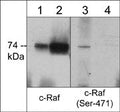
This antibody was cross-adsorbed to phospho-C-Raf (Ser-338) peptide before affinity purification using phospho-C-Raf (Ser-471) peptide. The purified antibody detects a band at 74 kDa* corresponding to C-Raf in western blots of human Jurkat cells treated with Calyculin A, but is not observed after lambda phosphatase treatment.
Phosphorylated
Ser-471 [S578/S433]
Western blots performed on each lot.
For research use only. Not intended for therapeutic or diagnostic use. Use of all products is subject to our terms and conditions, which can be viewed on our website.
United States
After date of receipt, stable for at least 1 year at -20°C.
CMD1NN; Raf1; NS5; Raf-1; c-Raf; C-Raf proto-oncogene; serine/threonine kinase; Oncogene RAF1; raf proto-oncogene serine/threonine protein kinase; proto-oncogene c-RAF; RAF proto-oncogene serine/threonine-protein kinase; v-raf-1 murine leukemia viral oncogene homolog 1; CRaf
P04049
UniProt Summary: Serine/threonine-protein kinase that acts as a regulatory link between the membrane-associated Ras GTPases and the MAPK/ERK cascade, and this critical regulatory link functions as a switch determining cell fate decisions including proliferation, differentiation, apoptosis, survival and oncogenic transformation. RAF1 activation initiates a mitogen-activated protein kinase (MAPK) cascade that comprises a sequential phosphorylation of the dual-specific MAPK kinases (MAP2K1/MEK1 and MAP2K2/MEK2) and the extracellular signal-regulated kinases (MAPK3/ERK1 and MAPK1/ERK2). The phosphorylated form of RAF1 (on residues Ser-338 and Ser-339, by PAK1) phosphorylates BAD/Bcl2-antagonist of cell death at 'Ser-75'. Phosphorylates adenylyl cyclases: ADCY2, ADCY5 and ADCY6, resulting in their activation. Phosphorylates PPP1R12A resulting in inhibition of the phosphatase activity. Phosphorylates TNNT2/cardiac muscle troponin T. Can promote NF-kB activation and inhibit signal transducers involved in motility (ROCK2), apoptosis (MAP3K5/ASK1 and STK3/MST2), proliferation and angiogenesis (RB1). Can protect cells from apoptosis also by translocating to the mitochondria where it binds BCL2 and displaces BAD/Bcl2-antagonist of cell death. Regulates Rho signaling and migration, and is required for normal wound healing. Plays a role in the oncogenic transformation of epithelial cells via repression of the TJ protein, occludin (OCLN) by inducing the up-regulation of a transcriptional repressor SNAI2/SLUG, which induces down-regulation of OCLN. Restricts caspase activation in response to selected stimuli, notably Fas stimulation, pathogen-mediated macrophage apoptosis, and erythroid differentiation.
5894
Blue Ice

