
Anti-c-Cbl (Tyr-700), Phosphospecific Antibody (M161)
Our c-Cbl (Tyr-700) mouse monoclonal phosphospecific primary antibody from PhosphoSolutions is produced in-house. It detects human, mouse, and rat c-Cbl (Tyr-700) and is Protein A purified. It is great for use in WB.
SKU: CM1611
Ships: 1-2 business days
Product Details
c-Cbl (Tyr-700)
c-Cbl proto-oncogene is a ubiquitously expressed cytoplasmic adaptor protein that is especially predominant in hematopoietic cells. c-Cbl possesses a highly conserved amino-terminal phosphotyrosine binding domain and a C3HC4 RING finger motif. c-Cbl is rapidly tyrosine phosphorylated in response to stimulation of a variety of cell-surface receptors and becomes associated with a number of intracellular signaling molecules such as protein tyrosine kinases, phosphatidylinositol 3 kinase (PI3K), Crk and 14-3-3 proteins. In human cancer tissues, c-Cbl is frequently tyrosine phosphorylated in a tumor-specific manner. Src-family kinases primarily phosphorylate c-Cbl at Tyr-700, Tyr-731, and Tyr-774. These sites of phosphorylation provide docking sites for downstream signaling components, such as Grb-2, PI3K, and Fyn.
Protein A Purified
Monoclonal
M161
IgG1
ELISA, WB
Mouse
CBL
120
Clone (M161) was generated from a synthetic peptide (coupled to KLH) corresponding to amino acid residues surrounding tyrosine 700 in human c-Cbl. This sequence is highly conserved in rat and mouse c-Cbl.
Human
Human
Storage at -20°C is recommended, as aliquots may be taken without freeze/thawing due to presence of 50% glycerol. Stable for at least 1 year at -20°C.
Liquid
PBS + 1 mg/ml BSA, 0.05% NaN3 and 50% glycerol
WB: 1:1000
Unconjugated
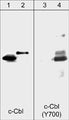
The antibody detects a 120 kDa* protein in human Jurkat cells treated with pervanadate, but not in control cells.
Phosphorylated
Tyr-700
Western blots performed on each lot.
For research use only. Not intended for therapeutic or diagnostic use. Use of all products is subject to our terms and conditions, which can be viewed on our website.
United States
After date of receipt, stable for at least 1 year at -20°C.
C-CBL; E3 ubiquitin ligase CBL; FRA11B; NSLL; RNF55; E3 ubiquitin-protein ligase CBL; Cbl proto-oncogene; E3 ubiquitin protein ligase; RING finger protein 55; RING-type E3 ubiquitin transferase CBL; casitas B-lineage lymphoma proto-oncogene; oncogene CBL2; proto-oncogene c-Cbl; signal transduction protein CBL; RING finger 55
P22681
UniProt Summary: E3 ubiquitin-protein ligase that acts as a negative regulator of many signaling pathways by mediating ubiquitination of cell surface receptors. Accepts ubiquitin from specific E2 ubiquitin-conjugating enzymes, and then transfers it to substrates promoting their degradation by the proteasome. Recognizes activated receptor tyrosine kinases, including KIT, FLT1, FGFR1, FGFR2, PDGFRA, PDGFRB, CSF1R, EPHA8 and KDR and mediates their ubiquitination to terminate signaling. Recognizes membrane-bound HCK, SRC and other kinases of the SRC family and mediates their ubiquitination and degradation. Ubiquitinates EGFR and SPRY2. Involved in LAG3-mediated inhibition of TCR signaling: following ligand-binding to LAG3, catalyzes 'Lys-63'-linked ubiquitination of LAG3, unleashing the LAG3 C-terminus from the membrane, and initiating a signaling that prevents TCR activation. Ubiquitinates NECTIN1 following association between NECTIN1 and herpes simplex virus 1/HHV-1 envelope glycoprotein D, leading to NECTIN1 removal from cell surface. Participates in signal transduction in hematopoietic cells. Plays an important role in the regulation of osteoblast differentiation and apoptosis. Essential for osteoclastic bone resorption. The 'Tyr-731' phosphorylated form induces the activation and recruitment of phosphatidylinositol 3-kinase to the cell membrane in a signaling pathway that is critical for osteoclast function. In association with CBLB, required for proper feedback inhibition of ciliary platelet-derived growth factor receptor-alpha (PDGFRA) signaling pathway via ubiquitination and internalization of PDGFRA.
867
Blue Ice

