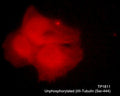
Anti-βIII-Tubulin Antibody
Our unphosphorylated βIII-Tubulin (Ser-444) rabbit polyclonal primary antibody from PhosphoSolutions is produced in-house. It detects human, mouse, and rat unphosphorylated βIII-Tubulin (Ser-444) and is antigen affinity purified. It is great for use in WB, ICC.
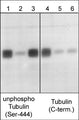
Western blot analysis of mouse brain. The blot was probed with anti-unphosphorylated βIII-Tubulin (Ser-444) (lanes 1-3) and anti-βIII-Tubulin (C-terminus) (lanes 4-6) polyclonal antibodies. Both antibodies were used in the presence of unphosphorylated βIII-Tublin (Ser-444) peptide (lanes 2 & 5; TX1815) and phospho-βIII-Tublin (Ser-444) peptide (lanes 3 & 6; TX1695).
Click on image to zoom

SKU: TP1811
Ships: 1-2 business days
Product Details
unphosphorylated βIII-Tubulin (Ser-444)
Microtubules (MTs) are cytoskeletal elements that play an essential role in cell division and cytoplasmic organization. MTs are dynamic polymers of α/β-tubulin heterodimers. At least two populations of MTs, called dynamic and stable according to their rates of turnover, are readily distinguishable in cells. The proteins associated with MTs (MAPs) are among the best-known factors that regulate MT dynamics and stability. In addition, a variety of different post-translational modifications may also regulate MT dynamics and stability. Phosphorylation is one of these modifications and it can occur on serine, threonine, and tyrosine residues in β-Tubulin isoforms. Multiple kinases can phosphorylate Ser-444 at the C-terminus of βIII-Tubulin in vitro. Unphosphorylated Ser-444 in βIII-Tubulin is an early marker for cells of neuronal lineage, while phosphorylation of Ser-444 is upregulated after neuronal maturation and may preferentially occur in assembled MTs. By contrast, Cdk1 phosphorylation of Ser-172 in β-Tubulin occurs in mitotic cells and may impair tubulin incorporation into microtubules.
Antigen Affinity Purified
Polyclonal
IgG
ELISA, ICC, WB
Rabbit
TUBB3
50
Unphosphorylated βIII-Tubulin synthetic peptide (coupled to KLH) corresponding to amino acid residues around serine 444 of human βIII-Tubulin. This sequence is not found in bI or βII-Tubulin isotypes, but is well conserved in βIII-Tubulins from rat and mouse.
Human
Human, Mouse, Rat
Storage at -20°C is recommended, as aliquots may be taken without freeze/thawing due to presence of 50% glycerol. Stable for at least 1 year at -20°C.
Liquid
PBS + 1 mg/ml BSA, 0.05% NaN3 and 50% glycerol
WB: 1:1000
ICC: 1:100
ICC: 1:100
Unconjugated
This antibody was cross-adsorbed to phospho-βIII-Tubulin (Ser-444) peptide before affinity purification using unphosphorylated βIII-Tubulin (Ser-444) peptide (without carrier). The antibody detects a 50 kDa* protein corresponding to the molecular mass of unphosphorylated βIII-Tubulin on SDS-PAGE immunoblots of purified brain tubulin and mouse brain tissue.
Western blots performed on each lot.
For research use only. Not intended for therapeutic or diagnostic use. Use of all products is subject to our terms and conditions, which can be viewed on our website.
United States
After date of receipt, stable for at least 1 year at -20°C.
beta 3 tubulin; TUBB3; beta-4; beta III Tubulin; CDCBM; CDCBM1; CFEOM3; CFEOM3A; FEOM3; M(beta3; M(beta6; MC1R; Neuron specific beta III Tubulin; Neuron-specific class III beta-tubulin; QccE-11995; QccE-15186; TBB3_HUMAN; Tubb 3; TUBB3; TUBB4; Tubulin beta 3; Tubulin beta 3 chain; Tubulin beta 4; Tubulin beta III; Tubulin beta-3 chain; Tubulin beta-4 chain; Tubulin beta-III
Q13509
UniProt Summary: Tubulin is the major constituent of microtubules, protein filaments consisting of alpha- and beta-tubulin heterodimers. Microtubules grow by the addition of GTP-tubulin dimers to the microtubule end, where a stabilizing cap forms. Below the cap, alpha-beta tubulin heterodimers are in GDP-bound state, owing to GTPase activity of alpha-tubulin. TUBB3 plays a critical role in proper axon guidance and maintenance. Binding of NTN1/Netrin-1 to its receptor UNC5C might cause dissociation of UNC5C from polymerized TUBB3 in microtubules and thereby lead to increased microtubule dynamics and axon repulsion. Plays a role in dorsal root ganglion axon projection towards the spinal cord.
10381
Blue Ice