Anti-B7-H3/CD276 (Extracellular region) Antibody (M045)
Our B7-H3/CD276 (Extracellular region) Antibody mouse monoclonal primary antibody from PhosphoSolutions is produced in-house. It detects human B7-H3/CD276 (Extracellular region) Antibody and is Protein G purified. It is great for use in WB, IP, ICC.
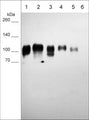
Western blot of human LNCaP prostate adenocarcinoma (lane 1), MCF-7 breast ductal carcinoma (lane 2), NCI-H28 pleural mesothelioma (lane 3), A431 epidermoid carcinoma (lane 4), MDAMB-231 breast carcinoma (lane 5) and Jurkat T-cell line (lane 6). The blot was probed with mouse monoclonal anti-B7-H3/CD276 (BM0451) at 1:500.
Click on image to zoom

SKU: BM0451
Ships: 1-2 business days
Product Details
B7-H3/CD276 (Extracellular region) Antibody
B7 homolog 3 (B7-H3, CD276) is a member of the B7 family of cell surface ligands that regulate T cell activation and immune responses. B7-H3 is a membrane protein with an extracellular region that includes two Ig-like V-type domains and two IgG-like C2-type domains, and a short intracellular domain. B7-H3 is a regulatory molecule for immune reactions, such as T cell proliferation and IFN-γ production. In colon cancers, B7-H3 inhibits T-cell cytotoxicity, and blocking B7-H3 function enhances T-cell cytotoxicity toward cancer cells. B7-H3 is expressed by antigen presenting cells, activated T cells, and a few normal tissues, including placenta and prostate. In cancer, B7-H3 is expressed in various tumor types including prostate, breast, colon, lung, and gastric cancers. The B7-H3 expression level correlates with tumor growth, invasion, metastasis, malignant stage, and recurrence rate. The inhibition or blockade of B7-H3 function could be an important immunotherapeutic approach for several types of cancer
Protein G Purified
Monoclonal
M045
IgG1
ELISA, ICC, IP, WB
Mouse
CD276
100-120
Clone (M045) was generated from a recombinant protein that included the extracellular region of human B7-H3 protein.
Human
Human
Storage at -20°C is recommended, as aliquots may be taken without freeze/thawing due to presence of 50% glycerol. Stable for at least 1 year at -20°C.
Liquid
PBS + 1 mg/ml BSA, 0.05% NaN3 and 50% glycerol
WB: 1:1000
ICC: 1:100
IP: 1:100
ICC: 1:100
IP: 1:100
Unconjugated
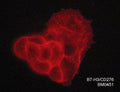
Clone M045 mouse monoclonal antibody detects a 100-120 kDa* protein on SDS-PAGE "Native" or denatured immunoblots of human LNCaP, MCF-7, NCI-H28, A431, and MDA-MB-231 carcinomas. The antibody detects B7-H3 in membranes and cytoplasm in MCF7 cell after immunocytochemical labeling. The antibody works for western blot, immunoprecipitation, immunocytochemistry, and ELISA capture.
Western blots performed on each lot.
For research use only. Not intended for therapeutic or diagnostic use. Use of all products is subject to our terms and conditions, which can be viewed on our website.
United States
After date of receipt, stable for at least 1 year at -20°C.
4Ig-B7-H3; CD276; B7H3; B7RP-2; CD276 antigen; B7 homolog 3; costimulatory molecule; B7-H3
Q5ZPR3
UniProt Summary: May participate in the regulation of T-cell-mediated immune response. May play a protective role in tumor cells by inhibiting natural-killer mediated cell lysis as well as a role of marker for detection of neuroblastoma cells. May be involved in the development of acute and chronic transplant rejection and in the regulation of lymphocytic activity at mucosal surfaces. Could also play a key role in providing the placenta and fetus with a suitable immunological environment throughout pregnancy. Both isoform 1 and isoform 2 appear to be redundant in their ability to modulate CD4 T-cell responses. Isoform 2 is shown to enhance the induction of cytotoxic T-cells and selectively stimulates interferon gamma production in the presence of T-cell receptor signaling.
80381
Blue Ice