Anti-Autophagy-Related Protein 4 Homolog B (APG4B) Antibody
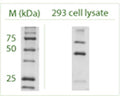
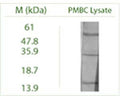
Our Anti-Autophagy-related protein 4 homolog B (APG4B) rabbit polyclonal primary antibody detects human and rat Autophagy-related protein 4 homolog B (APG4B), and is whole serum. It is validated for use in IHC-Frozen, WB.
SKU: R-157-100
Ships: 1-2 business days
Product Details
Autophagy-related protein 4 homolog B (APG4B)
FUNCTION: Cysteine protease required for autophagy, which cleaves the C-terminal part of either MAP1LC3, GABARAPL2 or GABARAP, allowing the liberation of form I. A subpopulation of form I is subsequently converted to a smaller form (form II). Form II, with a revealed C-terminal glycine, is considered to be the phosphatidylethanolamine (PE)-conjugated form, and has the capacity for the binding to autophagosomes. ENZYME REGULATION: Inhibited by N-ethylmaleimide. SUBCELLULAR LOCATION: Cytoplasm (Probable). ALTERNATIVE PRODUCTS: 5 named isoforms produced by alternative splicing. TISSUE SPECIFICITY: Mainly expressed in the skeletal muscle, followed by brain, heart, liver and pancreas. SIMILARITY: Belongs to the peptidase C54 family.
Whole serum
Polyclonal
Mixed
IHC, WB
Rabbit
A synthetic peptide (CLERFFDSEDED) corresponding to the C-terminus of human ATG4B protein conjugated to Blue Carrier Protein has been used as the immunogen. The peptide is homologous with the corresponding sequence derived from of ATG4B protein in mouse and rat.
Human
Human, Rat
Spin vial briefly before opening. Reconstitute in 100 µL sterile-filtered, ultrapure water. Centrifuge to remove any insoluble material. After reconstitution keep aliquots at -20°C for a higher stability, and at 2-8°C with an appropriate antibacterial agent. Glycerol (1:1) may be added for an additional stability. Avoid repetitive freeze/thaw cycles.
Lyophilized
IHC: 1:100-1:2000
Unconjugated
IHC, WB and ELISA confirmed the specificity for ATG4B. Human, rat. Other species not yet tested.
For research use only.
United States
12 months after date of receipt (unopened vial).
APG4B; Cysteine protease ATG4B; Autophagy-related protein 4 homolog B; APG4 autophagy 4 homolog B; hAPG4B; ATG4 autophagy related 4 homolog B; Autophagin-1; AUT-like 1 cysteine endopeptidase; Autophagy-related cysteine endopeptidase 1; ATG4B; AUTL1; KIAA0943
Q9Y4P1
UniProt Summary: Cysteine protease that plays a key role in autophagy by mediating both proteolytic activation and delipidation of ATG8 family proteins. Required for canonical autophagy (macroautophagy), non-canonical autophagy as well as for mitophagy. The protease activity is required for proteolytic activation of ATG8 family proteins: cleaves the C-terminal amino acid of ATG8 proteins MAP1LC3A, MAP1LC3B, MAP1LC3C, GABARAPL1, GABARAPL2 and GABARAP, to reveal a C-terminal glycine. Exposure of the glycine at the C-terminus is essential for ATG8 proteins conjugation to phosphatidylethanolamine (PE) and insertion to membranes, which is necessary for autophagy. Protease activity is also required to counteract formation of high-molecular weight conjugates of ATG8 proteins (ATG8ylation): acts as a deubiquitinating-like enzyme that removes ATG8 conjugated to other proteins, such as ATG3. In addition to the protease activity, also mediates delipidation of ATG8 family proteins. Catalyzes delipidation of PE-conjugated forms of ATG8 proteins during macroautophagy. Also involved in non-canonical autophagy, a parallel pathway involving conjugation of ATG8 proteins to single membranes at endolysosomal compartments, by catalyzing delipidation of ATG8 proteins conjugated to phosphatidylserine (PS). Compared to other members of the family (ATG4A, ATG4C or ATG4C), constitutes the major protein for proteolytic activation of ATG8 proteins, while it displays weaker delipidation activity than other ATG4 paralogs. Involved in phagophore growth during mitophagy independently of its protease activity and of ATG8 proteins: acts by regulating ATG9A trafficking to mitochondria and promoting phagophore-endoplasmic reticulum contacts during the lipid transfer phase of mitophagy.
23192
25°C (ambient)