Anti-Autophagy-related protein 3 (ATG3) Antibody
Our Anti-Autophagy-related protein 3 (ATG3) rabbit polyclonal primary antibody detects human, mouse, and rat Autophagy-related protein 3 (ATG3), and is whole serum. It is validated for use in IHC-Frozen, IHC-Paraffin-embedded, WB.
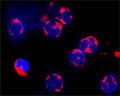
Confocal microscopy on immunofluorescently detected ATG3 in cytospin-isolated human white blood cells using Rabbit antibody to ATG3: whole serum (R-159-100) at a dilution of 1: 100, incubated for 1 h at room temperature. The cells stained for ATG3 appear in red . The cells were counter stained with Hoechst Dye (blue colour). Here, the merged picture is presented. More information on the staining: Fixation: In acetone for 90 seconds. Antibody dilutions: Primary antibody was diluted 1:100 and incubated for 1 hour, washed then 3x, and the secondary (Goat anti Rb 1:100 Alexa 546 conjugate) was incubated for 30 minutes. Magnification 80X. No staining was observed using the Pre-immunisation serum. No staining was observed in HL60 cell line using Rabbit antibody to ATG3: whole serum (R-159-100)
Click on image to zoom
SKU: R-159-100
Ships: 1-2 business days
Product Details
Autophagy-related protein 3 (ATG3)
FUNCTION: GABARAPL1 (GABARAPL2 or GABARAP or MAP1LC3)-modifier protein conjugating enzyme involved in its E2-like covalent binding to PE. ATG7 (E1-like enzyme) facilitates this reaction by forming an E1-E2 complex with ATG3 (E2-like enzyme). Preferred substrate is MAP1LC3A. Formation of the GABARAPL1-PE conjugate is essential for autophagy. SUBUNIT: Interacts with ATG7 and ATG12. The complex, composed of ATG3 and ATG7, plays a role in the conjugation of ATG12 to ATG5. SUBCELLULAR LOCATION: Cytoplasm. ALTERNATIVE PRODUCTS: 2 named isoforms produced by alternative splicing. TISSUE SPECIFICITY: Widely expressed, with a highest expression in heart, skeletal muscle, kidney, liver and placenta. SIMILARITY: Belongs to the ATG3 family.
Whole serum
Polyclonal
Mixed
IHC, WB
Rabbit
37 kDa
A synthetic peptide corresponding to a central region of the human ATG3 protein [aa. 151 EGEAADMEEYE 161] conjugated to Blue Carrier Protein has been used as the immunogen. The peptide is highly conserved and homologous with the corresponding sequence derived from ATG3 protein in mouse, rat, S. cerevisiae, Macaca mulatta (monkey), Canis familiaris (dog), and many more species.
Human
Human, Mouse, Rat
Spin vial briefly before opening. Reconstitute in 100 µL sterile-filtered, ultrapure water. Centrifuge to remove any insoluble material. After reconstitution keep aliquots at -20°C for a higher stability, and at 2-8°C with an appropriate antibacterial agent. Glycerol (1:1) may be added for an additional stability. Avoid repetitive freeze/thaw cycles.
Lyophilized
WB: 1:50-1:3000
IHC: 1:50-1:3000
IHC: 1:50-1:3000
Unconjugated
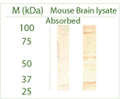
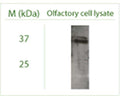
IHC, WB and ELISA confirmed the specificity for ATG3. A 37 kDa band, that corresponds to the molecular weight of ATG3, is detected via Western blot analysis. Human, rat, mouse. Other species not yet tested.
For research use only.
United States
12 months after date of receipt (unopened vial).
APG3; Autophagy-related protein 3; APG3L; PC3-96; APG3-like; ubiquitin-like-conjugating enzyme ATG3; hApg3; 2610016C12Rik; Protein PC3-96; APG3 autophagy 3-like; ATG3; ATG3 autophagy related 3 homolog
Q9NT62
UniProt Summary: E2 conjugating enzyme that catalyzes the covalent conjugation of the C-terminal Gly of ATG8-like proteins (GABARAP, GABARAPL1, GABARAPL2 or MAP1LC3A) to the amino group of phosphatidylethanolamine (PE)-containing lipids in the membrane resulting in membrane-bound ATG8-like proteins which is one of the key steps in the development of autophagic isolation membranes during autophagosome formation. Cycles back and forth between binding to ATG7 for loading with the ATG8-like proteins and binding to E3 enzyme, composed of ATG12, ATG5 and ATG16L1 to promote ATG8-like proteins lipidation. Also plays a role as a membrane curvature sensor that facilitates LC3/GABARAP lipidation by sensing local membrane stress associated with lipid-packing defects as occurs with high molar proportions of conical lipids or strident membrane curvature. Interacts with negatively-charged membranes promoting membrane tethering and enhancing LC3/GABARAP lipidation. Also acts as an autocatalytic E2-like enzyme by catalyzing the conjugation of ATG12 to itself in an ATG7-dependent manner, this complex thus formed, plays a role in mitochondrial homeostasis but not in autophagy. ATG12-ATG3 conjugation promotes late endosome to lysosome trafficking and basal autophagosome maturation via its interaction with PDCD6IP. ATG12-ATG3 conjugate is also formed upon viccina virus infection, leading to the disruption the cellular autophagy which is not necessary for vaccinia survival and proliferation. Promotes primary ciliogenesis by removing OFD1 from centriolar satellites via the autophagic pathway.
64422
25°C (ambient)