Anti-ATM (Ser-1981), Phosphospecific Antibody (M366)
Our ATM (Ser-1981) phosphospecific primary antibody from PhosphoSolutions is mouse monoclonal. It detects human, mouse, and rat ATM (Ser-1981) and is Protein A purified. It is great for use in WB, IP, ICC.
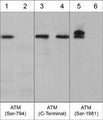
Western blot of human A431 cells treated with Calyculin A (100 nM) for 30 min. Blot lanes were untreated (lanes 1, 3, & 5) or treated with lambda phosphatase (lanes 2, 4, & 6) then probed with anti-ATM (Ser-794) (lanes 1 & 2), anti-ATM (C-Terminal) (lanes 3 & 4), or anti-ATM (Ser-1981) (lanes 5 & 6).
Click on image to zoom

SKU: AM3661
Ships: 1-2 business days
Product Details
ATM (Ser-1981)
Ataxia telangiectasia mutated kinase (ATM) is a serine/threonine kinase that regulates cell cycle checkpoints and DNA repair. Mutations of ATM cause a spectrum of defects ranging from neurodegeneration to cancer predisposition. Activation of ATM after DNA damage involves Cdk5 mediated phosphorylation of Ser-794 followed by autophosphorylation at Ser-1891. Active ATM kinase regulates a number of proteins involved in cell cycle checkpoint control, apoptosis and DNA repair. The Cdk5–ATM pathway regulates phosphorylation and function of the ATM targets p53 and H2AX in postmitotic neurons. Other known substrates of ATM include Chk2, Chk1, CtIP, 4E-BP1, BRCA1, RPA3, SMC1, FANCD2, Rad17, Artemis, Nbs1, and the I-2 regulatory subunit of PP1. Thus, activation of Cdk5 by DNA damage may be an important initiator of ATM-dependent regulation of cell cycle checkpoints.
Protein A Purified
Monoclonal
M366
IgG1
ELISA, ICC, IP, WB
Mouse
ATM
370
Clone M366 was generated from a phospho-peptide that included amino acids surrounding Serine 1981 in human ATM. This sequence has high homology to the conserved site in rat and mouse ATM.
Human
Human, Mouse, Rat
Storage at -20°C is recommended, as aliquots may be taken without freeze/thawing due to presence of 50% glycerol. Stable for at least 1 year at -20°C.
Liquid
PBS + 1 mg/ml BSA, 0.05% NaN3 and 50% glycerol
WB: 1:1000
ICC: 1:200
IP: 1:100
ICC: 1:200
IP: 1:100
Unconjugated
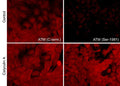
This antibody detects a 370 kDa* protein corresponding to the molecular mass of ATM on SDS-PAGE immunoblots of calyculin A treated human A431 and Jurkat Cells, but is not observed in control cells.
Phosphorylated
Ser-1981
Western blots performed on each lot.
For research use only. Not intended for therapeutic or diagnostic use. Use of all products is subject to our terms and conditions, which can be viewed on our website.
United States
After date of receipt, stable for at least 1 year at -20°C.
AT1; ataxia telangiectasia mutated; ATC; ATD; ATDC; ATE; TEL1; TELO1; serine-protein kinase ATM; A-T mutated; AT mutated; telomere maintenance 1; homolog; AT1 ATDC TEL1 TELO1
Q13315
UniProt Summary: Serine/threonine protein kinase which activates checkpoint signaling upon double strand breaks (DSBs), apoptosis and genotoxic stresses such as ionizing ultraviolet A light (UVA), thereby acting as a DNA damage sensor. Recognizes the substrate consensus sequence [ST]-Q. Phosphorylates 'Ser-139' of histone variant H2AX at double strand breaks (DSBs), thereby regulating DNA damage response mechanism. Also plays a role in pre-B cell allelic exclusion, a process leading to expression of a single immunoglobulin heavy chain allele to enforce clonality and monospecific recognition by the B-cell antigen receptor (BCR) expressed on individual B-lymphocytes. After the introduction of DNA breaks by the RAG complex on one immunoglobulin allele, acts by mediating a repositioning of the second allele to pericentromeric heterochromatin, preventing accessibility to the RAG complex and recombination of the second allele. Also involved in signal transduction and cell cycle control. May function as a tumor suppressor. Necessary for activation of ABL1 and SAPK. Phosphorylates DYRK2, CHEK2, p53/TP53, FBXW7, FANCD2, NFKBIA, BRCA1, CREBBP/CBP, RBBP8/CTIP, FBXO46, MRE11, nibrin (NBN), RAD50, RAD17, PELI1, TERF1, UFL1, RAD9, UBQLN4 and DCLRE1C. May play a role in vesicle and/or protein transport. Could play a role in T-cell development, gonad and neurological function. Plays a role in replication-dependent histone mRNA degradation. Binds DNA ends. Phosphorylation of DYRK2 in nucleus in response to genotoxic stress prevents its MDM2-mediated ubiquitination and subsequent proteasome degradation. Phosphorylates ATF2 which stimulates its function in DNA damage response. Phosphorylates ERCC6 which is essential for its chromatin remodeling activity at DNA double-strand breaks. Phosphorylates TTC5/STRAP at 'Ser-203' in the cytoplasm in response to DNA damage, which promotes TTC5/STRAP nuclear localization. Also involved in pexophagy by mediating phosphorylation of PEX5: translocated to peroxisomes in response to reactive oxygen species (ROS), and catalyzes phosphorylation of PEX5, promoting PEX5 ubiquitination and induction of pexophagy.
472
Blue Ice