Anti-Asc (Tyr-144), Phosphospecific Antibody
Our Asc (Tyr-144) rabbit polyclonal phosphospecific primary antibody from PhosphoSolutions is produced in-house. It detects human, mouse, and rat Asc (Tyr-144) and is antigen affinity purified. It is great for use in WB, ICC.
SKU: AP5631
Ships: 1-2 business days
Product Details
Asc (Tyr-144)
Host- and pathogen-associated cytoplasmic double-stranded DNA triggers the activation of a NALP3-independent inflammasome, which activates caspase-1, leading to maturation of pro-interleukin-1beta and inflammation. Several studies have isolated AIM2 (absent in melanoma 2) as a candidate cytoplasmic-DNA-sensing protein that contains an N-terminal pyrin domain and C-terminal oligonucleotide binding domain. A screen for transcripts induced by interferon-beta identified AIM2 gene expression. AIM2 protein bound double-stranded DNA, recruited the inflammasome adaptor ASC, and localized to ASC containing speckles. AIM2 and ASC form a pyroptosome, which induces pyroptotic cell death mediated by caspase-1. Asc can be phosphorylated at Tyr-144 in a Syk and JNK-dependent manner. This phosphorylation is critical for Asc speck formation and Caspase-1 activation.
Antigen Affinity Purified
Polyclonal
IgG
ELISA, ICC, WB
Rabbit
Pycard
22
Asc (Tyr-144) phospho-peptide (coupled to KLH) corresponding to amino acid residues surrounding Tyr-144 in mouse Asc. This peptide sequence is highly conserved in human and rat Asc.
Mouse
Human, Mouse, Rat
Storage at -20°C is recommended, as aliquots may be taken without freeze/thawing due to presence of 50% glycerol. Stable for at least 1 year at -20°C.
Liquid
PBS + 1 mg/ml BSA, 0.05% NaN3 and 50% glycerol
WB: 1:1000
ICC: 1:100
ICC: 1:100
Unconjugated
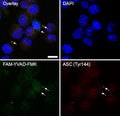
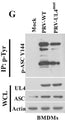
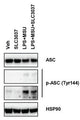
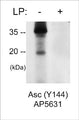
This antibody was cross-adsorbed to unphosphorylated Asc (Tyr-144) peptide before affinity purification using phospho-Asc (Tyr-144) peptide. The antibody detects phosphorylated Asc (Tyr-144) in the inflammasome. In J774 macrophage cells primed with LPS and treated with nigericin, the antibody colocalized with an inflammasome marker, caspase-1 inhibitor (FAM-YVAD-FMK). In addition, the antibody detects a 20 kDa Asc protein in western blots of J774A.1 mouse macrophages treated with pervanadate.
Phosphorylated
Tyr-144
Western blots performed on each lot.
For research use only. Not intended for therapeutic or diagnostic use. Use of all products is subject to our terms and conditions, which can be viewed on our website.
United States
After date of receipt, stable for at least 1 year at -20°C.
9130417A21Rik; Caspase; CARD5; TMS-1; TNS1; masc; PYD and CARD domain-containing protein; PYCARD; AIM; ASC; TMS1
Q9EPB4
UniProt Summary: Functions as a key mediator in apoptosis and inflammation. Promotes caspase-mediated apoptosis involving predominantly caspase-8 and also caspase-9 in a probable cell type-specific manner. Involved in activation of the mitochondrial apoptotic pathway, promotes caspase-8-dependent proteolytic maturation of BID independently of FADD in certain cell types and also mediates mitochondrial translocation of BAX and activates BAX-dependent apoptosis coupled to activation of caspase-9, -2 and -3. Involved in innate immune response by acting as an integral adapter in the assembly of various inflammasomes (NLRP1, NLRP2, NLRP3, NLRP6, AIM2 and probably IFI16) which recruit and activate caspase-1 leading to processing and secretion of pro-inflammatory cytokines. Caspase-1-dependent inflammation leads to macrophage pyroptosis, a form of cell death. The function as activating adapter in different types of inflammasomes is mediated by the pyrin and CARD domains and their homotypic interactions. Clustered PYCARD nucleates the formation of caspase-1 filaments through the interaction of their respective CARD domains, acting as a platform for of caspase-1 polymerization. In the NLRP1 and NLRC4 inflammasomes seems not be required but facilitates the processing of procaspase-1. In cooperation with NOD2 involved in an inflammasome activated by bacterial muramyl dipeptide leading to caspase-1 activation. May be involved in RIGI-triggered pro-inflammatory responses and inflammasome activation. In collaboration with AIM2 which detects cytosolic double-stranded DNA may also be involved in a caspase-1-independent cell death that involves caspase-8. In adaptive immunity may be involved in maturation of dendritic cells to stimulate T-cell immunity and in cytoskeletal rearrangements coupled to chemotaxis and antigen uptake may be involved in post-transcriptional regulation of the guanine nucleotide exchange factor DOCK2; the latter function is proposed to involve the nuclear form. Also involved in transcriptional activation of cytokines and chemokines independent of the inflammasome; this function may involve AP-1, NF-kappa-B, MAPK and caspase-8 signaling pathways. For regulation of NF-kappa-B activating and inhibiting functions have been reported. Modulates NF-kappa-B induction at the level of the IKK complex by inhibiting kinase activity of CHUK and IKBK. Proposed to compete with RIPK2 for association with CASP1 thereby down-regulating CASP1-mediated RIPK2-dependent NF-kappa-B activation and activating interleukin-1 beta processing. Modulates host resistance to DNA virus infection, probably by inducing the cleavage of and inactivating CGAS in presence of cytoplasmic double-stranded DNA.
66824
Blue Ice