
Anti-Argonaute 2 (Ser-387), Phosphospecific Antibody
Our Argonaute 2 (Ser-387) rabbit polyclonal phosphospecific primary antibody from PhosphoSolutions is produced in-house. It detects chicken, human, mouse, rat, and Xenopus Argonaute 2 (Ser-387) and is antigen affinity purified. It is great for use in WB, ICC.
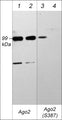
Western blot analysis of mouse recombinant Ago2 full length protein (lanes 1-4). The blot was treated with lambda phosphatase (lanes 2 & 4) then probed with rabbit polyclonal anti-Ago2 (AP5281) (lanes 1 & 2) and rabbit polyclonal anti-Ago2 (Ser-387) phospho-specific antibody (lanes 3 & 4).
Click on image to zoom

SKU: AP5291
Ships: 1-2 business days
Product Details
Argonaute 2 (Ser-387)
Several classes of small RNAs, including short interfering RNAs (siRNAs), microRNAs (miRNAs), and Piwi-interacting RNAs (piRNAs) have been identified. MicroRNAs are about 21 nucleotides in length and have been implicated in many cellular processes such as development, differentiation, and stress response. These small RNAs function together with complexes called micro-ribonucleoproteins (miRNPs) to regulate gene expression by modulating mRNA translation or stability. Among the most important components in these complexes are argonaute proteins. There are four members in the mammalian argonaute family and only argonaute 2 (Ago2) possesses the Slicer endonuclease activity. Argonaute proteins participate in various steps of microRNA-mediated gene silencing, such as repression of translation and mRNA turnover. These activities may be regulated by cell signaling events that alter argonaute phosphorylation. EGFR phosphorylates Tyr-393 in Ago2, which reduces binding to Dicer and inhibits miRNA processing. Akt3 phosphorylates Ago2 at Ser-387 leading to reduced mRNA cleavage and enhanced translational repression.
Antigen Affinity Purified
Polyclonal
IgG
ELISA, ICC, WB
Rabbit
AGO2
97
Phospho-Ago2 (Ser-387) synthetic peptide (coupled to KLH) corresponding to amino acid residues surrounding serine 387 in human Ago2. This peptide sequence is highly conserved in mouse, rat, chick, and fish Ago2. The site is also conserved in Ago1 and Ago4, but the homology surrounding the site is low between Ago2 and these two family members.
Human
Chicken, Frog, Human, Mouse, Rat
Storage at -20°C is recommended, as aliquots may be taken without freeze/thawing due to presence of 50% glycerol. Stable for at least 1 year at -20°C.
Liquid
PBS + 1 mg/ml BSA, 0.05% NaN3 and 50% glycerol
WB: 1:1000
ICC: 1:100
ICC: 1:100
Unconjugated
This antibody was cross-absorbed to unphospho-Ago2 (Ser-387), before affinity purification using phospho-Ago2 (Ser-387) peptide (without carrier). The antibody detects a 97 kDa* protein corresponding to the apparent molecular mass of phosphorylated Ago2 on SDS-PAGE immunoblots of human A431 cells treated with Calyculin A and mouse recombinant Ago2 full length protein. This reactivity is not observed after lambda phosphatase dephosphorylation.
Phosphorylated
Ser-387
Western blots performed on each lot.
For research use only. Not intended for therapeutic or diagnostic use. Use of all products is subject to our terms and conditions, which can be viewed on our website.
United States
After date of receipt, stable for at least 1 year at -20°C.
argonaute RISC catalytic component 2; Ago2; eukaryotic translation initiation factor 2C; protein slicer; CASC7; LINC00980; PPD; Q10; PAZ Piwi domain protein; cancer susceptibility candidate 7; long intergenic non-protein coding RNA 980; protein argonaute-2; Argonaute; eIF-2C2; eIF2C2
Q9UKV8
UniProt Summary: Required for RNA-mediated gene silencing (RNAi) by the RNA-induced silencing complex (RISC). The 'minimal RISC' appears to include AGO2 bound to a short guide RNA such as a microRNA (miRNA) or short interfering RNA (siRNA). These guide RNAs direct RISC to complementary mRNAs that are targets for RISC-mediated gene silencing. The precise mechanism of gene silencing depends on the degree of complementarity between the miRNA or siRNA and its target. Binding of RISC to a perfectly complementary mRNA generally results in silencing due to endonucleolytic cleavage of the mRNA specifically by AGO2. Binding of RISC to a partially complementary mRNA results in silencing through inhibition of translation, and this is independent of endonuclease activity. May inhibit translation initiation by binding to the 7-methylguanosine cap, thereby preventing the recruitment of the translation initiation factor eIF4-E. May also inhibit translation initiation via interaction with EIF6, which itself binds to the 60S ribosomal subunit and prevents its association with the 40S ribosomal subunit. The inhibition of translational initiation leads to the accumulation of the affected mRNA in cytoplasmic processing bodies (P-bodies), where mRNA degradation may subsequently occur. In some cases RISC-mediated translational repression is also observed for miRNAs that perfectly match the 3' untranslated region (3'-UTR). Can also up-regulate the translation of specific mRNAs under certain growth conditions. Binds to the AU element of the 3'-UTR of the TNF mRNA and up-regulates translation under conditions of serum starvation. Also required for transcriptional gene silencing (TGS), in which short RNAs known as antigene RNAs or agRNAs direct the transcriptional repression of complementary promoter regions.
27161
Blue Ice

