Anti-Alpha synuclein Antibody
Our Anti-Alpha synuclein chicken polyclonal primary antibody detects bovine, chicken, horse, human, mouse, pig, and rat Alpha synuclein, and is affinity-purified. It is validated for use in ICC, IHC-Frozen, WB.
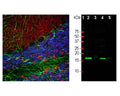
Left: Rat cerebellum section stained with chicken anti-α-synuclein antibody (red, 1:3,000) by Immunohistochemistry. Section was co-stained with rabbit anti-GFAP (green, R-1374-50, 1:5,000) and DAPI nuclear dye (blue). IHC method: Following transcardial perfusion with 4% paraformaldehyde, brain was post-fixed for 24 hours, cut into 45 uM sections, and free-floating sections were stained. The α-synuclein protein is concentrated in presynaptic regions in the granular and molecular layers, while GFAP antibody stains the network of Bergmann and astroglial cells. Right: Western blot analysis of tissue lysates. Lane 1: MWM; Lane 2: rat brain; Lane 3: rat spinal cord; Lane 4: mouse brain; Lane 5: mouse spinal cord. Antibody dilution: 1:2,000. A strong band at about 15 kDa corresponds to the α-synuclein protein in brain extracts, which are rich in synapses.
Click on image to zoom
Bovine, Chicken, Horse, Human, Mouse, Pig, Rat
ICC, IHC, WB
Chicken
SKU: C-1795-50
Ships: 1-2 business days
Product Details
Alpha synuclein
May be involved in the regulation of dopamine release and transport. Induces fibrillization of microtubule-associated protein tau. Reduces neuronal responsiveness to various apoptotic stimuli, leading to a decreased caspase-3 activation. Ref: uniprot.org.
Affinity-purified
Polyclonal
IgY
ICC, IHC, WB
Chicken
Full length human protein with the epitope from amino acids 61-95
Human
Bovine, Chicken, Horse, Human, Mouse, Pig, Rat
Spin vial briefly before opening. Reconstitute with 50 µL sterile-filtered, ultrapure water to achieve a 1 mg/mL concentration. Centrifuge to remove any insoluble material. Store lyophilized antibody at 2-8°C. After reconstitution divide into aliquots and store at -20°C for long-term storage. Store at 2-8°C short-term (up to 4 weeks) with an appropriate antibacterial agent. Avoid repetitive freeze/thaw cycles.
Liquid
PBS, pH 7.4, containing 0.02% sodium azide as preservative.
WB: 1:1000-1:2000
IHC: 1:1000-1:2000
ICC: 1:1000-1:2000
IHC: 1:1000-1:2000
ICC: 1:1000-1:2000
Unconjugated
Reacts with human, horse, cow, pig, chicken, rat, mouse.
For research use only.
United States
12 months after date of receipt (unopened vial).
Alpha synuclein; Non-A beta component of AD amyloid; Alpha-synuclein; Non-A4 component of amyloid precursor; Alpha-synuclein; NACP; isoform NACP140; SNCA; alphaSYN; PARK1; MGC105443; MGC110988; MGC127560; MGC64356; NACP; Non A beta component of AD amyloid; Non A4 component of amyloid; Non A4 component of amyloid precursor; Non-A beta component of AD amyloid; Non-A-beta component of alzheimers disease amyloid; precursor of; Non-A4 component of amyloid precursor; Non-A4 component of amyloid; OTTHUMP00000218549; OTTHUMP00000218551; OTTHUMP00000218552; OTTHUMP00000218553; OTTHUMP00000218554; PARK 1; PARK 4; PARK1; PARK4; Parkinson disease (autosomal dominant Lewy body 4; Parkinson disease familial 1; SNCA; Snca synuclein alpha (non A4 component of amyloid precursor; SYN; Synuclein alpha; Synuclein alpha 140; Synuclein alpha (non A4 component of amyloid precursor; SYUA_HUMAN
P37840
UniProt Summary: Neuronal protein that plays several roles in synaptic activity such as regulation of synaptic vesicle trafficking and subsequent neurotransmitter release. Participates as a monomer in synaptic vesicle exocytosis by enhancing vesicle priming, fusion and dilation of exocytotic fusion pores. Mechanistically, acts by increasing local Ca(2+) release from microdomains which is essential for the enhancement of ATP-induced exocytosis. Also acts as a molecular chaperone in its multimeric membrane-bound state, assisting in the folding of synaptic fusion components called SNAREs (Soluble NSF Attachment Protein REceptors) at presynaptic plasma membrane in conjunction with cysteine string protein-alpha/DNAJC5. This chaperone activity is important to sustain normal SNARE-complex assembly during aging. Also plays a role in the regulation of the dopamine neurotransmission by associating with the dopamine transporter (DAT1) and thereby modulating its activity.
6622
25°C (ambient)