
Anti-Adaptor Protein, APPL2 Antibody
Our Anti-Adaptor protein, phosphotyrosine interacting with PH domain and leucine zipper 2 (APPL2) rabbit polyclonal primary antibody detects human and mouse Adaptor protein, phosphotyrosine interacting with PH domain and leucine zipper 2 (APPL2), and is whole serum. It is validated for use in ICC, WB.
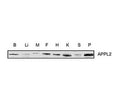
Western blot analysis with Rabbit polyclonal antibody to mouse APPL2, catalog number R-1332-100. Tissue homogenates of mouse brain (B), liver (Li), muscle (M), fat (F), heart (H), kidney (K), spleen (S) and pancreas (P) were used and 30 µg of protein was loaded in each lane. Image courtesy of Wang C. et al (2009) J Biol Chem.
Click on image to zoom
SKU: R-1332-100
Ships: 1-2 business days
Product Details
Adaptor protein, phosphotyrosine interacting with PH domain and leucine zipper 2 (APPL2)
APPL2 is an isoform of APPL1 with 54% identity in their protein sequences. APPL2 has a role in cell proliferation and embryonic development. Recently, it was shown that APPL2 regulates FSH signaling and acts as a negative regulator in adiponectin signaling.
Whole serum
Polyclonal
Mixed
ICC, WB
Rabbit
Mouse APPL2 protein (amino acids: 619-662) conjugated to GST.
Mouse
Human, Mouse
Aliquot and store at -20°C for a higher stability. Avoid freeze-thaw cycles.
Liquid
15% glycerol
WB: 1:2500-1:5000
IP: 3 µg/reaction
IP: 3 µg/reaction
Unconjugated
This antiserum is known to recognize both mouse and human APPL2.
For research use only.
United States
12 months after date of receipt (unopened vial).
DIP13B; DCC-interacting protein 13-beta; DIP13 beta; Dip13-beta; Adapter protein containing PH domain; PTB domain and leucine zipper motif 2; APPL2
Q8NEU8
UniProt Summary: Multifunctional adapter protein that binds to various membrane receptors, nuclear factors and signaling proteins to regulate many processes, such as cell proliferation, immune response, endosomal trafficking and cell metabolism. Regulates signaling pathway leading to cell proliferation through interaction with RAB5A and subunits of the NuRD/MeCP1 complex. Plays a role in immune response by modulating phagocytosis, inflammatory and innate immune responses. In macrophages, enhances Fc-gamma receptor-mediated phagocytosis through interaction with RAB31 leading to activation of PI3K/Akt signaling. In response to LPS, modulates inflammatory responses by playing a key role on the regulation of TLR4 signaling and in the nuclear translocation of RELA/NF-kappa-B p65 and the secretion of pro- and anti-inflammatory cytokines. Also functions as a negative regulator of innate immune response via inhibition of AKT1 signaling pathway by forming a complex with APPL1 and PIK3R1. Plays a role in endosomal trafficking of TGFBR1 from the endosomes to the nucleus. Plays a role in cell metabolism by regulating adiponecting and insulin signaling pathways and adaptative thermogenesis. In muscle, negatively regulates adiponectin-simulated glucose uptake and fatty acid oxidation by inhibiting adiponectin signaling pathway through APPL1 sequestration thereby antagonizing APPL1 action. In muscles, negatively regulates insulin-induced plasma membrane recruitment of GLUT4 and glucose uptake through interaction with TBC1D1. Plays a role in cold and diet-induced adaptive thermogenesis by activating ventromedial hypothalamus (VMH) neurons throught AMPK inhibition which enhances sympathetic outflow to subcutaneous white adipose tissue (sWAT), sWAT beiging and cold tolerance. Also plays a role in other signaling pathways namely Wnt/beta-catenin, HGF and glucocorticoid receptor signaling. Positive regulator of beta-catenin/TCF-dependent transcription through direct interaction with RUVBL2/reptin resulting in the relief of RUVBL2-mediated repression of beta-catenin/TCF target genes by modulating the interactions within the beta-catenin-reptin-HDAC complex. May affect adult neurogenesis in hippocampus and olfactory system via regulating the sensitivity of glucocorticoid receptor. Required for fibroblast migration through HGF cell signaling.
55198
2-8°C (on cold packs)

