
Anti-VEGFR-3 (N-terminus) Antibody
Our VEGFR-3 (N-terminus) rabbit polyclonal primary antibody from PhosphoSolutions is produced in-house. It detects human, rat VEGFR-3 (N-terminus) and is antigen affinity purified. It is great for use in WB.
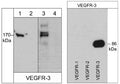
Left: Western blot image of human K-562 cells (lanes 1 & 2) and HUVEC (lanes 3 & 4). The blots were probed with rabbit polyclonal anti-VEGFR-3 (a.a. 1285-1298) in the absence (lanes 1 & 3) or presence of blocking peptide (VX2945) (lanes 2 & 4). Right: Western blot image of GST-recombinant human VEGFR-1 (89 kDa), VEGFR-2 (110 kDa), and VEGFR-3 (86 kDa) C-terminal regions. The blot was probed with anti-VEGFR-3 (a.a. 1285-1298).
Click on image to zoom

SKU: VP2941
Ships: 1-2 business days
Product Details
VEGFR-3 (N-terminus)
Vascular endothelial growth factor receptor-2 (VEGFR-2/Flk-1/KDR) is the primary receptor for VEGF in endothelial cells. Other VEGFR family members, VEGFR-1 (Flt-1) and VEGFR-3 (Flt-4), can also transduce the intracellular signals of VEGF. However, the role of VEGFR-1 is observed mainly during embryonic angiogenesis and VEGFR-3 signaling may be restricted to specific types of endothelial cells. Major autophosphorylation sites of VEGFR-2 are located in the kinase insert domain (Tyr-951/996) and in the tyrosine kinase catalytic domain (Tyr-1054/1059). Other sites, Tyr-1175 and Tyr-1212 provide docking sites for downstream signaling molecules. Activation of VEGFR-2 also phosphorylates Tyr-801, leading to PI3-kinase-Akt activation and increases in endothelial nitric oxide synthase activity. Phosphorylation of mutliple sites in VEGFR-2 is required for downstream activation of several signaling pathways that control proliferation, chemotaxis, and sprouting during angiogenesis.
Antigen Affinity Purified
Polyclonal
IgG
ELISA, WB
Rabbit
FLT4
170
A synthetic peptide (coupled to carrier protein) corresponding to amino acids from the N-terminal region of human VEGFR-3. This sequence has two amino acid differences from rat VEGFR-3, and five amino acid differences from mouse VEGFR-3.
Human
Human, Rat
Storage at -20°C is recommended, as aliquots may be taken without freeze/thawing due to presence of 50% glycerol. Stable for at least 1 year at -20°C.
Liquid
PBS + 1 mg/ml BSA, 0.05% NaN3 and 50% glycerol
WB: 1:1000
Unconjugated
The antibody detects a 170 kDa* band corresponding to VEGFR-3 in western blots of human endothelial and K-562 cells, and shows strong reactivity to recombinant human VEGFR-3, but not VEGFR-1 or VEGFR-2.
Western blots performed on each lot.
For research use only. Not intended for therapeutic or diagnostic use. Use of all products is subject to our terms and conditions, which can be viewed on our website.
United States
After date of receipt, stable for at least 1 year at -20°C.
FLT-4; LMPH1A; PCL; VEGFR-3; VEGFR3; vascular endothelial growth factor receptor 3; fms-like tyrosine kinase 4; tyrosine-protein kinase receptor FLT4
P35916
UniProt Summary: Tyrosine-protein kinase that acts as a cell-surface receptor for VEGFC and VEGFD, and plays an essential role in adult lymphangiogenesis and in the development of the vascular network and the cardiovascular system during embryonic development. Promotes proliferation, survival and migration of endothelial cells, and regulates angiogenic sprouting. Signaling by activated FLT4 leads to enhanced production of VEGFC, and to a lesser degree VEGFA, thereby creating a positive feedback loop that enhances FLT4 signaling. Modulates KDR signaling by forming heterodimers. The secreted isoform 3 may function as a decoy receptor for VEGFC and/or VEGFD and play an important role as a negative regulator of VEGFC-mediated lymphangiogenesis and angiogenesis. Binding of vascular growth factors to isoform 1 or isoform 2 leads to the activation of several signaling cascades; isoform 2 seems to be less efficient in signal transduction, because it has a truncated C-terminus and therefore lacks several phosphorylation sites. Mediates activation of the MAPK1/ERK2, MAPK3/ERK1 signaling pathway, of MAPK8 and the JUN signaling pathway, and of the AKT1 signaling pathway. Phosphorylates SHC1. Mediates phosphorylation of PIK3R1, the regulatory subunit of phosphatidylinositol 3-kinase. Promotes phosphorylation of MAPK8 at 'Thr-183' and 'Tyr-185', and of AKT1 at 'Ser-473'.
2324
Blue Ice

