Anti-VEGFR-2 (Tyr-801) [conserved site], Phosphospecific Antibody
Our VEGFR-2 (Tyr-801) rabbit polyclonal phosphospecific primary antibody from PhosphoSolutions is produced in-house. It detects human, mouse, and rat VEGFR-2 (Tyr-801) and is antigen affinity purified. It is great for use in WB, ICC.
SKU: VP2921
Ships: 1-2 business days
Product Details
VEGFR-2 (Tyr-801)
Vascular endothelial growth factor receptor-2 (VEGFR-2/Flk-1/KDR) is the primary receptor for VEGF in endothelial cells. Other VEGFR family members, VEGFR-1 (Flt-1) and VEGFR-3 (Flt-4), can also transduce the intracellular signals of VEGF. However, the role of VEGFR-1 is observed mainly during embryonic angiogenesis and VEGFR-3 signaling may be restricted to specific types of endothelial cells. Major autophosphorylation sites of VEGFR-2 are located in the kinase insert domain (Tyr-951/996) and in the tyrosine kinase catalytic domain (Tyr-1054/1059). Other sites, Tyr-1175 and Tyr-1212 provide docking sites for downstream signaling molecules. Activation of VEGFR-2 also phosphorylates Tyr-801, leading to PI3-kinase-Akt activation and increases in endothelial nitric oxide synthase activity. Phosphorylation of mutliple sites in VEGFR-2 is required for downstream activation of several signaling pathways that control proliferation, chemotaxis, and sprouting during angiogenesis.
Antigen Affinity Purified
Polyclonal
IgG
ELISA, ICC, WB
Rabbit
KDR
180
Phospho-VEGFR-2 (Tyr-801) peptide (coupled to carrier protein) corresponding to amino acids surrounding Tyr-801 in human VEGFR-2. This sequence has high homology to the conserved site in rat and mouse VEGFR-2, and has significant homology to the conserved sites in VEGFR-1 (Tyr-794) and VEGFR-3 (Tyr-812).
Human
Human, Mouse, Rat
Storage at -20°C is recommended, as aliquots may be taken without freeze/thawing due to presence of 50% glycerol. Stable for at least 1 year at -20°C.
Liquid
PBS + 1 mg/ml BSA, 0.05% NaN3 and 50% glycerol
WB: 1:1000
ICC: 1:100
ICC: 1:100
Unconjugated
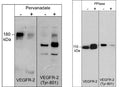
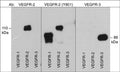
The antibody detects a 180 kDa* band corresponding to VEGFR-2 in western blots of human endothelial cells treated with pervanadate, and shows strong reactivity toward recombinant human VEGFR-2. This reactivity is removed by akaline phosphatase treatment. In addition, the antibody detects the conserved site in VEGFR-1 (Tyr-794). The antibody also works for immunofluorescent staining of VEGFR-2 in HUVEC cells.
Phosphorylated
Tyr-801
Western blots performed on each lot.
For research use only. Not intended for therapeutic or diagnostic use. Use of all products is subject to our terms and conditions, which can be viewed on our website.
United States
After date of receipt, stable for at least 1 year at -20°C.
CD309; KDR; VEGFR; VEGFR2; vascular endothelial growth factor receptor 2; fetal liver kinase-1; protein-tyrosine kinase receptor Flk-1; soluble VEGFR2; tyrosine kinase growth factor receptor; flk-1
P35968
UniProt Summary: Tyrosine-protein kinase that acts as a cell-surface receptor for VEGFA, VEGFC and VEGFD. Plays an essential role in the regulation of angiogenesis, vascular development, vascular permeability, and embryonic hematopoiesis. Promotes proliferation, survival, migration and differentiation of endothelial cells. Promotes reorganization of the actin cytoskeleton. Isoforms lacking a transmembrane domain, such as isoform 2 and isoform 3, may function as decoy receptors for VEGFA, VEGFC and/or VEGFD. Isoform 2 plays an important role as negative regulator of VEGFA- and VEGFC-mediated lymphangiogenesis by limiting the amount of free VEGFA and/or VEGFC and preventing their binding to FLT4. Modulates FLT1 and FLT4 signaling by forming heterodimers. Binding of vascular growth factors to isoform 1 leads to the activation of several signaling cascades. Activation of PLCG1 leads to the production of the cellular signaling molecules diacylglycerol and inositol 1,4,5-trisphosphate and the activation of protein kinase C. Mediates activation of MAPK1/ERK2, MAPK3/ERK1 and the MAP kinase signaling pathway, as well as of the AKT1 signaling pathway. Mediates phosphorylation of PIK3R1, the regulatory subunit of phosphatidylinositol 3-kinase, reorganization of the actin cytoskeleton and activation of PTK2/FAK1. Required for VEGFA-mediated induction of NOS2 and NOS3, leading to the production of the signaling molecule nitric oxide (NO) by endothelial cells. Phosphorylates PLCG1. Promotes phosphorylation of FYN, NCK1, NOS3, PIK3R1, PTK2/FAK1 and SRC.
3791
Blue Ice