
Anti-TAO2 (Ser181) Antibody
Our Anti-TAO2 (Ser181) rabbit polyclonal phosphospecific primary antibody from PhosphoSolutions is produced in-house. It detects human, mouse, and rat TAO2 (Ser181) and is antigen affinity purified from pooled serum. It is great for use in WB.
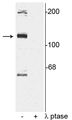
Western blot of rat cortical lysate showing specific immunolabeling of the ~120 kDa TAO2 phosphorylated at Ser181 in the first lane (-). Phosphospecificity is shown in the second lane (+) where the immunolabeling is completely eliminated by blot treatment with lambda phosphatase (λ-Ptase, 1200 units for 30 minutes).
Click on image to zoom

SKU: p275-181
Ships: 1-2 business days
Product Details
TAO2 (Ser181)
In vitro, TAO (thousand and one amino acid) protein kinase 2 (TAO2) activates MAP/ERK kinases (MEKs) 3, 4, and 6 toward their substrates p38 MAP kinase JNK/SAPK (Chen et al., 1999; Chen and Cobb, 2001). This and more recent work has led to the proposal that the TAO protein kinases play an essential role in signaling from physiological agonists to the stress-responsive p38 MAPKs (Chen et al., 2003). Autophosphorylation of TAO may play a role in the mechanism of TAO activation. The MEK binding domain of TAO is autophosphorylated on both serine and threonine residues and Ser-181 is located within this domain.
Antigen Affinity Purified from Pooled Serum
Polyclonal
IgG
ELISA, WB
Rabbit
TAOK2
120 kDa
Synthetic phospho-peptide corresponding to amino acid residues surrounding Ser181 of human TAO2, conjugated to keyhole limpet hemocyanin (KLH).
Human
Human, Mouse, Rat
Canine, Chicken, Finch, Xenopus, Zebrafish
AB_2492255
Storage at -20°C is recommended, as aliquots may be taken without freeze/thawing due to presence of 50% glycerol. Stable for at least 1 year at -20°C.
Liquid
Prepared from pooled rabbit serum by affinity purification via sequential chromatography on phospho and non-phosphopeptide affinity columns.
10 mM HEPES (pH 7.5), 150 mM NaCl, 100 µg per ml BSA and 50% glycerol.
WB: 1:1000
WB Brain: 1:1000
WB Brain: 1:1000
Unconjugated
Specific for endogenous levels of the ~120 kDa TAO2 phosphorylated at Ser181. Immunolabeling is completely eliminated by treatment with λ-phosphatase.
Phosphorylated
Ser181
Western blots performed on each lot.
For research use only. Not intended for therapeutic or diagnostic use. Use of all products is subject to our terms and conditions, which can be viewed on our website.
After date of receipt, stable for at least 1 year at -20°C.
1110033K02Rik; B230344N16; hKFC C; hKFC-C; KIAA0881; Kinase from chicken homolog C; MAP3K17; mKIAA0881; Prostate derived STE20 like kinase 1; Prostate derived STE20 like kinase PSK; Prostate derived sterile 20 like kinase 1; Prostate-derived STE20-like kinase 1; PSK 1; PSK; PSK-1; PSK1; PSK1 beta; Serine/threonine protein kinase TAO2; Serine/threonine-protein kinase TAO2; TAO 1; TAO 2; TAO kinase 2; TAO1; TAO2; TAOK2; TAOK 2; TAOK2_HUMAN; Thousand and one amino acid protein 2; Thousand and one amino acid protein kinase; UNQ2971/PRO7431
Q9UL54
UniProt Summary: Serine/threonine-protein kinase involved in different processes such as membrane blebbing and apoptotic bodies formation DNA damage response and MAPK14/p38 MAPK stress-activated MAPK cascade. Phosphorylates itself, MBP, activated MAPK8, MAP2K3, MAP2K6 and tubulins. Activates the MAPK14/p38 MAPK signaling pathway through the specific activation and phosphorylation of the upstream MAP2K3 and MAP2K6 kinases. In response to DNA damage, involved in the G2/M transition DNA damage checkpoint by activating the p38/MAPK14 stress-activated MAPK cascade, probably by mediating phosphorylation of upstream MAP2K3 and MAP2K6 kinases. Isoform 1, but not isoform 2, plays a role in apoptotic morphological changes, including cell contraction, membrane blebbing and apoptotic bodies formation. This function, which requires the activation of MAPK8/JNK and nuclear localization of C-terminally truncated isoform 1, may be linked to the mitochondrial CASP9-associated death pathway. Isoform 1 binds to microtubules and affects their organization and stability independently of its kinase activity. Prevents MAP3K7-mediated activation of CHUK, and thus NF-kappa-B activation, but not that of MAPK8/JNK. May play a role in the osmotic stress-MAPK8 pathway. Isoform 2, but not isoform 1, is required for PCDH8 endocytosis. Following homophilic interactions between PCDH8 extracellular domains, isoform 2 phosphorylates and activates MAPK14/p38 MAPK which in turn phosphorylates isoform 2. This process leads to PCDH8 endocytosis and CDH2 cointernalization. Both isoforms are involved in MAPK14 phosphorylation. {ECO:0000269|PubMed:10660600, ECO:0000269|PubMed:11279118, ECO:0000269|PubMed:12639963, ECO:0000269|PubMed:12665513, ECO:0000269|PubMed:13679851, ECO:0000269|PubMed:16893890, ECO:0000269|PubMed:17158878, ECO:0000269|PubMed:17396146}.
9344
Blue Ice
- Western Blot Protocol: Download
General References
- Chen, Z., Raman, M., Chen, L., Lee, S.F., Gilman, A.G. and Cobb, M.H., 2003. TAO (thousand-and-one amino acid) protein kinases mediate signaling from carbachol to p38 mitogen-activated protein kinase and ternary complex factors. Journal of Biological Chemistry, 278(25), pp.22278-22283. PMID: 12665513
- Chen, Z. and Cobb, M.H., 2001. Regulation of stress-responsive mitogen-activated protein (MAP) kinase pathways by TAO2. Journal of Biological Chemistry, 276(19), pp.16070-16075. PMID: 11279118
- Chen, Z., Hutchison, M. and Cobb, M.H., 1999. Isolation of the protein kinase TAO2 and identification of its mitogen-activated protein kinase/extracellular signal-regulated kinase kinase binding domain. Journal of Biological Chemistry, 274(40), pp.28803-28807. PMID: 10497253

