Anti-SARM1 Antibody
Our Anti-SARM1 Antibody primary antibody from PhosphoSolutions is rabbit polyclonal. It detects human, mouse, and rat SARM1 and is antigen affinity purified from pooled serum. It is great for use in WB, ICC.
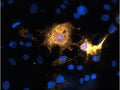
Immunofluorescence of transfected COS-7 cells specifically labeling the positive SARM1 cells using our anti-SARM1 antibody (1:50, red) and anti-FLAG antibody (green). The yellow color results from the overlap of cells labeled with both antibodies. DNA is labeled with DAPI (blue).
Click on image to zoom
Human, Mouse, Rat
ELISA, ICC, WB
Rabbit
SKU: 1901-SARM1
Ships: 1-2 business days
Product Details
SARM1
NAD(+) hydrolase sterile alpha and TIR motif-containing protein 1 (SARM1), is the fifth member of the Toll/Il-1 Receptor (TIR) domain protein family. The highly conserved 724 amino acid protein is predominantly expressed in the brain, kidney and liver (Mink, M., et al 2001). Furthermore, SARM1 is enriched in the cytoplasm, mitchondria, and the axons, dendrites, and synapses of neurons (Panneerselvam, P., et al, 2012). SARM1 plays a key role in axonal degeneration by catalyzing the cleavage of NAD+ into ADPR, cADPR, and nicotinamide in response to injury triggering Wallerian degeneration (Gerdts, J. et al 2015). SARM1 has also been shown to activate neuronal cell death in response to stress (Peng, J. et al. 2010).
Antigen Affinity Purified from Pooled Serum
Polyclonal
IgG
ELISA, ICC, WB
Rabbit
SARM1
79 kDa
Full length recombinant human SARM1 protein.
Human
Human, Mouse, Rat
AB_2922825
Storage at -20°C is recommended, as aliquots may be taken without freeze/thawing due to presence of 50% glycerol. Stable for at least 1 year at -20°C.
Liquid
Prepared from pooled rabbit serum by affinity purification using a column to which the recombinant protein antigen was coupled.
10 mM HEPES (pH 7.5), 150 mM NaCl, 100 µg per ml BSA and 50% glycerol.
WB: 1:1000
ICC: 1:50
ICC: 1:50
Unconjugated
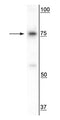
Specific for endogenous levels of the ~79 kDa SARM1 protein.
Western blots performed on each lot.
For research use only. Not intended for therapeutic or diagnostic use. Use of all products is subject to our terms and conditions, which can be viewed on our website.
United States
After date of receipt, stable for at least 1 year at -20°C.
FLJ36296; KIAA0524; MyD88-5; SAM and ARM-containing protein; SAM domain-containing protein 2; SAMD2; SARM 1; SARM1; SARM1_HUMAN; Sterile alpha and Armadillo repeat protein; sterile alpha and HEAT/Armadillo motif protein; ortholog of Drosophila; sterile alpha and HEAT/Armadillo motifs-containing protein; sterile alpha and TIR motif containing 1; Sterile alpha and TIR motif-containing protein 1; Sterile alpha and TIR motifs-containing protein 1; Sterile alpha motif domain-containing protein 2; Tir-1 homolog
Q6SZW1
UniProt Summary: NAD(+) hydrolase, which plays a key role in axonal degeneration following injury by regulating NAD(+) metabolism (PubMed:25908823, PubMed:27671644, PubMed:28334607). Acts as a negative regulator of MYD88- and TRIF-dependent toll-like receptor signaling pathway by promoting Wallerian degeneration, an injury-induced form of programmed subcellular death which involves degeneration of an axon distal to the injury site (PubMed:15123841, PubMed:16964262, PubMed:20306472, PubMed:25908823). Wallerian degeneration is triggered by NAD(+) depletion: in response to injury, SARM1 is activated and catalyzes cleavage of NAD(+) into ADP-D-ribose (ADPR), cyclic ADPR (cADPR) and nicotinamide; NAD(+) cleavage promoting cytoskeletal degradation and axon destruction (PubMed:25908823, PubMed:28334607, PubMed:30333228, PubMed:31128467, PubMed:31439792, PubMed:31439793, PubMed:32049506, PubMed:32828421, PubMed:33053563). Also able to hydrolyze NADP(+), but not other NAD(+)-related molecules (PubMed:29395922). Can activate neuronal cell death in response to stress (PubMed:20306472). Regulates dendritic arborization through the MAPK4-JNK pathway (By similarity). Involved in innate immune response: inhibits both TICAM1/TRIF- and MYD88-dependent activation of JUN/AP-1, TRIF-dependent activation of NF-kappa-B and IRF3, and the phosphorylation of MAPK14/p38 (PubMed:16964262). {ECO:0000250|UniProtKB:Q6PDS3, ECO:0000269|PubMed:15123841, ECO:0000269|PubMed:16964262, ECO:0000269|PubMed:20306472, ECO:0000269|PubMed:25908823, ECO:0000269|PubMed:27671644, ECO:0000269|PubMed:28334607, ECO:0000269|PubMed:29395922, ECO:0000269|PubMed:30333228, ECO:0000269|PubMed:31128467, ECO:0000269|PubMed:31439792, ECO:0000269|PubMed:31439793, ECO:0000269|PubMed:32049506, ECO:0000269|PubMed:32828421, ECO:0000269|PubMed:33053563}.

23098
Blue Ice
- Western Blot Protocol: Download