Anti-p62 (Ser28) Antibody
Our Anti-p62 (Ser28) rabbit polyclonal phosphospecific primary antibody from PhosphoSolutions is produced in-house. It detects human p62 (Ser28) and is antigen affinity purified from pooled serum. It is great for use in WB.
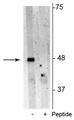
Western blot of Jurkat cell lysate showing specific immunolabeling of the ~48 kDa p62 phosphorylated at Ser28 in the first lane (-). Phosphospecificity is shown in the second lane (+) where immunolabeling is blocked by preadsorption of the phosphopeptide used as antigen, but not by the corresponding non-phosphopeptide (not shown).
Click on image to zoom
SKU: p196-28
Ships: 1-2 business days
Product Details
p62 (Ser28)
p62, also known as sequestosome1 (SQSTM1), is a shuttle protein transporting polyubiquitinated proteins for both proteasomal and lysosomal degradation. p62 is an integral component of inclusions in brains of various neurodegenerative disorders, including Alzheimer disease (AD) neurofibrillary tangles (NFTs) and Lewy bodies in Parkinson disease (Nogalaska et al., 2009). p62 plays an important role in the protection of cells from the toxicity of misfolded proteins by enhancing aggregate formation especially in the later stages (Nakaso et al., 2004). Phosphorylation of Ser-28 has recently been demonstrated to be related to the pathogenesis of Parkinson’s disease.
Antigen Affinity Purified from Pooled Serum
Polyclonal
IgG
ELISA, WB
Rabbit
SQSTM1
48 kDa
Synthetic phospho-peptide corresponding to amino acid residues surrounding Ser28 of human p62, conjugated to keyhole limpet hemocyanin (KLH).
Human
Human
Non-Human Primate
AB_2492197
Storage at -20°C is recommended, as aliquots may be taken without freeze/thawing due to presence of 50% glycerol. Stable for at least 1 year at -20°C.
Liquid
Prepared from pooled rabbit serum by affinity purification via sequential chromatography on phospho and non-phosphopeptide affinity columns.
10 mM HEPES (pH 7.5), 150 mM NaCl, 100 µg per ml BSA and 50% glycerol.
WB: 1:1000
Unconjugated
Specific for endogenous levels of the ~48 kDa p62 protein phosphorylated at Ser28. Immunolabeling is blocked by preadsorption with the phosphopeptide used as antigen, but not by the corresponding non-phosphopeptide.
Phosphorylated
Ser28
Western blots performed on each lot.
For research use only. Not intended for therapeutic or diagnostic use. Use of all products is subject to our terms and conditions, which can be viewed on our website.
After date of receipt, stable for at least 1 year at -20°C.
A170; DMRV; EBI 3 associated protein of 60 kDa; EBI 3 associated protein p60; EBI3 associated protein of 60 kDa; EBI3 associated protein p60; EBI3-associated protein of 60 kDa; EBIAP; FTDALS3; MGC127197; ORCA; OSF-6; Osi; OSIL; Oxidative stress induced like; p60; p62; p62B; Paget disease of bone 3; PDB 3; PDB3; Phosphotyrosine independent ligand for the Lck SH2 domain of 62 kDa; Phosphotyrosine independent ligand for the Lck SH2 domain p62; Phosphotyrosine-independent ligand for the Lck SH2 domain of 62 kDa; PKC-zeta-interacting protein; Protein kinase C-zeta-interacting protein; Sequestosome 1; Sequestosome-1; SQSTM 1; SQSTM_HUMAN; Sqstm1; STAP; STONE14; Ubiquitin binding protein p62; Ubiquitin-binding protein p62; ZIP 3; ZIP; ZIP3
Q13501
UniProt Summary: Molecular adapter required for selective macroautophagy (aggrephagy) by acting as a bridge between polyubiquitinated proteins and autophagosomes (PubMed:15340068, PubMed:15953362, PubMed:16286508, PubMed:17580304, PubMed:20168092, PubMed:22017874, PubMed:22622177, PubMed:24128730, PubMed:28404643, PubMed:29343546, PubMed:29507397, PubMed:31857589, PubMed:33509017, PubMed:34471133, PubMed:34893540, PubMed:35831301, PubMed:37306101, PubMed:37802024). Promotes the recruitment of ubiquitinated cargo proteins to autophagosomes via multiple domains that bridge proteins and organelles in different steps (PubMed:16286508, PubMed:20168092, PubMed:22622177, PubMed:24128730, PubMed:28404643, PubMed:29343546, PubMed:29507397, PubMed:34893540, PubMed:37802024). SQSTM1 first mediates the assembly and removal of ubiquitinated proteins by undergoing liquid-liquid phase separation upon binding to ubiquitinated proteins via its UBA domain, leading to the formation of insoluble cytoplasmic inclusions, known as p62 bodies (PubMed:15911346, PubMed:20168092, PubMed:22017874, PubMed:24128730, PubMed:29343546, PubMed:29507397, PubMed:31857589, PubMed:37802024). SQSTM1 then interacts with ATG8 family proteins on autophagosomes via its LIR motif, leading to p62 body recruitment to autophagosomes, followed by autophagic clearance of ubiquitinated proteins (PubMed:16286508, PubMed:17580304, PubMed:20168092, PubMed:22622177, PubMed:24128730, PubMed:28404643, PubMed:37802024). SQSTM1 is itself degraded along with its ubiquitinated cargos (PubMed:16286508, PubMed:17580304, PubMed:37802024). Also required to recruit ubiquitinated proteins to PML bodies in the nucleus (PubMed:20168092). Also involved in autophagy of peroxisomes (pexophagy) in response to reactive oxygen species (ROS) by acting as a bridge between ubiquitinated PEX5 receptor and autophagosomes (PubMed:26344566). Acts as an activator of the NFE2L2/NRF2 pathway via interaction with KEAP1: interaction inactivates the BCR(KEAP1) complex by sequestering the complex in inclusion bodies, promoting nuclear accumulation of NFE2L2/NRF2 and subsequent expression of cytoprotective genes (PubMed:20452972, PubMed:28380357, PubMed:33393215, PubMed:37306101). Promotes relocalization of 'Lys-63'-linked ubiquitinated STING1 to autophagosomes (PubMed:29496741). Involved in endosome organization by retaining vesicles in the perinuclear cloud: following ubiquitination by RNF26, attracts specific vesicle-associated adapters, forming a molecular bridge that restrains cognate vesicles in the perinuclear region and organizes the endosomal pathway for efficient cargo transport (PubMed:27368102, PubMed:33472082). Sequesters tensin TNS2 into cytoplasmic puncta, promoting TNS2 ubiquitination and proteasomal degradation (PubMed:25101860). May regulate the activation of NFKB1 by TNF, nerve growth factor (NGF) and interleukin-1 (PubMed:10356400, PubMed:10747026, PubMed:11244088, PubMed:12471037, PubMed:16079148, PubMed:19931284). May play a role in titin/TTN downstream signaling in muscle cells (PubMed:15802564). Adapter that mediates the interaction between TRAF6 and CYLD (By similarity). {ECO:0000250|UniProtKB:Q64337, ECO:0000269|PubMed:10356400, ECO:0000269|PubMed:10747026, ECO:0000269|PubMed:11244088, ECO:0000269|PubMed:12471037, ECO:0000269|PubMed:15340068, ECO:0000269|PubMed:15802564, ECO:0000269|PubMed:15911346, ECO:0000269|PubMed:15953362, ECO:0000269|PubMed:16079148, ECO:0000269|PubMed:16286508, ECO:0000269|PubMed:17580304, ECO:0000269|PubMed:19931284, ECO:0000269|PubMed:20168092, ECO:0000269|PubMed:20452972, ECO:0000269|PubMed:22017874, ECO:0000269|PubMed:22622177, ECO:0000269|PubMed:24128730, ECO:0000269|PubMed:25101860, ECO:0000269|PubMed:26344566, ECO:0000269|PubMed:27368102, ECO:0000269|PubMed:28380357, ECO:0000269|PubMed:28404643, ECO:0000269|PubMed:29343546, ECO:0000269|PubMed:29496741, ECO:0000269|PubMed:29507397, ECO:0000269|PubMed:31857589, ECO:0000269|PubMed:33393215, ECO:0000269|PubMed:33472082, ECO:0000269|PubMed:33509017, ECO:0000269|PubMed:34471133, ECO:0000269|PubMed:34893540, ECO:0000269|PubMed:35831301, ECO:0000269|PubMed:37306101, ECO:0000269|PubMed:37802024}.

8878
Blue Ice
- Western Blot Protocol: Download
General References
- Nogalska, A., Terracciano, C., D’Agostino, C., Engel, W.K. and Askanas, V., 2009. p62/SQSTM1 is overexpressed and prominently accumulated in inclusions of sporadic inclusion-body myositis muscle fibers, and can help differentiating it from polymyositis and dermatomyositis. Acta neuropathologica, 118(3), pp.407-413. PMID: 19557423
- Nakaso, K., Yoshimoto, Y., Nakano, T., Takeshima, T., Fukuhara, Y., Yasui, K., Araga, S., Yanagawa, T., Ishii, T. and Nakashima, K., 2004. Transcriptional activation of p62/A170/ZIP during the formation of the aggregates: possible mechanisms and the role in Lewy body formation in Parkinson's disease. Brain research, 1012(1-2), pp.42-51. PMID: 15158159