Our Anti-MEK1/2 (Ser218,222) rabbit polyclonal phosphospecific primary antibody from PhosphoSolutions is produced in-house. It detects mouse and human MEK1/2 (Ser218,222) and is antigen affinity purified from pooled serum. It is great for use in WB.
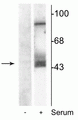
Western Blot of NIH 3T3 cell lysates showing specific immunolabeling of the ~45 kDa MEK 1/2 protein phosphorylated at Ser218 and Ser222. The cells were either serum starved (-) or incubated in the presence of serum (+). Immunolabeling of an additional band at ~95 kDa was also observed.
MEK 1 (MAP Kinase Kinase, also known as MKK) is an integral component of the MAP kinase cascade that regulates cell growth and differentiation (Ahn, 1993; Chong et al., 2003). This pathway also plays a key role in synaptic plasticity in the brain (Adams and Sweatt, 2002). Activated MEK 1 acts as a dual specificity kinase phosphorylating both a threonine and a tyrosine residue on MAP kinase (Kyriakis et al., 1991; Seger et al., 1991; Crews et al., 1992).
Antigen Affinity Purified from Pooled Serum
Polyclonal
IgG
ELISA, WB
Rabbit
MAP2K1/2
45 kDa
Synthetic phospho-peptide corresponding to amino acid residues surrounding Ser218/222 of human MEK1/2, conjugated to keyhole limpet hemocyanin (KLH). Note: The phosphosites in human MEK 1/2 are Ser218 and Ser222; the phosphosites in mouse MEK 1/2 are Ser217 and Ser221.
Human
Human, Mouse
Bovine, Canine, Chicken, Non-Human Primate, Rat, Xenopus, Zebrafish
AB_2492146
Storage at -20°C is recommended, as aliquots may be taken without freeze/thawing due to presence of 50% glycerol. Stable for at least 1 year at -20°C.
Liquid
Prepared from pooled rabbit serum by affinity purification via sequential chromatography on phospho and non-phosphopeptide affinity columns.
10 mM HEPES (pH 7.5), 150 mM NaCl, 100 µg per ml BSA and 50% glycerol.
WB: 1:1000
Unconjugated
Specific for endogenous levels of the ~45 kDa MEK 1/2 protein phosphorylated at Ser218/222. Immunolabeling is blocked by preadsorption with the phosphopeptide used as antigen, but not by the corresponding non-phosphopeptide.
Phosphorylated
Ser218,222
Western blots performed on each lot.
For research use only. Not intended for therapeutic or diagnostic use. Use of all products is subject to our terms and conditions, which can be viewed on our website.
After date of receipt, stable for at least 1 year at -20°C.
Q02750
UniProt Summary: Dual specificity protein kinase which acts as an essential component of the MAP kinase signal transduction pathway. Binding of extracellular ligands such as growth factors, cytokines and hormones to their cell-surface receptors activates RAS and this initiates RAF1 activation. RAF1 then further activates the dual-specificity protein kinases MAP2K1/MEK1 and MAP2K2/MEK2. Both MAP2K1/MEK1 and MAP2K2/MEK2 function specifically in the MAPK/ERK cascade, and catalyze the concomitant phosphorylation of a threonine and a tyrosine residue in a Thr-Glu-Tyr sequence located in the extracellular signal-regulated kinases MAPK3/ERK1 and MAPK1/ERK2, leading to their activation and further transduction of the signal within the MAPK/ERK cascade. Activates BRAF in a KSR1 or KSR2-dependent manner; by binding to KSR1 or KSR2 releases the inhibitory intramolecular interaction between KSR1 or KSR2 protein kinase and N-terminal domains which promotes KSR1 or KSR2-BRAF dimerization and BRAF activation (PubMed:29433126). Depending on the cellular context, this pathway mediates diverse biological functions such as cell growth, adhesion, survival and differentiation, predominantly through the regulation of transcription, metabolism and cytoskeletal rearrangements. One target of the MAPK/ERK cascade is peroxisome proliferator-activated receptor gamma (PPARG), a nuclear receptor that promotes differentiation and apoptosis. MAP2K1/MEK1 has been shown to export PPARG from the nucleus. The MAPK/ERK cascade is also involved in the regulation of endosomal dynamics, including lysosome processing and endosome cycling through the perinuclear recycling compartment (PNRC), as well as in the fragmentation of the Golgi apparatus during mitosis. {ECO:0000269|PubMed:14737111, ECO:0000269|PubMed:17101779, ECO:0000269|PubMed:29433126}.
Adams JP, Sweatt JD (2002) Molecular psychology: Roles for the ERK MAP kinase cascade in memory. Annual Review of Pharmacology and Toxicology 42:135-163. PMID: 10508514
Ahn NG (1993) The MAP kinase cascade. Discovery of a new signal transduction pathway. Molecular andCellular Biochemistry 127-128:201-209. PMID: 23055506
Chong H, Vikis HG, Guan KL (2003) Mechanisms of regulating the Raf kinase family. Cellular Signalling 15:463-469. PMID: 9620804
Crews CM, Alessandrini A, Erikson RL (1992) The primary structure of MEK, a protein kinase that phosphorylates the ERK gene product. Science 258:478-480.PMID: 9620804
Kyriakis JM, Brautigan DL, Ingebritsen TS, Avruch J (1991) pp54 Microtubule-associated protein-2 kinase requires both tyrosine and serine/threonine phosphorylation for activity. Journal of Biological Chemistry 266:10043-10046.PMID: 9620804
Seger R, Ahn NG, Boulton TG, Yancopoulos GD, Panayotatos N, Radziejewska E, Ericsson L, Bratlien RL, Cobb MH, Krebs EG (1991) Microtubule-associated protein 2 kinases, ERK1 and ERK2, undergo autophos-phorylation on both tyrosine and threonine residues:Implications for their mechanism of activation. PNAS USA 88:6142-6146.PMID: 9620804
Bulk Order Anti-MEK1/2 (Ser218,222) Antibody
Related Products
Recently Viewed
Your research is our top priority
Highly-validated antibodies and reagents from our family of brands.