Anti-Hsp70 (Ser153) Antibody
Our Anti-Hsp70 (Ser153) rabbit polyclonal phosphospecific primary antibody from PhosphoSolutions is produced in-house. It detects human Hsp70 (Ser153) and is antigen affinity purified from pooled serum. It is great for use in WB.
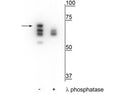
Western blot of T47D cell lysate treated with EGF (1 nM) for 60 minutes showing specific labeling of the ~70 kDa Hsp70 in the first lane (-). Phosphospecificity is shown in the second lane (+) where immunolabeling is eliminated or significantly decreased with lambda phosphatase (λ-Ptase, 1200 units for 30 minutes).
Click on image to zoom
SKU: p1182-153
Ships: 1-2 business days
Product Details
Hsp70 (Ser153)
The Hsp70 family of heat shock proteins are considered stress-induced survival proteins as they are expressed when exposed to factors such as heat, hypoxia, oxidative stress, altered pH or by underlying factors like cancer (Daugaard et al. 2007). Hsp70 proteins are able to bind hydrophobic residues on misfolded proteins, thereby preventing their aggregation and thus serving important roles in protein homeostasis. To date, there have been 8 members of the family identified; the majority of which are found in the cytosol though some have specific function in tissue or an organelle (Murphy, 2013). Hsp70 has also been shown to play a major role in cancer; from tumor grade to prognosis, as well as chemotherapeutic drug resistance (Ciocca et al, 2005). There have been several phospho-serine and threonine sites identified within Hsp70, the role of each one has yet to be determined.
Antigen Affinity Purified from Pooled Serum
Polyclonal
IgG
ELISA, WB
Rabbit
HSPA1A
70 kDa
Synthetic phospho-peptide corresponding to amino acid residues surrounding Thr153 of human HSP, conjugated to keyhole limpet hemocyanin (KLH).
Human
Human
AB_2636998
Storage at -20°C is recommended, as aliquots may be taken without freeze/thawing due to presence of 50% glycerol. Stable for at least 1 year at -20°C.
Liquid
Prepared from pooled rabbit serum by affinity purification via sequential chromatography on phospho and non-phosphopeptide affinity columns.
10 mM HEPES (pH 7.5), 150 mM NaCl, 100 µg per ml BSA and 50% glycerol.
WB: 1:1000
Unconjugated
Specific for the ~70 kDa Hsp70 phosphorylated at Ser153. Immunolabeling of Hsp70 is completely eliminated with λ-phosphatase treatment. Additional bands detected are thought to be other members of the Hsp70 family.
Phosphorylated
Ser153
Western blots performed on each lot.
For research use only. Not intended for therapeutic or diagnostic use. Use of all products is subject to our terms and conditions, which can be viewed on our website.
After date of receipt, stable for at least 1 year at -20°C.
DnaK type molecular chaperone HSP70 1; Epididymis secretory protein Li 103; FLJ54303; FLJ54370; FLJ54392; FLJ54408; FLJ75127; Heat shock 70 kDa protein 1; Heat shock 70 kDa protein 1/2; Heat shock 70 kDa protein 1A; Heat shock 70 kDa protein 1A/1B; Heat shock 70kDa protein 1B; Heat shock induced protein; HEL S 103; HSP70 1; HSP70 1A; HSP70 1B; HSP70 2; HSP70-1; HSP70-1/HSP70-2; HSP70-1A; HSP70.1; HSP70.1/HSP70.2; HSP71_HUMAN; HSP72; HSPA1; HSPA1A; HSPA1B
P0DMV8
UniProt Summary: Molecular chaperone implicated in a wide variety of cellular processes, including protection of the proteome from stress, folding and transport of newly synthesized polypeptides, activation of proteolysis of misfolded proteins and the formation and dissociation of protein complexes. Plays a pivotal role in the protein quality control system, ensuring the correct folding of proteins, the re-folding of misfolded proteins and controlling the targeting of proteins for subsequent degradation. This is achieved through cycles of ATP binding, ATP hydrolysis and ADP release, mediated by co-chaperones. The co-chaperones have been shown to not only regulate different steps of the ATPase cycle, but they also have an individual specificity such that one co-chaperone may promote folding of a substrate while another may promote degradation. The affinity for polypeptides is regulated by its nucleotide bound state. In the ATP-bound form, it has a low affinity for substrate proteins. However, upon hydrolysis of the ATP to ADP, it undergoes a conformational change that increases its affinity for substrate proteins. It goes through repeated cycles of ATP hydrolysis and nucleotide exchange, which permits cycles of substrate binding and release. The co-chaperones are of three types: J-domain co-chaperones such as HSP40s (stimulate ATPase hydrolysis by HSP70), the nucleotide exchange factors (NEF) such as BAG1/2/3 (facilitate conversion of HSP70 from the ADP-bound to the ATP-bound state thereby promoting substrate release), and the TPR domain chaperones such as HOPX and STUB1 (PubMed:24012426, PubMed:24318877, PubMed:26865365). Maintains protein homeostasis during cellular stress through two opposing mechanisms: protein refolding and degradation. Its acetylation/deacetylation state determines whether it functions in protein refolding or protein degradation by controlling the competitive binding of co-chaperones HOPX and STUB1. During the early stress response, the acetylated form binds to HOPX which assists in chaperone-mediated protein refolding, thereafter, it is deacetylated and binds to ubiquitin ligase STUB1 that promotes ubiquitin-mediated protein degradation (PubMed:27708256). Regulates centrosome integrity during mitosis, and is required for the maintenance of a functional mitotic centrosome that supports the assembly of a bipolar mitotic spindle (PubMed:27137183). Enhances STUB1-mediated SMAD3 ubiquitination and degradation and facilitates STUB1-mediated inhibition of TGF-beta signaling (PubMed:24613385). Essential for STUB1-mediated ubiquitination and degradation of FOXP3 in regulatory T-cells (Treg) during inflammation (PubMed:23973223). Required as a co-chaperone for optimal STUB1/CHIP ubiquitination of NFATC3 (By similarity). Negatively regulates heat shock-induced HSF1 transcriptional activity during the attenuation and recovery phase period of the heat shock response (PubMed:9499401). Involved in the clearance of misfolded PRDM1/Blimp-1 proteins. Sequesters them in the cytoplasm and promotes their association with SYNV1/HRD1, leading to proteasomal degradation (PubMed:28842558). {ECO:0000250|UniProtKB:P0DMW0, ECO:0000269|PubMed:22528486, ECO:0000269|PubMed:23973223, ECO:0000269|PubMed:24318877, ECO:0000269|PubMed:24613385, ECO:0000269|PubMed:27137183, ECO:0000269|PubMed:27708256, ECO:0000269|PubMed:28842558, ECO:0000269|PubMed:9499401, ECO:0000303|PubMed:24012426, ECO:0000303|PubMed:26865365}.; (Microbial infection) In case of rotavirus A infection, serves as a post-attachment receptor for the virus to facilitate entry into the cell. {ECO:0000269|PubMed:16537599}.

33033304
Blue Ice
- Western Blot Protocol: Download
General References
- Daugaard M, Rohde M, Jäättelä M (2007) The Heat Shock Protein 70 Family:Highly homologous proteins with overlapping and distinct functions. FEBS Lett, 581: 3702-10. PMID: 17544402
- Ciocca DR, Calderwood SK (2005) Heat Shock Proteins in Cancer: Diagnostic, Prognostic, Predictive, and Treatment Implications. Cell Stress Chaperones, 10: 86-103. PMID: 16038406
- Murphy ME (2013) The Hsp70 Family and Cancer. Carcinogenesis, 34:1181-8. PMID: 23563090