Anti-GABAB Receptor (Ser923), R1-Subunit Antibody
Our Anti-GABAB Receptor (Ser923), R1-Subunit rabbit polyclonal phosphospecific primary antibody from PhosphoSolutions is produced in-house. It detects mouse and rat GABAB Receptor (Ser923), R1-Subunit and is antigen affinity purified from pooled serum. It is great for use in WB.
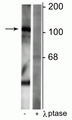
Western blot of rat synaptic membrane lysate showing specific immunolabeling of the ~102 kDa GABAB R1 protein phosphorylated at Ser923 in the first lane (-). Phosphospecificity is shown in the second lane (+) where immunolabeling is completely eliminated by blot treatment with lambda phosphatase (λ-Ptase, 1200 units for 30 min).
Click on image to zoom
SKU: p1148-923
Ships: 1-2 business days
Product Details
GABAB Receptor (Ser923), R1-Subunit
Gamma-aminobutyric acid (GABA) is the primary inhibitory neurotransmitter in the central nervous system. There are two major classes of GABA receptors: the GABA-A and the GABA-B subtype of receptors. GABA-B receptors are heterodimeric G protein-coupled receptors that mediate slow synaptic inhibition in the central nervous system. Phosphorylation enhances GABA-B receptor effector coupling (Couve et al., 2004). Phosphorylation of Ser-923 is thought to be important in the regulation of GABA-B receptor function.
Antigen Affinity Purified from Pooled Serum
Polyclonal
IgG
ELISA, WB
Rabbit
GABBR1
102 kDa
Synthetic phospho-peptide corresponding to amino acid residues surrounding Ser923 of the R1-subunit of rat GABAB receptor, conjugated to keyhole limpet hemocyanin (KLH).
Rat
Mouse, Rat
Bovine, Human, Non-Human Primate
AB_2492118
Storage at -20°C is recommended, as aliquots may be taken without freeze/thawing due to presence of 50% glycerol. Stable for at least 1 year at -20°C.
Liquid
Prepared from pooled rabbit serum by affinity purification via sequential chromatography on phospho and non-phosphopeptide affinity columns.
10 mM HEPES (pH 7.5), 150 mM NaCl, 100 µg per ml BSA and 50% glycerol.
WB: 1:1000
WB Brain: 1:1000
WB Brain: 1:1000
Unconjugated
Specific for endogenous levels of the ~102 kDa GABAB R1 phosphorylated at Ser923. Immunolabeling is completely eliminated by treatment with λ-phosphatase.
Phosphorylated
Ser923
Western blots performed on each lot.
For research use only. Not intended for therapeutic or diagnostic use. Use of all products is subject to our terms and conditions, which can be viewed on our website.
After date of receipt, stable for at least 1 year at -20°C.
dJ271M21.1.1; dJ271M21.1.2; GABA B receptor 1; FLJ92613; GABA-B receptor 1; GABA-B-R1; GABA-BR1; GABAB R1; GABAB subunit 1c; GABABR1; GABBR1 3; GABBR1; GABR1_HUMAN; Gamma aminobutyric acid (GABA B receptor 1; Gamma-aminobutyric acid type B receptor subunit 1; Gb1; GPRC3A; Seven transmembrane helix receptor; Gamma aminobutyric acid
Q9Z0U4
UniProt Summary: Component of a heterodimeric G-protein coupled receptor for GABA, formed by GABBR1 and GABBR2 (PubMed:15617512, PubMed:18165688, PubMed:22660477, PubMed:24305054, PubMed:36103875, PubMed:9872316, PubMed:9872744). Within the heterodimeric GABA receptor, only GABBR1 seems to bind agonists, while GABBR2 mediates coupling to G proteins (PubMed:18165688). Ligand binding causes a conformation change that triggers signaling via guanine nucleotide-binding proteins (G proteins) and modulates the activity of down-stream effectors, such as adenylate cyclase (PubMed:10075644, PubMed:10773016, PubMed:10906333, PubMed:24305054, PubMed:9872744). Signaling inhibits adenylate cyclase, stimulates phospholipase A2, activates potassium channels, inactivates voltage-dependent calcium-channels and modulates inositol phospholipid hydrolysis (PubMed:10075644). Calcium is required for high affinity binding to GABA (By similarity). Plays a critical role in the fine-tuning of inhibitory synaptic transmission (PubMed:9844003). Pre-synaptic GABA receptor inhibits neurotransmitter release by down-regulating high-voltage activated calcium channels, whereas postsynaptic GABA receptor decreases neuronal excitability by activating a prominent inwardly rectifying potassium (Kir) conductance that underlies the late inhibitory postsynaptic potentials (PubMed:10075644, PubMed:22660477, PubMed:9844003, PubMed:9872316, PubMed:9872744). Not only implicated in synaptic inhibition but also in hippocampal long-term potentiation, slow wave sleep, muscle relaxation and antinociception (Probable). Activated by (-)-baclofen, cgp27492 and blocked by phaclofen (PubMed:24305054, PubMed:9844003, PubMed:9872316). {ECO:0000250|UniProtKB:Q9Z0U4, ECO:0000269|PubMed:10075644, ECO:0000269|PubMed:10773016, ECO:0000269|PubMed:10906333, ECO:0000269|PubMed:15617512, ECO:0000269|PubMed:18165688, ECO:0000269|PubMed:22660477, ECO:0000269|PubMed:24305054, ECO:0000269|PubMed:36103875, ECO:0000269|PubMed:9844003, ECO:0000269|PubMed:9872316, ECO:0000269|PubMed:9872744, ECO:0000305}.; Isoform 1E may regulate the formation of functional GABBR1/GABBR2 heterodimers by competing for GABBR2 binding. This could explain the observation that certain small molecule ligands exhibit differential affinity for central versus peripheral sites.

81657
Blue Ice
- Western Blot Protocol: Download
General References
- Couve A, Calver AR, Fairfax B, Moss SJ, Pangalos MN (2004) Unraveling the unusual signaling properties of the GABA(B) receptor. Biochem. Pharmacol. Oct 15;68(8):1527-36. PMID: 15451395