Anti-EGFR (N-terminal region) Antibody
Our EGFR (N-terminal region) rabbit polyclonal primary antibody from PhosphoSolutions is produced in-house. It detects human, mouse, and rat EGFR (N-terminal region) and is antigen affinity purified. It is great for use in WB, ICC.
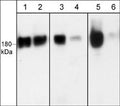
Western blot image of human A431 cells treated with Calyculin A (100 nM) for 30 min. Blot lanes were untreated (lanes 1, 3, & 5) or treated with lambda phosphatase (lanes 2, 4, & 6) then were probed with anti-EGFR (a.a. 961-972) (lanes 1 & 2), anti-EGFR (Ser-967) (lanes 3 & 4), and anti-EGFR (Ser-1142) (lanes 5 & 6).
Click on image to zoom

SKU: EP1871
Ships: 1-2 business days
Product Details
EGFR (N-terminal region)
The epidermal growth factor receptor (EGFR) is a transmembrane glycoprotein with an extracellular ligand-binding domain and a cytoplasmic domain with intrinsic tyrosine kinase activity. The cytoplasmic domain has a C-terminal region with multiple autophosphorylation sites (Tyr-992, 1068, 1086, 1148, and 1173). These sites are important for downstream signaling and rapid internalization. In addition, EGFR activation leads to c-Src mediated phosphorylation of Tyr-845 and Tyr-1101. The former site is required for mitogenic responses to EGFR activation, while the latter may be an SH2 binding site. Phosphorylation of EGFR on serine and threonine residues is thought to represent a mechanism for regulation of receptor kinase activity and internalization. These sites include a PKC site (Thr-654), CAMKII sites (Ser-1046, 1047, 1057, and 1142), and constitutively phosphorylated sites (Ser-967 and Ser-1002). Thus, the regulation of EGFR activity involves a complex series of phosphorylation events at multiple sites throughout the intracellular portion of the receptor.
Antigen Affinity Purified
Polyclonal
IgG
ELISA, ICC, WB
Rabbit
EGFR
180
EGFR synthetic peptide (coupled to KLH) corresponding to amino acid residues from the N-terminal region of human EGFR (ErbB-1). This human EGFR sequence has high homology to rat and mouse EGFR, and low homology to other ErbB family members.
Human
Human, Mouse, Rat
Storage at -20°C is recommended, as aliquots may be taken without freeze/thawing due to presence of 50% glycerol. Stable for at least 1 year at -20°C.
Liquid
PBS + 1 mg/ml BSA, 0.05% NaN3 and 50% glycerol
WB: 1:1000
ICC: 1:200
ICC: 1:200
Unconjugated
The antibody detects a 180 kDa* protein on SDS-PAGE immunoblots of human A431 cells.
Western blots performed on each lot.
For research use only. Not intended for therapeutic or diagnostic use. Use of all products is subject to our terms and conditions, which can be viewed on our website.
United States
After date of receipt, stable for at least 1 year at -20°C.
ERBB; EGF; HER1; NISBD2; PIG61; mENA; epidermal growth factor receptor; cell growth inhibiting protein 40; cell proliferation-inducing protein 61; erb-b2 receptor tyrosine kinase 1; proto-oncogene c-ErbB-1; receptor tyrosine-protein kinase erbB-1; Epidermal
P00533
UniProt Summary: Receptor tyrosine kinase binding ligands of the EGF family and activating several signaling cascades to convert extracellular cues into appropriate cellular responses. Known ligands include EGF, TGFA/TGF-alpha, AREG, epigen/EPGN, BTC/betacellulin, epiregulin/EREG and HBEGF/heparin-binding EGF. Ligand binding triggers receptor homo- and/or heterodimerization and autophosphorylation on key cytoplasmic residues. The phosphorylated receptor recruits adapter proteins like GRB2 which in turn activates complex downstream signaling cascades. Activates at least 4 major downstream signaling cascades including the RAS-RAF-MEK-ERK, PI3 kinase-AKT, PLCgamma-PKC and STATs modules. May also activate the NF-kappa-B signaling cascade. Also directly phosphorylates other proteins like RGS16, activating its GTPase activity and probably coupling the EGF receptor signaling to the G protein-coupled receptor signaling. Also phosphorylates MUC1 and increases its interaction with SRC and CTNNB1/beta-catenin. Positively regulates cell migration via interaction with CCDC88A/GIV which retains EGFR at the cell membrane following ligand stimulation, promoting EGFR signaling which triggers cell migration. Plays a role in enhancing learning and memory performance. Plays a role in mammalian pain signaling (long-lasting hypersensitivity).
1956
Blue Ice