Anti-Dynamin Antibody
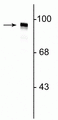
Our Anti-Dynamin rabbit polyclonal primary antibody from PhosphoSolutions is produced in-house. It detects human, mouse, and rat Dynamin and is antigen affinity purified from pooled serum. It is great for use in WB.
SKU: 480-DYN
Ships: 1-2 business days
Product Details
Dynamin
Dynamin is a member of a group of nerve terminal proteins called dephosphins that regulate synaptic vesicle endocytosis (Cousin et al., 2001; Graham et al., 2002; Tsuboi et al., 2002). There are 3 known isoforms of Dynamin, each having several splice variants as well. Dynamin I is expressed only in neurons whereas Dynamin II is ubiquitously expressed and Dynamin III is found primarily in the testes. Dynamin 1 is phosphorylated by PKC and dephosphorylated by calcineurin.
Antigen Affinity Purified from Pooled Serum
Polyclonal
IgG
ELISA, WB
Rabbit
DNM1
95 kDa
Synthetic peptide corresponding to amino acid residues from the N-terminal region of human dynamin, conjugated to keyhole limpet hemocyanin (KLH).
Human
Human, Mouse, Rat
Bovine, Chicken, Non-Human Primate
AB_2492081
Storage at -20°C is recommended, as aliquots may be taken without freeze/thawing due to presence of 50% glycerol. Stable for at least 1 year at -20°C.
Liquid
Prepared from rabbit serum by affinity purification via chromatography on an affinity column made with the N-terminal peptide used as antigen.
10 mM HEPES (pH 7.5), 150 mM NaCl, 100 µg per ml BSA and 50% glycerol.
WB: 1:1000
WB Brain: 1:1000
WB Brain: 1:1000
Unconjugated
Specific for endogenous levels of the ~95 kDa dynamin protein.
Western blots performed on each lot.
For research use only. Not intended for therapeutic or diagnostic use. Use of all products is subject to our terms and conditions, which can be viewed on our website.
After date of receipt, stable for at least 1 year at -20°C.
B dynamin; D100; DNM 1; DNM; DNM1; DYN1_HUMAN; Dynamin; Dynamin-1; Dynamin1
Q05193
UniProt Summary: Catalyzes the hydrolysis of GTP and utilizes this energy to mediate vesicle scission and participates in many forms of endocytosis, such as clathrin-mediated endocytosis or synaptic vesicle endocytosis as well as rapid endocytosis (RE) (PubMed:15703209, PubMed:20428113, PubMed:29668686, PubMed:8101525, PubMed:8910402, PubMed:9362482). Associates to the membrane, through lipid binding, and self-assembles into rings and stacks of interconnected rings through oligomerization to form a helical polymer around the vesicle membrane leading to constriction of invaginated coated pits around their necks (PubMed:30069048, PubMed:7877694, PubMed:9922133). Self-assembly of the helical polymer induces membrane tubules narrowing until the polymer reaches a length sufficient to trigger GTP hydrolysis (PubMed:19084269). Depending on the curvature imposed on the tubules, membrane detachment from the helical polymer upon GTP hydrolysis can cause spontaneous hemifission followed by complete fission (PubMed:19084269). May play a role in regulating early stages of clathrin-mediated endocytosis in non-neuronal cells through its activation by dephosphorylation via the signaling downstream of EGFR (PubMed:29668686). Controls vesicle size at a step before fission, during formation of membrane pits, at hippocampal synapses (By similarity). Controls plastic adaptation of the synaptic vesicle recycling machinery to high levels of activity (By similarity). Mediates rapid endocytosis (RE), a Ca(2+)-dependent and clathrin- and K(+)-independent process in chromaffin cells (By similarity). Microtubule-associated force-producing protein involved in producing microtubule bundles and able to bind and hydrolyze GTP (By similarity). Through its interaction with DNAJC6, acts during the early steps of clathrin-coated vesicle (CCV) formation (PubMed:12791276). {ECO:0000250|UniProtKB:P39053, ECO:0000250|UniProtKB:Q08DF4, ECO:0000269|PubMed:12791276, ECO:0000269|PubMed:15703209, ECO:0000269|PubMed:19084269, ECO:0000269|PubMed:20428113, ECO:0000269|PubMed:29668686, ECO:0000269|PubMed:30069048, ECO:0000269|PubMed:7877694, ECO:0000269|PubMed:8101525, ECO:0000269|PubMed:8910402, ECO:0000269|PubMed:9362482, ECO:0000269|PubMed:9922133}.

1759
Blue Ice
- Western Blot Protocol: Download
General References
- Cousin, M.A., Tan, T.C. and Robinson, P.J., 2001. Protein phosphorylation is required for endocytosis in nerve terminals: potential role for the dephosphins dynamin I and synaptojanin, but not AP180 or amphiphysin. Journal of Neurochemistry, 76(1), pp.105-116. PMID: 11145983
- Graham, M.E., O'Callaghan, D.W., McMahon, H.T. and Burgoyne, R.D., 2002. Dynamin-dependent and dynamin-independent processes contribute to the regulation of single vesicle release kinetics and quantal size. Proceedings of the National Academy of Sciences, 99(10), pp.7124-7129. PMID: 11997474
- Tan, T.C., Valova, V.A., Malladi, C.S., Graham, M.E., Berven, L.A., Jupp, O.J., Hansra, G., McClure, S.J., Sarcevic, B., Boadle, R.A. and Larsen, M.R., 2003. Cdk5 is essential for synaptic vesicle endocytosis. Nature Cell Biology, 5(8), p.701. PMID: 12855954
- Tsuboi, T., Terakawa, S., Scalettar, B.A., Fantus, C., Roder, J. and Jeromin, A., 2002. Sweeping model of dynamin activity - Visualization of coupling between exocytosis and endocytosis under an evanescent wave microscope with green fluorescent proteins. Journal of Biological Chemistry, 277(18), pp.15957-15961. PMID: 11856729