
Anti-DISC1 (C-terminus) Antibody
Our DISC1 (C-terminus) rabbit polyclonal primary antibody from PhosphoSolutions is produced in-house. It detects rat, mouse DISC1 (C-terminus) and is antigen affinity purified. It is great for use in WB.
SKU: DP3021
Ships: 1-2 business days
Product Details
DISC1 (C-terminus)
Disrupted in schizophrenia 1 (DISC1) is a multifunctional scaffold protein that has important roles in neurodevelopment. DISC1 is expressed in both neuronal progenitor cells and postmitotic neurons in the developing cerebral cortex. DISC1 can interact with both centrosomal proteins and dynein-motor related proteins. In addition, DISC1 interacts with and inhibits the kinase GSK-3β to enable Wnt activation of β-catenin–mediated gene transcription and neuron proliferation. These functions of DISC1 may be regulated by post-translational modification. PKA and CDK5 can phosphorylate Ser-710, and a non-phosphorylatable Ser-710 mutant shows decreased interaction with the centrosomal proteins, BBS1 and BBS4, while a constituitively phosphorylated Ser-710 mutant shows increased interaction with these proteins. During neuronal progenitor cell proliferation, DISC1 phosphorylation at Ser-710 is low and the interaction with GSK-3β is enhanced. By contrast, DISC1 phosphorylation is increased, association with GSK-3β is decreased, and interaction with BBS1 is enhanced during postmitotic neuron migration.
Antigen Affinity Purified
Polyclonal
IgG
ELISA, WB
Rabbit
DISC1
100
DISC1 synthetic peptide (coupled to KLH) containing amino acid residues from the C-terminus of mouse DISC1. This peptide sequence is well conserved in rat DISC1, but has 7 amino acid differences with the conserved site in human DISC1.
Mouse
Mouse, Rat
Storage at -20°C is recommended, as aliquots may be taken without freeze/thawing due to presence of 50% glycerol. Stable for at least 1 year at -20°C.
Liquid
PBS + 1 mg/ml BSA, 0.05% NaN3 and 50% glycerol
WB: 1:500
Unconjugated
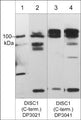
The antibody detects a 100 kDa* protein corresponding to the molecular mass of DISC1 on SDS-PAGE immunoblots of mouse brain and rat PC12 cells.
Western blots performed on each lot.
For research use only. Not intended for therapeutic or diagnostic use. Use of all products is subject to our terms and conditions, which can be viewed on our website.
United States
After date of receipt, stable for at least 1 year at -20°C.
disrupted in schizophrenia 1 homolog; disrupted schizophrenia
Q811T9
UniProt Summary: Involved in the regulation of multiple aspects of embryonic and adult neurogenesis. Required for neural progenitor proliferation in the ventrical/subventrical zone during embryonic brain development and in the adult dentate gyrus of the hippocampus. Participates in the Wnt-mediated neural progenitor proliferation as a positive regulator by modulating GSK3B activity and CTNNB1 abundance. Plays a role as a modulator of the AKT-mTOR signaling pathway controlling the tempo of the process of newborn neurons integration during adult neurogenesis, including neuron positioning, dendritic development and synapse formation. Inhibits the activation of AKT-mTOR signaling upon interaction with CCDC88A. Regulates the migration of early-born granule cell precursors toward the dentate gyrus during the hippocampal development. Inhibits ATF4 transcription factor activity in neurons by disrupting ATF4 dimerization and DNA-binding. Plays a role, together with PCNT, in the microtubule network formation.
244667
Blue Ice

