
Anti-Che-1 (AATF) (Ser477) Antibody
Our Anti-Che-1 (AATF) (Ser477) rabbit polyclonal phosphospecific primary antibody from PhosphoSolutions is produced in-house. It detects human Che-1 (AATF) (Ser477) and is antigen affinity purified from pooled serum. It is great for use in WB.
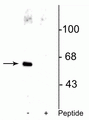
Western blot of HeLa cell lysate showing specific immunolabeling of the ~66 kDa Che-1 protein phosphorylated at Ser477 in the first lane (-). Phosphospecificity is shown in the second lane (+) where immunolabeling is blocked by preadsorption of the phosphopeptide used as the antigen, but not by the corresponding non-phosphopeptide (not shown).
Click on image to zoom

SKU: p142-477
Ships: 1-2 business days
Product Details
Che-1 (AATF) (Ser477)
Che-1, also known as AATF (apoptosis-antagonizing transcription factor), is a RNA polymerase II-binding protein involved in regulating the transcription factor E2F and promoting cell cycle progression (Burgdorf et al., 2004). It has been suggested that Che-1 may act as a neuroprotective factor against Abeta-induced apoptosis by suppressing the production of reactive oxidative species (Xie et al., 2004). The checkpoint kinase Chk2 has been shown to phosphorylate Che-1 at Ser-477 contributing to the maintenance of the G2/M checkpoint induced by DNA damage (Bruno et al., 2006).
Antigen Affinity Purified from Pooled Serum
Polyclonal
IgG
ELISA, WB
Rabbit
AATF
66 kDa
Synthetic phospho-peptide corresponding to amino acid residues surrounding Ser477 of human Che-1, conjugated to keyhole limpet hemocyanin (KLH).
Human
Human
Bovine, Canine, Mouse, Non-Human Primate, Rat, Sheep, Xenopus
AB_2492057
Storage at -20°C is recommended, as aliquots may be taken without freeze/thawing due to presence of 50% glycerol. Stable for at least 1 year at -20°C.
Liquid
Prepared from pooled rabbit serum by affinity purification via sequential chromatography on phospho and non-phosphopeptide affinity columns.
10 mM HEPES (pH 7.5), 150 mM NaCl, 100 µg per ml BSA and 50% glycerol.
WB: 1:1000
Unconjugated
Specific for endogenous levels of the ~66 kDa Che-1 protein phosphorylated at Ser477. Immunolabeling is blocked by preadsorption with the phosphopeptide used as antigen, but not by the corresponding non-phosphopeptide.
Phosphorylated
Ser477
Western blots performed on each lot.
For research use only. Not intended for therapeutic or diagnostic use. Use of all products is subject to our terms and conditions, which can be viewed on our website.
After date of receipt, stable for at least 1 year at -20°C.
AATF; AATF_HUMAN; Apoptosis antagonizing transcription factor; Apoptosis-antagonizing transcription factor; BFR2; CHE 1; CHE1; DED; Protein AATF; Rb binding protein Che 1; Rb-binding protein Che-1
Q9NY61
UniProt Summary: Part of the small subunit (SSU) processome, first precursor of the small eukaryotic ribosomal subunit. During the assembly of the SSU processome in the nucleolus, many ribosome biogenesis factors, an RNA chaperone and ribosomal proteins associate with the nascent pre-rRNA and work in concert to generate RNA folding, modifications, rearrangements and cleavage as well as targeted degradation of pre-ribosomal RNA by the RNA exosome (PubMed:34516797). May function as a general inhibitor of the histone deacetylase HDAC1. Binding to the pocket region of RB1 may displace HDAC1 from RB1/E2F complexes, leading to activation of E2F target genes and cell cycle progression. Conversely, displacement of HDAC1 from SP1 bound to the CDKN1A promoter leads to increased expression of this CDK inhibitor and blocks cell cycle progression. Also antagonizes PAWR mediated induction of aberrant amyloid peptide production in Alzheimer disease (presenile and senile dementia), although the molecular basis for this phenomenon has not been described to date. {ECO:0000269|PubMed:12450794, ECO:0000269|PubMed:12847090, ECO:0000269|PubMed:14627703, ECO:0000269|PubMed:15207272, ECO:0000269|PubMed:34516797}.
26574
Blue Ice
- Western Blot Protocol: Download

