
Anti-Cdc42 Antibody (M430)
Our Cdc42 mouse monoclonal primary antibody from PhosphoSolutions is produced in-house. It detects human, mouse, and rat Cdc42 and is antigen affinity purified. It is great for use in WB, ICC.
Immunocytochemical labeling in paraformaldehyde fixed and NP-40 permeabilized rat A7r5 cells. The cells were labeled with mouse monoclonal Anti-Cdc42 (CM4301) in the absence (Left) or presence of full length Cdc42 recombinant protein (Right), then the antibody was detected using Goat anti-Mouse secondary antibody conjugated to DyLight® 594.
Click on image to zoom

SKU: CM4301
Ships: 1-2 business days
Product Details
Cdc42
Cdc42 proteins are Rho GTPase family members, which act as molecular switches in regulating a variety of biological response pathways including cell motility, cell-cycle progression, gene transcription, and cell transformation. Cdc42 GTPases regulate molecular events by cycling from the inactive GDP-bound state to active GTP-bound forms. The ratio of GDP versus GTP, which is bound to the GTPase, is determined by the opposing effects of guanine nucleotide exchange factors and GTPase activating proteins. Active (GTP-bound) Cdc42 binds to the p21-binding domain of p21-activated protein kinase 1 (PAK1) to regulate downstream signaling cascades.
Antigen Affinity Purified
Monoclonal
M430
IgM
ELISA, ICC, WB
Mouse
CDC42
21
Clone (M430) was generated from a rat recombinant Cdc42 protein. This sequence is highly conserved in human and mouse Cdc42.
Rat
Human, Mouse, Rat
Storage at -20°C is recommended, as aliquots may be taken without freeze/thawing due to presence of 50% glycerol. Stable for at least 1 year at -20°C.
Liquid
PBS + 1 mg/ml BSA, 0.05% NaN3 and 50% glycerol
WB: 1:500
ICC: 1:200
ICC: 1:200
Unconjugated
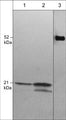
The antibody detects a 21 kDa* protein in human Jurkat cells, rat A7r5 cells, and mouse brain. The antibody also detects recombinant full length rat Cdc42 fusion protein, but does not recognize a full length human RhoA GST fusion protein.
Western blots performed on each lot.
For research use only. Not intended for therapeutic or diagnostic use. Use of all products is subject to our terms and conditions, which can be viewed on our website.
United States
After date of receipt, stable for at least 1 year at -20°C.
cell division control protein 42 homolog; CDC-42; cell division cycle 42 homolog; G25K
Q8CFN2
UniProt Summary: Plasma membrane-associated small GTPase which cycles between an active GTP-bound and an inactive GDP-bound state. In active state binds to a variety of effector proteins to regulate cellular responses. Involved in epithelial cell polarization processes. Regulates the bipolar attachment of spindle microtubules to kinetochores before chromosome congression in metaphase. Regulates cell migration. In neurons, plays a role in the extension and maintenance of the formation of filopodia, thin and actin-rich surface projections. Required for DOCK10-mediated spine formation in Purkinje cells and hippocampal neurons. In podocytes, facilitates filopodia and podosomes formation upon DOCK11-activation. Upon activation by CaMKII, modulates dendritic spine structural plasticity by relaying CaMKII transient activation to synapse-specific, long-term signaling. Also plays a role in phagocytosis through organization of the F-actin cytoskeleton associated with forming phagocytic cups. Upon activation by PLEKHG4B, involved in actin cytoskeletal remodeling during epithelial cell-cell junction formation.
64465
Blue Ice

