Anti-CD47 (Extracellular region) Antibody (M054)
Our CD47 (Extracellular region) Antibody mouse monoclonal primary antibody from PhosphoSolutions is produced in-house. It detects human CD47 (Extracellular region) Antibody and is Protein G purified. It is great for use in WB(Nat), ICC, IP.
SKU: CM0541
Ships: 1-2 business days
Product Details
CD47 (Extracellular region) Antibody
CD47 is a five-pass transmembrane protein expressed on all normal cells, as well as in cancer cells. CD47 is used by macrophages to distinguish between "self" and "non-self" cells. SIRPα expressed on myeloid cells including macrophages, and neuronal cells in the central nervous system, can bind CD47. SIRPα cytoplasmic tail can inhibit macrophage phagocytosis towards CD47-expressing cells. Thus, the CD47/SIRPα pathway serves as an innate immune checkpoint. Additionally, CD47 was reported to modulate lymphocyte cell activation and proliferation. CD47 is over-expressed in many types of cancer, and the expression level of CD47 on cancer cells is negatively associated with cancer survival. Monoclonal antibody therapies that can block CD47-SIRPα interaction are being actively pursued for clinical applications. In addition to SIRPα, CD47 interacts with thrombospondin-1, VEGFR2, FAS, and certain integrins in different contexts, and influences their downstream signaling.
Protein G Purified
Monoclonal
M054
IgG1
ELISA, ICC, IP, WB
Mouse
CD47
45-55
Clone (M054) was generated from a recombinant protein that included the extracellular region of human CD47 protein.
Human
Human
Storage at -20°C is recommended, as aliquots may be taken without freeze/thawing due to presence of 50% glycerol. Stable for at least 1 year at -20°C.
Liquid
PBS + 1 mg/ml BSA, 0.05% NaN3 and 50% glycerol
WB: 1:500
ICC: 1:200
IP: 1:100
ICC: 1:200
IP: 1:100
Unconjugated
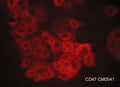
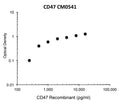
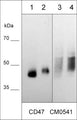
Clone M054 mouse monoclonal antibody detects native human CD47, as well as aldehyde-fixed CD47. The antibody works for staining in immunocytochemistry, capture and detection in ELISA, native immunoprecipitation and western blot. The antibody detects a 45 to 55 kDa band in native western blots of A431, BEAS-2B, MCF7, NCI-H446, NCI-H28, and NCI-H2052 cell lines.
Western blots performed on each lot.
For research use only. Not intended for therapeutic or diagnostic use. Use of all products is subject to our terms and conditions, which can be viewed on our website.
United States
After date of receipt, stable for at least 1 year at -20°C.
IAP; Antigenic surface determinant protein OA3; OA3; leukocyte surface antigen CD47; CD47 glycoprotein; Rh-related antigen; antigen identified by monoclonal 1D8; integrin associated protein; integrin-associated signal transducer; Integrin-associated protein; MER6
Q08722
UniProt Summary: Adhesive protein that mediates cell-to-cell interactions. Acts as a receptor for thrombospondin THBS1 and as modulator of integrin signaling through the activation of heterotrimeric G proteins. Involved in signal transduction, cardiovascular homeostasis, inflammation, apoptosis, angiogenesis, cellular self-renewal, and immunoregulation. Plays a role in modulating pulmonary endothelin EDN1 signaling. Modulates nitrous oxide (NO) signaling, in response to THBS1, hence playing a role as a pressor agent, supporting blood pressure. Plays an important role in memory formation and synaptic plasticity in the hippocampus. Receptor for SIRPA, binding to which prevents maturation of immature dendritic cells and inhibits cytokine production by mature dendritic cells. Interaction with SIRPG mediates cell-cell adhesion, enhances superantigen-dependent T-cell-mediated proliferation and costimulates T-cell activation. Positively modulates FAS-dependent apoptosis in T-cells, perhaps by enhancing FAS clustering. Plays a role in suppressing angiogenesis and may be involved in metabolic dysregulation during normal aging. In response to THBS1, negatively modulates wound healing. Inhibits stem cell self-renewal, in response to THBS1, probably by regulation of the stem cell transcription factors POU5F1/OCT4, SOX2, MYC/c-Myc and KLF4. May play a role in membrane transport and/or integrin dependent signal transduction. May prevent premature elimination of red blood cells.
961
Blue Ice