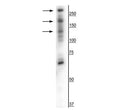
Anti-CaSR Antibody
Our Anti-CaSR rabbit polyclonal primary antibody from PhosphoSolutions is produced in-house. It detects human, mouse, and rat CaSR and is antigen affinity purified from pooled serum. It is great for use in WB.
SKU: 305-CaSR
Ships: 1-2 business days
Product Details
CaSR
Calcium sensing receptor, CaSR, is a unique G protein-coupled receptor activated by extracellular Ca2+, Mg2+, Sr2+, Mn2+, Ba2+, Ni2+, Al2+, Gd3+, amino acids, polyamines, pH and ionic strength (Quinn, S.J. et al., 1998). CaSR is a cell surface dimer located in the caveolin-rich plasma membrane domains (Kifor, O., et al., 1998). CaSR tightly regulates extracellular calcium levels to avoid hyper/hypo-calcemia through complex interactions with PTH, calcitonin, and vitamin D by balancing their effects on the parathyroid glands, bone, kidney, and intestine (Díaz-Soto, G. et al., 2016). Additionally, CaSR has been identified in the nervous system and recent studies suggest CaSR as a direct target of reducing Aβ42 secretion that may contribute to Alzheimer’s Disease (Armato, U., et al., 2013). Recent studies have shown CaSR negatively impacts the formation and progression of neuroblastomas by calcium exposure leading NB cells overexpressing CaSR to undergo apoptosis by means of activating ERK1/2 (Casalà, C., et al., 2013).
Antigen Affinity Purified from Pooled Serum
Polyclonal
IgG
ELISA, WB
Rabbit
CASR
130/260 kDa
Synthetic peptide from the N-terminus region of rat calcium sensing receptor, conjugated to keyhole limpet hemocyanin (KLH).
Rat
Human, Mouse, Rat
AB_2888632
Storage at -20°C is recommended, as aliquots may be taken without freeze/thawing due to presence of 50% glycerol. Stable for at least 1 year at -20°C.
Liquid
Prepared from pooled rabbit serum by affinity purification on a column made with the N-terminal peptide used as antigen.
10 mM HEPES (pH 7.5), 150 mM NaCl, 100 µg per ml BSA and 50% glycerol.
WB: 1:1000
Unconjugated
Specific for endogenous levels of the ~130-260 kDa CaSR protein.
Western blots performed on each lot.
For research use only. Not intended for therapeutic or diagnostic use. Use of all products is subject to our terms and conditions, which can be viewed on our website.
After date of receipt, stable for at least 1 year at -20°C.
Ca sensing receptor; Ca2+ sensing receptor 1; Ca2+ sensing receptor; Calcium sensing receptor; CAR; CaSR; CASR_HUMAN; Extracellular calcium sensing receptor; Extracellular calcium sensing receptor [Precursor; Extracellular calcium-sensing receptor; FHH; FIH; GPRC2A; HHC; HHC1; Hypocalciuric hypercalcemia 1; Hypocalciuric hypercalcemia 1 severe neonatal hyperparathyroidism; MGC138441; NSHPT; Parathyroid Ca(2+ sensing receptor 1; Parathyroid Cell calcium sensing receptor; Parathyroid Cell calcium-sensing receptor; PCAR 1; PCaR1; Extracellular calcium sensing receptor [Precursor]; Parathyroid Ca(2+) sensing receptor 1
P48442
UniProt Summary: G-protein-coupled receptor that senses changes in the extracellular concentration of calcium ions and plays a key role in maintaining calcium homeostasis (PubMed:17555508, PubMed:19789209, PubMed:21566075, PubMed:22114145, PubMed:22789683, PubMed:23966241, PubMed:25104082, PubMed:25292184, PubMed:25766501, PubMed:26386835, PubMed:32817431, PubMed:33603117, PubMed:34194040, PubMed:34467854, PubMed:7759551, PubMed:8636323, PubMed:8702647, PubMed:8878438). Senses fluctuations in the circulating calcium concentration: activated by elevated circulating calcium, leading to decreased parathyroid hormone (PTH) secretion in parathyroid glands (By similarity). In kidneys, acts as a key regulator of renal tubular calcium resorption (By similarity). Ligand binding causes a conformation change that triggers signaling via guanine nucleotide-binding proteins (G-proteins) and modulates the activity of downstream effectors (PubMed:38632411). CASR is coupled with different G(q)/G(11), G(i)/G(o)- or G(s)-classes of G-proteins depending on the context (PubMed:38632411). In the parathyroid and kidney, CASR signals through G(q)/G(11) and G(i)/G(o) G-proteins: G(q)/G(11) coupling activates phospholipase C-beta, releasing diacylglycerol (DAG) and inositol 1,4,5-trisphosphate (IP3) second messengers, while G(i)/G(o) coupling mediates inhibition of adenylate cyclase activity (PubMed:38632411, PubMed:7759551). The G-protein-coupled receptor activity is activated by a co-agonist mechanism: aromatic amino acids, such as Trp or Phe, act concertedly with divalent cations, such as calcium or magnesium, to achieve full receptor activation (PubMed:27386547, PubMed:27434672, PubMed:32817431, PubMed:33603117, PubMed:34194040). Acts as an activator of the NLRP3 inflammasome via G(i)/G(o)-mediated signaling: down-regulation of cyclic AMP (cAMP) relieving NLRP3 inhibition by cAMP (PubMed:32843625). Acts as a regulator of proton-sensing receptor GPR68 in a seesaw manner: CASR-mediated signaling inhibits GPR68 signaling in response to extracellular calcium, while GPR68 inhibits CASR in presence of extracellular protons (By similarity). {ECO:0000250|UniProtKB:P48442, ECO:0000250|UniProtKB:Q9QY96, ECO:0000269|PubMed:17555508, ECO:0000269|PubMed:19789209, ECO:0000269|PubMed:21566075, ECO:0000269|PubMed:22114145, ECO:0000269|PubMed:22789683, ECO:0000269|PubMed:23966241, ECO:0000269|PubMed:25104082, ECO:0000269|PubMed:25292184, ECO:0000269|PubMed:25766501, ECO:0000269|PubMed:26386835, ECO:0000269|PubMed:27386547, ECO:0000269|PubMed:27434672, ECO:0000269|PubMed:32817431, ECO:0000269|PubMed:32843625, ECO:0000269|PubMed:33603117, ECO:0000269|PubMed:34194040, ECO:0000269|PubMed:34467854, ECO:0000269|PubMed:38632411, ECO:0000269|PubMed:7759551, ECO:0000269|PubMed:8636323, ECO:0000269|PubMed:8702647, ECO:0000269|PubMed:8878438}.

24247
Blue Ice
- Western Blot Protocol: Download