Anti-beta Catenin Antibody
Our beta Catenin rabbit polyclonal primary antibody from PhosphoSolutions is produced in-house. It detects beta Catenin and is antigen affinity purified from pooled serum. It is great for use in WB, ICC.
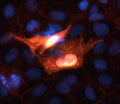
Immunofluorescence of transfected COS-7 cells specifically labeling positive beta Catenin cells using our anti-beta Catenin antibody (1:200, red) and anti-FLAG antibody (green). The yellow color results from the overlap of cells labeled with both antibodies. DNA is labeled with DAPI (blue).
Click on image to zoom
SKU: 213-bCAT
Ships: 1-2 business days
Product Details
beta Catenin
beta Catenin, considered a moonlighting protein, is a component of mammalian cell adhesion complex in the cytoplasm along with playing a key downstream component of the canonical Wingless Int-1 (Wnt) signaling pathway in the nucleus (McTrea P.D et al, 1991 and Kemler R. et al, 1993). As part of a protein complex that forms adheren junctions, beta Catenin is necessary for the creation and maintenance of epithelial cell layers and barriers (Brembeck F.H. et al, 2006). beta Catenin is responsible for transmitting the contact inhibition signal that causes cells to stop dividing once the epithelial sheet is complete (Brembeck F.H. et al, 2006). The Wnt/beta Catenin signaling pathway plays important roles in mammalian development (Logan C.Y. et al, 2004 ) and irregular regulation of this signaling pathway is associated with human diseases and cancers (Moon R.T., 2004). HIPK2 is a negative regulator of the Wnt signaling via the direct phosphorylation of beta Catenin at ser33/37 causing degradation (Kim E.A. et al, 2010). Additionally, stabilization of beta Catenin has been shown when AMPK phosphorylates at ser552 regulating energy metabolism to cell differentiation and development by enhancing the beta Catenin/TCF mediated transcription within the Wnt/betaCatenin signaling pathway (Zhao J. et al, 2010).
Antigen Affinity Purified from Pooled Serum
Polyclonal
IgG
ELISA, ICC, WB
Rabbit
CTNNB1
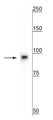
92 kDa
Synthetic peptide corresponding to amino acid residues from the C-terminal region of rat beta Catenin, conjugated to keyhole limpet hemocyanin (KLH).
Rat
Mouse, Rat
Human
AB_2927666
Storage at -20°C is recommended, as aliquots may be taken without freeze/thawing due to presence of 50% glycerol. Stable for at least 1 year at -20°C.
Liquid
Prepared from pooled rabbit serum by affinity purification on a column made with the C-terminal peptide used as antigen.
10 mM HEPES (pH 7.5), 150 mM NaCl, 100 µg per ml BSA and 50% glycerol.
WB: 1:1000
WB Brain: 1:1000
ICC: 1:200
WB Brain: 1:1000
ICC: 1:200
Unconjugated
Specific for endogenous levels of the ~92 kDa beta Catenin protein. Immunolabeling of the beta Catenin band is completely blocked by preadsorption of the antibody with the peptide used as antigen.
Western blots performed on each lot.
For research use only. Not intended for therapeutic or diagnostic use. Use of all products is subject to our terms and conditions, which can be viewed on our website.
United States
After date of receipt, stable for at least 1 year at -20°C.
b-catenin; Beta catenin; cadherin associated protein; Beta-catenin; Cadherin associated protein; Catenin (cadherin associated protein; beta 1; 88kDa; Catenin beta 1; Catenin beta-1; CATNB; CHBCAT; CTNB1_HUMAN; CTNNB; CTNNB1; DKFZp686D02253; FLJ25606; FLJ37923; OTTHUMP00000162082; OTTHUMP00000165222; OTTHUMP00000165223; OTTHUMP00000209288; OTTHUMP00000209289; Catenin
Q9WU82
UniProt Summary: Key downstream component of the canonical Wnt signaling pathway (PubMed:17524503, PubMed:18077326, PubMed:18086858, PubMed:18957423, PubMed:21262353, PubMed:22155184, PubMed:22647378, PubMed:22699938). In the absence of Wnt, forms a complex with AXIN1, AXIN2, APC, CSNK1A1 and GSK3B that promotes phosphorylation on N-terminal Ser and Thr residues and ubiquitination of CTNNB1 via BTRC and its subsequent degradation by the proteasome (PubMed:17524503, PubMed:18077326, PubMed:18086858, PubMed:18957423, PubMed:21262353, PubMed:22155184, PubMed:22647378, PubMed:22699938). In the presence of Wnt ligand, CTNNB1 is not ubiquitinated and accumulates in the nucleus, where it acts as a coactivator for transcription factors of the TCF/LEF family, leading to activate Wnt responsive genes (PubMed:17524503, PubMed:18077326, PubMed:18086858, PubMed:18957423, PubMed:21262353, PubMed:22155184, PubMed:22647378, PubMed:22699938). Also acts as a coactivator for other transcription factors, such as NR5A2 (PubMed:22187462). Promotes epithelial to mesenchymal transition/mesenchymal to epithelial transition (EMT/MET) via driving transcription of CTNNB1/TCF-target genes (PubMed:29910125). Involved in the regulation of cell adhesion, as component of an E-cadherin:catenin adhesion complex (By similarity). Acts as a negative regulator of centrosome cohesion (PubMed:18086858). Involved in the CDK2/PTPN6/CTNNB1/CEACAM1 pathway of insulin internalization (PubMed:21262353). Blocks anoikis of malignant kidney and intestinal epithelial cells and promotes their anchorage-independent growth by down-regulating DAPK2 (PubMed:18957423). Disrupts PML function and PML-NB formation by inhibiting RANBP2-mediated sumoylation of PML (PubMed:22155184). Promotes neurogenesis by maintaining sympathetic neuroblasts within the cell cycle (By similarity). Involved in chondrocyte differentiation via interaction with SOX9: SOX9-binding competes with the binding sites of TCF/LEF within CTNNB1, thereby inhibiting the Wnt signaling (By similarity). Acts as a positive regulator of odontoblast differentiation during mesenchymal tooth germ formation, via promoting the transcription of differentiation factors such as LEF1, BMP2 and BMP4 (By similarity). Activity is repressed in a MSX1-mediated manner at the bell stage of mesenchymal tooth germ formation which prevents premature differentiation of odontoblasts (By similarity). {ECO:0000250|UniProtKB:Q02248, ECO:0000269|PubMed:17524503, ECO:0000269|PubMed:18077326, ECO:0000269|PubMed:18086858, ECO:0000269|PubMed:18957423, ECO:0000269|PubMed:21262353, ECO:0000269|PubMed:22155184, ECO:0000269|PubMed:22187462, ECO:0000269|PubMed:22647378, ECO:0000269|PubMed:22699938, ECO:0000269|PubMed:29910125}.

84353
Blue Ice
- Western Blot Protocol: Download