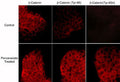
Anti-β-Catenin (Tyr-86), Phosphospecific Antibody
Our β-Catenin (Tyr-86) rabbit polyclonal phosphospecific primary antibody from PhosphoSolutions is produced in-house. It detects human, mouse, and rat β-Catenin (Tyr-86) and is antigen affinity purified. It is great for use in WB, ICC.
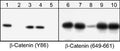
Western blot of β-Catenin immunoprecipitated from A431 cells treated with pervanadate. The blots were probed with β-Catenin (Tyr-86) or β-Catenin (a.a. 649-661) antibodies. The immunoprecipitates were untreated (lanes 1 & 6) or treated with alkaline phosphatase (lanes 5 & 10), and the antibodies were incubated with β-Catenin (Tyr-86) (lanes 2,7) or β-Catenin (a.a. 649-661) (lanes 3,8) peptides or phospho-Tyr (lanes 4,9).
Click on image to zoom

SKU: CP1191
Ships: 1-2 business days
Product Details
β-Catenin (Tyr-86)
β-Catenin is a 92 kDa protein that binds to the cytoplasmic tail of E-Cadherin. The cadherins, transmembrane adhesion molecules, are found with catenins at adherens junctions. Deletions in the cytoplasmic domain of E-Cadherin eliminate catenin binding and result in a loss of cell adhesion. Tyrosine phosphorylation of β-Catenin can regulate its interaction with critical components of adherens junctions. Both Fer and Fyn kinases phosphorylate tyrosine 142 in vitro. Overexpression of these kinases in epithelial cells disrupts interactions between α- and β-Catenins. The phosphorylation of tyrosine 142 may act as a switch from the transcriptional to the adhesive role of β-Catenin. Src family kinases can also phosphorylate tyrosine 86 and 654 in β-Catenin. The Tyr-654 phosphorylation regulates β-Catenin binding to E-cadherin. Thus, site-specific tyrosine phosphorylation of β-Catenin may regulate protein-protein interactions leading to changes in cell adhesion.
Antigen Affinity Purified
Polyclonal
IgG
ELISA, ICC, WB
Rabbit
CTNNB1
92
Phospho-β-Catenin (Tyr-86) synthetic peptide (coupled to KLH) corresponding to amino acid residues around tyrosine 86 of human β-Catenin. This peptide sequence is highly conserved in rat and mouse β-Catenin.
Human
Human, Mouse, Rat
Storage at -20°C is recommended, as aliquots may be taken without freeze/thawing due to presence of 50% glycerol. Stable for at least 1 year at -20°C.
Liquid
PBS + 1 mg/ml BSA, 0.05% NaN3 and 50% glycerol
WB: 1:1000
ICC: 1:100
ICC: 1:100
Unconjugated
This antibody was cross-adsorbed to phospho-tyrosine coupled to agarose before affinity purification using phospho- β-Catenin (Tyr-86) peptide (without carrier). The antibody detects a 92kDa* protein corresponding to the molecular mass of β-Catenin on SDS-PAGE immunoblots of A431 and Hct116 src transformed cells treated with pervanadate (1 mM for 30 min), but not in control cells.
Phosphorylated
Tyr-86
Western blots performed on each lot.
For research use only. Not intended for therapeutic or diagnostic use. Use of all products is subject to our terms and conditions, which can be viewed on our website.
United States
After date of receipt, stable for at least 1 year at -20°C.
b-catenin; Catenin beta1; Beta catenin; Beta-catenin; Cadherin associated protein; Catenin (cadherin associated protein; beta 1; 88kDa; Catenin beta 1; Catenin beta-1; CATNB; CHBCAT; CTNB1_HUMAN; CTNNB; CTNNB1; DKFZp686D02253; FLJ25606; FLJ37923; OTTHUMP00000162082; OTTHUMP00000165222; OTTHUMP00000165223; OTTHUMP00000209288; OTTHUMP00000209289; CTNNB1; catenin
P35222
UniProt Summary: Key downstream component of the canonical Wnt signaling pathway. In the absence of Wnt, forms a complex with AXIN1, AXIN2, APC, CSNK1A1 and GSK3B that promotes phosphorylation on N-terminal Ser and Thr residues and ubiquitination of CTNNB1 via BTRC and its subsequent degradation by the proteasome. In the presence of Wnt ligand, CTNNB1 is not ubiquitinated and accumulates in the nucleus, where it acts as a coactivator for transcription factors of the TCF/LEF family, leading to activate Wnt responsive genes. Also acts as a coactivator for other transcription factors, such as NR5A2. Promotes epithelial to mesenchymal transition/mesenchymal to epithelial transition (EMT/MET) via driving transcription of CTNNB1/TCF-target genes. Involved in the regulation of cell adhesion, as component of an E-cadherin:catenin adhesion complex. Acts as a negative regulator of centrosome cohesion. Involved in the CDK2/PTPN6/CTNNB1/CEACAM1 pathway of insulin internalization. Blocks anoikis of malignant kidney and intestinal epithelial cells and promotes their anchorage-independent growth by down-regulating DAPK2. Disrupts PML function and PML-NB formation by inhibiting RANBP2-mediated sumoylation of PML. Promotes neurogenesis by maintaining sympathetic neuroblasts within the cell cycle. Involved in chondrocyte differentiation via interaction with SOX9: SOX9-binding competes with the binding sites of TCF/LEF within CTNNB1, thereby inhibiting the Wnt signaling. Acts as a positive regulator of odontoblast differentiation during mesenchymal tooth germ formation, via promoting the transcription of differentiation factors such as LEF1, BMP2 and BMP4. Activity is repressed in a MSX1-mediated manner at the bell stage of mesenchymal tooth germ formation which prevents premature differentiation of odontoblasts.
1499
Blue Ice