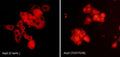
Our Arp2 (Thr-237/Thr-238) rabbit polyclonal phosphospecific primary antibody from PhosphoSolutions is produced in-house. It detects chicken, human, mouse, and rat Arp2 (Thr-237/Thr-238) and is antigen affinity purified. It is great for use in WB, ICC.
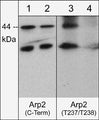
Western blot of human A431 cells treated with Calyculin A (100 nM) for 30 min. Blot lanes were untreated (lanes 1 & 3) or treated with lambda phosphatase (lanes 2 & 4) then probed with anti-Arp2 (C-terminal) (lanes 1 & 2) or anti-Arp2 (Thr-237/Thr-238) (lanes 3 & 4).
Cellular morphology, adhesion, and motility occur through dynamic reorganization of actin-based superstructures. Actin-binding proteins are critical for regulating actin polymerization and superstructure formation. The Arp2/3 complex is an actin polymerization-inducing complex that includes Arp2, Arp3, p41-Arc, p34-Arc, p21-Arc, p20-Arc, and p16-Arc. Several nucleation promoting factors, such as WASP and coronin, regulate the activity of the Arp2/3 complex. In addition, the Arp2/3 complex may be regulated by phosphorylation of specific subunits in the complex. Arp2 has two phosphosites, Thr-237 and Thr-238, that are evolutionarily conserved, and are phosphorylated along with Tyr-202 in response to growth factor stimulation. These phosphorylation events may regulate binding to the pointed end of actin filaments, and alanine substitutions of these Arp2 phosphosites inhibit membrane protrusions. Thus, phosphorylation may be another mode of Arp2/3 complex regulation in addition to the activity of nucleation-promoting factors.
Antigen Affinity Purified
Polyclonal
IgG
ELISA, ICC, WB
Rabbit
ACTR2
44
Phospho-Arp2 (Thr-237/Thr-238) synthetic peptide (coupled to KLH) corresponding to amino acid residues surrounding threonine 237 and threonine 238 in human Arp2. This peptide sequence is highly conserved in rat, mouse, chicken, and fish Arp2 proteins.
Human
Chicken, Human, Mouse, Rat
Storage at -20°C is recommended, as aliquots may be taken without freeze/thawing due to presence of 50% glycerol. Stable for at least 1 year at -20°C.
Liquid
PBS + 1 mg/ml BSA, 0.05% NaN3 and 50% glycerol
WB: 1:1000
ICC: 1:100
Unconjugated
The antibody detects 44 and 32 kDa* proteins corresponding to the molecular mass of Arp2 on SDS-PAGE immunoblots of human A431 and Jurkat cells treated with Calyculin A. This reactivity is not observed after lambda phosphatase treatment.
Phosphorylated
T237/T238
Western blots performed on each lot.
For research use only. Not intended for therapeutic or diagnostic use. Use of all products is subject to our terms and conditions, which can be viewed on our website.
United States
After date of receipt, stable for at least 1 year at -20°C.
ARP2; ACTR2; actin-like protein 2
P61160
UniProt Summary: ATP-binding component of the Arp2/3 complex, a multiprotein complex that mediates actin polymerization upon stimulation by nucleation-promoting factor (NPF). The Arp2/3 complex mediates the formation of branched actin networks in the cytoplasm, providing the force for cell motility. Seems to contact the pointed end of the daughter actin filament. In podocytes, required for the formation of lamellipodia downstream of AVIL and PLCE1 regulation. In addition to its role in the cytoplasmic cytoskeleton, the Arp2/3 complex also promotes actin polymerization in the nucleus, thereby regulating gene transcription and repair of damaged DNA. The Arp2/3 complex promotes homologous recombination (HR) repair in response to DNA damage by promoting nuclear actin polymerization, leading to drive motility of double-strand breaks (DSBs).
10097
Blue Ice
Bulk Order Anti-Arp2 (Thr-237/Thr-238), Phosphospecific Antibody
Related Products
Recently Viewed
Your research is our top priority
Highly-validated antibodies and reagents from our family of brands.