Our Anti-Ubiquitin C-terminal Hydrolase 1 (UCHL1) primary antibody from PhosphoSolutions is chicken polyclonal. It detects bovine, human, mouse, pig, and rat Ubiquitin C-terminal Hydrolase 1 (UCHL1) and is total IgY fraction. It is great for use in WB, IHC, ICC.
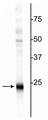
Western blot of rat hippocampal homogenate showing specific immunolabeling of the ~24 kDa UCHL1 protein.
Ubiquitin C-terminal hydrolase 1 (UCHL1) is also known as ubiquitin carboxyl esterase L1, ubiquitin thiolesterase, neuron-specific protein PGP9.5 and Park5. It was originally identified as a major component of the neuronal cytoplasm from 2-dimensional gel analysis of brain tissues, and was given the name PGP9.5 (1). It was later found that ubiquitin C-terminal hydrolase enzyme activity was associated with the PGP9.5 protein (2). The ubiquitin C-terminal hydrolases cleave ubiquitin from other molecules. Regulation of the ubiquitin pathway is very important and many disease states are associated with defects in this pathway. Genetic knockout of UCHL1 in mice results in a motor neuron degeneration similar to the spontaneous gracile axonal dystrophy (gad) mutant mice (3). Point mutations in the UCHL1 gene are associated with some forms of human Parkinson's disease (4). Since UCHL1 is heavily expressed in neurons, it is released in large amounts following injury or degeneration, so the detection of UCHL1 in CSF and other bodily fluids can be used as a biomarker.
Total IgY fraction
Polyclonal
IgY
ELISA, ICC, IHC, WB
Chicken
UCHL1
24 kDa
Recombinant full length human UCHL1 purified from E. coli.
Recommended that the undiluted antibody be aliquoted into smaller working volumes (10-30 uL/vial depending on usage) upon arrival and stored long term at -20° C or -80° C, while keeping a working aliquot stored at 4° C for short term. Avoid freeze/thaw cycles. Stable for at least 1 year.
Specific for endogenous levels of the ~24 kDa UCHL1 protein.
Western blots performed on each lot.
For research use only. Not intended for therapeutic or diagnostic use. Use of all products is subject to our terms and conditions, which can be viewed on our website.
After date of receipt, stable for at least 1 year at -20°C.
Epididymis luminal protein 117; Epididymis secretory protein Li 53; HEL 117; HEL S 53; NDGOA; Neuron cytoplasmic protein 9.5; OTTHUMP00000218137; OTTHUMP00000218139; OTTHUMP00000218140; OTTHUMP00000218141; Park 5; PARK5; PGP 9.5; PGP9.5; PGP95; Protein gene product 9.5; Ubiquitin C terminal esterase L1; Ubiquitin C terminal hydrolase; Ubiquitin C terminal hydrolase L1; Ubiquitin carboxyl terminal esterase L1; Ubiquitin carboxyl terminal hydrolase isozyme L1; Ubiquitin carboxyl-terminal hydrolase isozyme L1; Ubiquitin thioesterase L1; Ubiquitin thiolesterase; Ubiquitin thiolesterase L1; UCH-L1; UCHL1; UCHL1_HUMAN
P09936
UniProt Summary: Deubiquitinase that plays a role in the regulation of several processes such as maintenance of synaptic function, cardiac function, inflammatory response or osteoclastogenesis (PubMed:22212137, PubMed:23359680). Abrogates the ubiquitination of multiple proteins including WWTR1/TAZ, EGFR, HIF1A and beta-site amyloid precursor protein cleaving enzyme 1/BACE1 (PubMed:22212137, PubMed:25615526). In addition, recognizes and hydrolyzes a peptide bond at the C-terminal glycine of ubiquitin to maintain a stable pool of monoubiquitin that is a key requirement for the ubiquitin-proteasome and the autophagy-lysosome pathways (PubMed:12408865, PubMed:8639624, PubMed:9774100). Regulates amyloid precursor protein/APP processing by promoting BACE1 degradation resulting in decreased amyloid beta production (PubMed:22212137). Plays a role in the immune response by regulating the ability of MHC I molecules to reach cross-presentation compartments competent for generating Ag-MHC I complexes (By similarity). Mediates the 'Lys-48'-linked deubiquitination of the transcriptional coactivator WWTR1/TAZ leading to its stabilization and inhibition of osteoclastogenesis (By similarity). Deubiquitinates and stabilizes epidermal growth factor receptor EGFR to prevent its degradation and to activate its downstream mediators (By similarity). Modulates oxidative activity in skeletal muscle by regulating key mitochondrial oxidative proteins (By similarity). Enhances the activity of hypoxia-inducible factor 1-alpha/HIF1A by abrogateing its VHL E3 ligase-mediated ubiquitination and consequently inhibiting its degradation (PubMed:25615526). {ECO:0000250|UniProtKB:Q9R0P9, ECO:0000269|PubMed:12408865, ECO:0000269|PubMed:22212137, ECO:0000269|PubMed:23359680, ECO:0000269|PubMed:25615526, ECO:0000269|PubMed:8639624, ECO:0000269|PubMed:9774100}.
Doran, J.F., Jackson, P., Kynoch, P.A. and Thompson, R.J., 1983. Isolation of PGP 9.5, a new human neurone‐specific protein detected by high‐resolution two‐dimensional electrophoresis. Journal of Neurochemistry, 40(6), pp.1542-1547. PMID: 6343558
Wilkinson, K.D., Lee, K.M., Deshpande, S., Duerksen-Hughes, P., Boss, J.M. and Pohl, J., 1989. The neuron-specific protein PGP 9.5 is a ubiquitin carboxyl-terminal hydrolase. Science, 246(4930), pp.670-673. PMID: 2530630
Kurihara, L.J., Kikuchi, T., Wada, K. and Tilghman, S.M., 2001. Loss of Uch-L1 and Uch-L3 leads to neurodegeneration, posterior paralysis and dysphagia. Human Molecular Genetics, 10(18), pp.1963-1970. PMID: 11555633
Liu, Y., Fallon, L., Lashuel, H.A., Liu, Z. and Lansbury Jr, P.T., 2002. The UCH-L1 gene encodes two opposing enzymatic activities that affect α-synuclein degradation and Parkinson's disease susceptibility. Cell, 111(2), pp.209-218. PMID: 12408865
Bulk Order Anti-Ubiquitin C-terminal Hydrolase 1 (UCHL1) Antibody
Related Products
Recently Viewed
Your research is our top priority
Highly-validated antibodies and reagents from our family of brands.