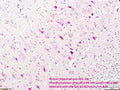
Anti-Tau (Ser416) Antibody
Our Anti-Tau (Ser416) rabbit polyclonal phosphospecific primary antibody from PhosphoSolutions is produced in-house. It detects human, mouse, and rat Tau (Ser416) and is antigen affinity purified from pooled serum. It is great for use in WB, IHC.
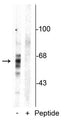
Western blot of rat brain homogenate showing specific immunolabeling of the ~59 kDa, ~65 kDa, ~68 kDa Tau isoforms phosphorylated at Ser416 in the first lane (-). Phosphospecificity is shown in the second lane (+) where immunolabeling is blocked by preadsorption with the phosphopeptide used as antigen, but not by the corresponding non-phosphopeptide (not shown).
Click on image to zoom

SKU: p1573-416
Ships: 1-2 business days
Product Details
Tau (Ser416)
Tau is a key microtubule-associated protein that plays an important role in the formation of microtubules in axons (Binder et al. 1985). Six tau isoforms have been identified as products of a single gene produced by alternative mRNA splicing (Goedert 1990). Tau mutations have been implicated in many neurodegenerative disorders such as Alzheimer’s disease (AD), Pick’s disease and progressive supranuclear palsy. It has been well documented that hyperphosphorylated tau is a major component of paired helical filaments in AD brain (Lee 1995). Ser-416 has been demonstrated to be a major phosphorylation site in vitro by CaM kinase II (Steiner at al. 1990).
Antigen Affinity Purified from Pooled Serum
Polyclonal
IgG
ELISA, IHC, WB
Rabbit
MAPT
59/65/68 kDa
Synthetic phospho-peptide corresponding to amino acid residues surrounding Ser416 of rat tau, conjugated to keyhole limpet hemocyanin (KLH).
Rat
Mouse, Rat
Bovine, Canine, Non-Human Primate
AB_2492257
Storage at -20°C is recommended, as aliquots may be taken without freeze/thawing due to presence of 50% glycerol. Stable for at least 1 year at -20°C.
Liquid
Prepared from pooled rabbit serum by affinity purification via sequential chromatography on phospho and non-phosphopeptide affinity columns.
10 mM HEPES (pH 7.5), 150 mM NaCl, 100 µg per ml BSA and 50% glycerol.
WB: 1:1000
WB Brain: 1:1000
IHC: 1:200
WB Brain: 1:1000
IHC: 1:200
Unconjugated
Specific for ~59, 65, 68 kDa tau protein phosphorylated at Ser416. Immunolabeling is blocked by preadsorption with the phosphopeptide used as antigen, but not by the corresponding non-phosphopeptide.
Phosphorylated
Ser416
Western blots performed on each lot.
For research use only. Not intended for therapeutic or diagnostic use. Use of all products is subject to our terms and conditions, which can be viewed on our website.
After date of receipt, stable for at least 1 year at -20°C.
AI413597; AW045860; DDPAC; FLJ31424; FTDP 17; G protein beta1/gamma2 subunit interacting factor 1; MAPT; MAPTL; MGC134287; MGC138549; MGC156663; Microtubule associated protein tau; Microtubule associated protein tau isoform 4; Microtubule-associated protein tau; MSTD; Mtapt; MTBT1; MTBT2; Neurofibrillary tangle protein; Paired helical filament tau; Paired helical filament-tau; PHF tau; PHF-tau; PPND; PPP1R103; Protein phosphatase 1 regulatory subunit 103; pTau; RNPTAU; TAU; TAU_HUMAN; Tauopathy and respiratory failure included
P19332
UniProt Summary: Promotes microtubule assembly and stability, and might be involved in the establishment and maintenance of neuronal polarity (PubMed:21985311). The C-terminus binds axonal microtubules while the N-terminus binds neural plasma membrane components, suggesting that tau functions as a linker protein between both (PubMed:21985311, PubMed:32961270). Axonal polarity is predetermined by TAU/MAPT localization (in the neuronal cell) in the domain of the cell body defined by the centrosome. The short isoforms allow plasticity of the cytoskeleton whereas the longer isoforms may preferentially play a role in its stabilization. {ECO:0000269|PubMed:21985311, ECO:0000269|PubMed:32961270}.
4137
Blue Ice
- Western Blot Protocol: Download
General References
- Binder, L.I., Frankfurter, A. and Rebhun, L.I., 1985. The distribution of tau in the mammalian central nervous system. The Journal of Cell Biology, 101(4), pp.1371-1378. PMID: 3930508
- Lee, V.M., 1995. Disruption of the cytoskeleton in Alzheimer's disease. Current Opinion in Neurobiology, 5(5), pp.663-668. PMID: 8580719
- Goedert, M. and Jakes, R., 1990. Expression of separate isoforms of human tau protein: correlation with the tau pattern in brain and effects on tubulin polymerization. The EMBO Journal, 9(13), pp.4225-4230. PMID: 2124967
- Steiner, B., Mandelkow, E.M., Biernat, J., Gustke, N., Meyer, H.E., Schmidt, B., Mieskes, G., Söling, H.D., Drechsel, D. and Kirschner, M.W., 1990. Phosphorylation of microtubule‐associated protein tau: identification of the site for Ca2 (+)‐calmodulin dependent kinase and relationship with tau phosphorylation in Alzheimer tangles. The EMBO Journal, 9(11), pp.3539-3544. PMID: 2120043