
Anti-Small ubiquitin-related modifier 1 (SUMO-1) Antibody
Our Anti-Small ubiquitin-related modifier 1 (SUMO-1) sheep polyclonal primary antibody detects human and rat Small ubiquitin-related modifier 1 (SUMO-1), and is whole serum. It is validated for use in IHC-Frozen, WB.
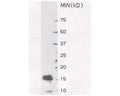
Western blot detection of recombinant SUMO-1 protein using Sheep antibody to SUMO-1 (6-21): ws, (catalogue no. S-064-100) at a dilution of 1:8000. The protein sample was 1 µl of E.Coli cell lysate containing approximately 50 ng of recombinant SUMO-1 protein. This antibody recognises a major band of approximately 17 kDa corresponding to SUMO-1, as well as a smaller minor band of 8 kDa.
Click on image to zoom
SKU: S-064-100
Ships: 5-7 business days
Product Details
Small ubiquitin-related modifier 1 (SUMO-1)
SUMO-1 binds to a wide range of target proteins as part of a post-translational modification system. Unlike ubiquitin, it does not seem to target protein for degradation, but is involved in a number of cellular processes such as nuclear transport, DNA replication and repair, mitosis, apoptosis, protein stability and signal transduction. SUBUNIT: Covalently attached to a number of proteins such as PmL, RANGAP1, HIPK2, SP100, p53, p73alpha, MDM2, JUN and DNMT3B. Also interacts with HIF1A, HIPK2, HIPK3, CHD3, PIAS1, EXOSC9, TDG, RAD51 and RAD52. SUBCELLULAR LOCATION: Nucleus; nuclear membrane. Nucleus; nucleoplasm; nuclear speckle. Cytoplasm. SIMILARITY: Belongs to the ubiquitin family. SMT3 subfamily. SIMILARITY: Contains 1 ubiquitin-like domain. PTM: Cleavage of the last four amino acids of the carboxy-terminus of the precursor form by SENP1 or SENP2 is necessary for function. Several pseudogenes have been reported as well as a number of alternatively spliced isoforms.
Whole serum
Polyclonal
Mixed
IHC, WB
Sheep
A synthetic peptide (AKPSTEDLGDKKEGEY) as part of human SUMO-1 peptide (aa: 6-21) conjugated to diphtheria toxoid has been used as the immunogen. This antigen is homologous with SUMO-1 of rat.
Human
Human, Rat
Spin vial briefly before opening. Reconstitute in 100 µL sterile-filtered, ultrapure water. Centrifuge to remove any insoluble material. After reconstitution keep aliquots at -20°C for a higher stability, and at 2-8°C with an appropriate antibacterial agent. Glycerol (1:1) may be added for an additional stability. Avoid repetitive freeze/thaw cycles.
Lyophilized
WB: 1:4000-1:8000
IHC: 1:2000-1:4000
IHC: 1:2000-1:4000
Cell lysate from Hela and NIH-3T3 cell lysates may be used as a positive control, and for IHC, lung carcinoma may be used.
Unconjugated
This antiserum recognizes human SUMO-1 and not ubiquitin. This antiserum is known to cross react with rat and human SUMO-1.
For research use only.
United States
12 months after date of receipt (unopened vial).
DAP1; Small ubiquitin-related modifier 1; OFC10; Ubiquitin-like protein SMT3C; PIC1; SMT3 homolog 3; SENP2; Ubiquitin-homology domain protein PIC1; SMT3; Ubiquitin-like protein UBL1; SMT3C; GAP-modifying protein 1; SMT3H3; GMP1; UBL1; Sentrin; SUMO1; GAP modifying protein 1; SMT3 suppressor of mif two 3 homolog 1
P63165
UniProt Summary: Ubiquitin-like protein that can be covalently attached to proteins as a monomer or a lysine-linked polymer. Covalent attachment via an isopeptide bond to its substrates requires prior activation by the E1 complex SAE1-SAE2 and linkage to the E2 enzyme UBE2I, and can be promoted by E3 ligases such as PIAS1-4, RANBP2 or CBX4. This post-translational modification on lysine residues of proteins plays a crucial role in a number of cellular processes such as nuclear transport, DNA replication and repair, mitosis and signal transduction. Involved for instance in targeting RANGAP1 to the nuclear pore complex protein RANBP2. Covalently attached to the voltage-gated potassium channel KCNB1; this modulates the gating characteristics of KCNB1. Polymeric SUMO1 chains are also susceptible to polyubiquitination which functions as a signal for proteasomal degradation of modified proteins. May also regulate a network of genes involved in palate development. Covalently attached to ZFHX3.
7341
25°C (ambient)

