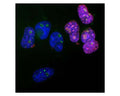
Anti-Ki-67 Antibody
Our Anti-Ki-67 rabbit polyclonal primary antibody detects human Ki-67, and is whole serum. It is validated for use in ICC, WB.
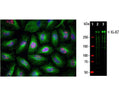
Left: Immunofluorescence analysis of HeLa cells costained with rabbit antibody to Ki-67 (1:5,000, red) and a mouse antibody to beta-tubulin. Ki-67 is predominantly localized in nucleoli of cells in interphase, while in mitotic cells Ki-67 is associated with condensed chromosomes. Ki-67 is not expressed in cells in quiescent G0 state. Blue: DAPI staining of nuclear DNA. Right: Western blots analysis of equal amounts of HeLa (Lane 2) and HEK293 (Lane 3) cell lysates using rabbit antibody to Ki-67 (1:10,000). Double bands above 250 kDa correspond to two major Ki-67 isoforms of molecular weight ~345 and 395 kDa. Smaller fragments of these isoforms are also detected on the blot.
Click on image to zoom
SKU: R-1806-100
Ships: 1-2 business days
Product Details
Ki-67
Required to maintain individual mitotic chromosomes dispersed in the cytoplasm following nuclear envelope disassembly (PubMed:27362226). Associates with the surface of the mitotic chromosome, the perichromosomal layer, and covers a substantial fraction of the chromosome surface (PubMed:27362226). Prevents chromosomes from collapsing into a single chromatin mass by forming a steric and electrostatic charge barrier: the protein has a high net electrical charge and acts as a surfactant, dispersing chromosomes and enabling independent chromosome motility (PubMed:27362226). Binds DNA, with a preference for supercoiled DNA and AT-rich DNA (PubMed:10878551). Does not contribute to the internal structure of mitotic chromosomes (By similarity). May play a role in chromatin organization (PubMed:24867636). It is however unclear whether it plays a direct role in chromatin organization or whether it is an indirect consequence of its function in maintaining mitotic chromosomes dispersed (Probable). Ref: uniprot.org
Whole serum
Polyclonal
IgG
ICC, WB
Rabbit
Recombinant human Ki-67 protein (amino acids 1,111-1,490) expressed in and purified from E. coli.
Human
Human
Spin vial briefly before opening. Reconstitute with 100 µL sterile-filtered, ultrapure water. Centrifuge to remove any insoluble material. Store lyophilized antibody at 2-8°C. After reconstitution divide into aliquots and store at -20°C for long-term storage. Store at 2-8°C short-term (up to 4 weeks) with an appropriate antibacterial agent. Avoid repetitive freeze/thaw cycles.
Lyophilized
Lyophilized with sodium azide.
WB: 1:2000-1:10000
ICC: 1:1000-1:5000
ICC: 1:1000-1:5000
Unconjugated
Reacts with human only. Does not react with mouse or rat.
For research use only.
United States
12 months after date of receipt (unopened vial).
Antigen identified by monoclonal Ki 67; KI-67; Antigen identified by monoclonal Ki-67; Antigen KI-67; Antigen KI67; Ki67; KI67_HUMAN; KIA; Marker of proliferation Ki-67; MIB 1; MIB; MKI67; PPP1R105; Proliferation marker protein Ki-67; Proliferation related Ki 67 antigen; Protein phosphatase 1 regulatory subunit 105; RP11-380J17.2
P46013
UniProt Summary: Protein that associates with the surface of mitotic chromosomes and acts both as a chromosome repellent during early mitosis and chromosome attractant during late mitosis. Required to maintain individual mitotic chromosomes dispersed in the cytoplasm following nuclear envelope disassembly. During early mitosis, relocalizes from nucleoli to the chromosome surface where it forms extended brush structures that cover a substantial fraction of the chromosome surface. The MKI67 brush structure prevents chromosomes from collapsing into a single chromatin mass by forming a steric and electrostatic charge barrier: the protein has a high net electrical charge and acts as a surfactant, dispersing chromosomes and enabling independent chromosome motility. During mitotic anaphase, the MKI67 brush structure collapses and MKI67 switches from a chromosome repellent to a chromosome attractant to promote chromosome clustering and facilitate the exclusion of large cytoplasmic particles from the future nuclear space. Mechanistically, dephosphorylation during mitotic exit and simultaneous exposure of a conserved basic patch induce the RNA-dependent formation of a liquid-like condensed phase on the chromosome surface, promoting coalescence of neighboring chromosome surfaces and clustering of chromosomes. Binds premature ribosomal RNAs during anaphase; promoting liquid-liquid phase separation. Binds DNA, with a preference for supercoiled DNA and AT-rich DNA. Does not contribute to the internal structure of mitotic chromosomes. May play a role in chromatin organization; it is however unclear whether it plays a direct role in chromatin organization or whether it is an indirect consequence of its function in mitotic chromosome.
4288
25°C (ambient)