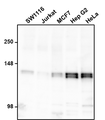
Anti-GOLGA2 (GM130) Antibody
Our Anti-GOLGA2 (GM130) chicken polyclonal primary antibody from Aves Labs is produced in-house. It detects human GOLGA2 (GM130) , and is affinity-purified IgY. It is great for use in IHC, ICC, WB.
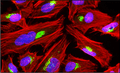
Immunofluorescent staining of HeLa cells using 1 µg/mL Aves Labs chicken anti-GM130 (GOLGA2) (Cat. GOLGA2-0100) antibody (green). Actin filaments were stained using Phalloidin (red). DAPI nuclear stain (blue) shows cell nuclei. The cells were mounted with Antibodies Incorporated Fluoroshield with DAPI mounting medium (Cat. AR-6501). Anti-GM130 specifically stains the Golgi apparatus in HeLa cells.
Click on image to zoom
SKU: GOLGA2-0100
Ships: 1-2 business days
Product Details
GM130
GOLGA2, also known as GM130, is a Golgi matrix protein critical for the proper functioning and organization of the Golgi apparatus. Discovered in the mid-1990s, GOLGA2 is involved in the maintenance of Golgi structure and the facilitation of vesicle trafficking within the cell. This protein is pivotal in ensuring that proteins and lipids are correctly modified, sorted, and sent to their destined locations, which is essential for various cellular processes including secretion, plasma membrane repair, and lysosome function. GOLGA2's role in cellular homeostasis and its effect on the Golgi apparatus associates it with several neurodegenerative and congenital disorders. Mutations in the gene and dysfunction of the protein can lead to brain development delays, and diseases such as Parkinson’s and ALS (Huang et al. 2021). Also, changes in GOLGA2 levels can affect Golgi structure and vesicle trafficking leading to aberrant cell proliferation, tumorigenesis and metastasis, making GOLGA2 a target of anti-cancer gene therapy (Chang et al. 2012).
Affinity-Purified IgY
200 µg/mL
Polyclonal
IgY
ICC, IHC, WB
Chicken
GOLGA2
130 kDa
Synthetic peptide
Human
Human
AB_3105809
Store at 4°C in the dark. Under these conditions, the antibodies should have a shelf life of at least twelve months, provided they remain sterile. For longer term storage, aliquot and freeze to avoid freeze-thaw of the antibody.
Liquid
Eggs from hens hyperimmunized with target were used to prepare an IgY fraction which was then subjected to antigen-specific affinity purification
Phosphate-buffered (10 mM) isotonic (0.9%, w/v) saline (“PBS," pH 7.2) with sodium azide (0.02%, w/v) added as a preservative.
WB: 1:500-1:2000
IHC: 1:100-1:500
ICC: 1:100-1:500
IHC: 1:100-1:500
ICC: 1:100-1:500
Unconjugated
No cross-reactivity reported
Each new lot of this antibody is tested to confirm that it recognizes a single immunoreactive band of expected molecular weight when used to probe HeLa cell lysate.
These antibodies are to be used as research laboratory reagents and are not for use as diagnostic or therapeutic reagents in humans.
United States
12 months from receipt of product
GM130; Golgin A2; 130 kDa cis-Golgi matrix protein; GM130 autoantigen; Golgi matrix protein GM130; SY11 protein; golgi autoantigen; golgin subfamily a; golgin-95; DEDHMB
Q08379
UniProt Summary: Peripheral membrane component of the cis-Golgi stack that acts as a membrane skeleton that maintains the structure of the Golgi apparatus, and as a vesicle thether that facilitates vesicle fusion to the Golgi membrane (Probable). Required for normal protein transport from the endoplasmic reticulum to the Golgi apparatus and the cell membrane. Together with p115/USO1 and STX5, involved in vesicle tethering and fusion at the cis-Golgi membrane to maintain the stacked and inter-connected structure of the Golgi apparatus. Plays a central role in mitotic Golgi disassembly: phosphorylation at Ser-37 by CDK1 at the onset of mitosis inhibits the interaction with p115/USO1, preventing tethering of COPI vesicles and thereby inhibiting transport through the Golgi apparatus during mitosis. Also plays a key role in spindle pole assembly and centrosome organization. Promotes the mitotic spindle pole assembly by activating the spindle assembly factor TPX2 to nucleate microtubules around the Golgi and capture them to couple mitotic membranes to the spindle: upon phosphorylation at the onset of mitosis, GOLGA2 interacts with importin-alpha via the nuclear localization signal region, leading to recruit importin-alpha to the Golgi membranes and liberate the spindle assembly factor TPX2 from importin-alpha. TPX2 then activates AURKA kinase and stimulates local microtubule nucleation. Upon filament assembly, nascent microtubules are further captured by GOLGA2, thus linking Golgi membranes to the spindle. Regulates the meiotic spindle pole assembly, probably via the same mechanism. Also regulates the centrosome organization. Also required for the Golgi ribbon formation and glycosylation of membrane and secretory proteins.
2801
Ice packs