Anti-Eukaryotic translation initiation factor 2C (elF2c) Antibody
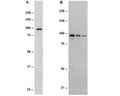
Our Anti-Eukaryotic translation initiation factor 2C (elF2c) rabbit polyclonal primary antibody detects human, mouse, and rat Eukaryotic translation initiation factor 2C (elF2c), and is affinity-purified. It is validated for use in IHC-Frozen, IHC-Paraffin-embedded, IP, WB.
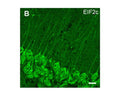
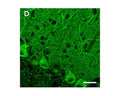
Immunohistochemical staining with Rabbit polyclonal antibody to mouse elF2c (R-1556-100) in(B) mouse hippocampal area. Fixed (4% paraformaldehyde) mouse brain free floating sections were incubated with R-1556-100 at 1 µg/mL overnight followed by incubation with fluoroscein donkey anti-rabbit IgG conjugate at a dilution of 1:100. Scale bar = 20µm.
Click on image to zoom
SKU: R-1556-100
Ships: 1-2 business days
Product Details
Eukaryotic translation initiation factor 2C (elF2c)
The elF2c (Argonaute, Ago) protein is a core protein of the RNA-induced silencing complex (RISC).
Affinity-purified
Polyclonal
IgG
EM, IHC, IP, WB
Rabbit
94 kDa
A synthetic peptide corresponding to a sequence (845-860 aa) from the C-terminus of mouse elF2C conjugated to KLH.
Mouse
Human, Mouse, Rat
Spin vial briefly before opening. Reconstitute in 100 µL sterile-filtered, ultrapure water. Centrifuge to remove any insoluble material. At least 12 months after purchase at 2-8°C (lyophilized formulations). After reconstitution, aliquot and store at -20°C for a higher stability and at 2-8°C with an appropriate antibacterial agent. Avoid freeze-thaw cycles.
Lyophilized
Lyophilized from PBS.
WB: 1:1000-1:2000
IHC: 1:200-1:500
IHC: 1:200-1:500
Unconjugated
Specificity has been confirmed by IHC, WB and IP in mouse brain. This antibody is expected to recognize at least elF2c-1, 2 and 3 since they have identical C-termini. Human; mouse; rat; The Ago proteins are highly conserved so cross-reactivity with other species is expected.
For research use only.
United States
12 months after date of receipt (unopened vial).
1110029L17Rik; Protein argonaute-1; AI225898; Protein argonaute-2; AL022874; Protein argonaute-3; AW546247; Argonaute1; Eif2c2; Argonaute2; Gerp95; Argonaute3; Gm10365; mAgo1; mKIAA4215; mAgo2; Piwi/Argonaute family protein meIF2C2; Eukaryotic translation initiation factor 2C; argonaute 2; eIF-2C 2; eIF-2C 1; eIF2C 2; Piwi/argonaute family protein meIF2C2 Protein slicer; Ago1; Ago2
Q8CJG0
UniProt Summary: Required for RNA-mediated gene silencing (RNAi) by the RNA-induced silencing complex (RISC). The 'minimal RISC' appears to include AGO2 bound to a short guide RNA such as a microRNA (miRNA) or short interfering RNA (siRNA). These guide RNAs direct RISC to complementary mRNAs that are targets for RISC-mediated gene silencing. The precise mechanism of gene silencing depends on the degree of complementarity between the miRNA or siRNA and its target. Binding of RISC to a perfectly complementary mRNA generally results in silencing due to endonucleolytic cleavage of the mRNA specifically by AGO2. Binding of RISC to a partially complementary mRNA results in silencing through inhibition of translation, and this is independent of endonuclease activity. May inhibit translation initiation by binding to the 7-methylguanosine cap, thereby preventing the recruitment of the translation initiation factor eIF4-E. May also inhibit translation initiation via interaction with EIF6, which itself binds to the 60S ribosomal subunit and prevents its association with the 40S ribosomal subunit. The inhibition of translational initiation leads to the accumulation of the affected mRNA in cytoplasmic processing bodies (P-bodies), where mRNA degradation may subsequently occur. In some cases RISC-mediated translational repression is also observed for miRNAs that perfectly match the 3' untranslated region (3'-UTR). Can also up-regulate the translation of specific mRNAs under certain growth conditions. Binds to the AU element of the 3'-UTR of the TNF mRNA and up-regulates translation under conditions of serum starvation. Also required for transcriptional gene silencing (TGS), in which short RNAs known as antigene RNAs or agRNAs direct the transcriptional repression of complementary promoter regions.
239528
25°C (ambient)