
Anti-EphrinB (Tyr317) Antibody
Our Anti-EphrinB (Tyr317) rabbit polyclonal phosphospecific primary antibody from PhosphoSolutions is produced in-house. It detects mouse and rat EphrinB (Tyr317) and is antigen affinity purified from pooled serum. It is great for use in WB.
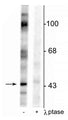
Western blot of rat testes lysate showing specific immunolabeling of the ~46 kDa EphrinB phosphorylated at Tyr317 in the first lane (-). Phosphospecificity is shown in the second lane (+) where immunolabeling is completely eliminated by blot treatment with lambda phosphatase (λ-Ptase, 1200 units for 30 min).
Click on image to zoom

SKU: p1110-317
Ships: 1-2 business days
Product Details
EphrinB (Tyr317)
EphrinB proteins are thought to play key roles in cellular functions as diverse as neuronal migration and blood vessel development (Flanagan and Vanderhaeghen, 1998; Dufour et al., 2003; Oike et al., 2002). EphrinB molecules expressed at the membrane surface bind to the EphB family receptors on target cells during cell-to cell contact. This interaction leads to cell signaling in the target cell but also generates a reverse signal in the cell expressing EphrinB on its surface. This reverse signaling event is thought to be critical for vessel maturation and neuronal development. Importantly, tyrosine phosphorylation of EphrinB is thought to be a critical component of this reverse signaling event (Palmer et al., 2002). Recent work suggests that phosphorylation of a specific EphrinB residue (Tyr-298) plays a key role in EphrinB signaling (Kalo, et al., 2001).
Antigen Affinity Purified from Pooled Serum
Polyclonal
IgG
ELISA, WB
Rabbit
EPHB2
46 kDa
Synthetic phosphopeptide corresponding to amino acid residues surrounding the phospho Tyr317 of chicken EphrinB, conjugated to keyhole limpet hemocyanin (KLH). Note: Chicken Tyr317 is the homolog of rat and mouse Tyr328, human Tyr329 and Xenopus Tyr310.
Chicken
Mouse, Rat
Bovine, Chicken, Human, Xenopus, Zebrafish
AB_2492087
Storage at -20°C is recommended, as aliquots may be taken without freeze/thawing due to presence of 50% glycerol. Stable for at least 1 year at -20°C.
Liquid
Prepared from pooled rabbit serum by affinity purification via sequential chromatography on phospho and non-phosphopeptide affinity columns.
10 mM HEPES (pH 7.5), 150 mM NaCl, 100 µg per ml BSA and 50% glycerol.
WB: 1:1000
Unconjugated
Specific for endogenous levels of the ~46 kDa EphrinB protein phosphorylated at Tyr317. Immunolabeling is completely eliminated by treatment with λ-phosphatase.
Phosphorylated
Tyr317
Western blots performed on each lot.
For research use only. Not intended for therapeutic or diagnostic use. Use of all products is subject to our terms and conditions, which can be viewed on our website.
After date of receipt, stable for at least 1 year at -20°C.
CEK5 ligand; EFNB1; ELK L; ELK ligand; ELKL; EPH related receptor tyrosine kinase ligand 2; Ephrin B1; Ephrin B2; LERK2
P28693
UniProt Summary: Receptor tyrosine kinase which binds promiscuously transmembrane ephrin-B family ligands residing on adjacent cells, leading to contact-dependent bidirectional signaling into neighboring cells. The signaling pathway downstream of the receptor is referred to as forward signaling while the signaling pathway downstream of the ephrin ligand is referred to as reverse signaling. Functions in axon guidance during development. Involved in the guidance of commissural axons, that form a major interhemispheric connection between the 2 temporal lobes of the cerebral cortex. Also involved in guidance of contralateral inner ear efferent growth cones at the midline and of retinal ganglion cell axons to the optic disk. In addition to axon guidance, also regulates dendritic spines development and maturation and stimulates the formation of excitatory synapses. Upon activation by EFNB1, abolishes the ARHGEF15-mediated negative regulation on excitatory synapse formation. Controls other aspects of development including angiogenesis, palate development and in inner ear development through regulation of endolymph production. Forward and reverse signaling through the EFNB2/EPHB2 complex regulate movement and adhesion of cells that tubularize the urethra and septate the cloaca. May function as a tumor suppressor. May be involved in the regulation of platelet activation and blood coagulation (PubMed:30213874). {ECO:0000269|PubMed:15300251, ECO:0000269|PubMed:30213874}.
396513
Blue Ice
- Western Blot Protocol: Download

