
Anti-Alpha Synuclein (Ser129) Antibody
Our Anti-Alpha Synuclein (Ser129) rabbit polyclonal phosphospecific primary antibody from PhosphoSolutions is produced in-house. It detects human, mouse, and rat Alpha Synuclein (ser129) and is antigen affinity purified from pooled serum. It is great for use in WB, IHC.
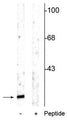
Western blot of rat cortical lysate showing specific immunolabeling of the ~15 kDa alpha synuclein protein phosphorylated at Ser129 in the first lane (-). Phosphospecificity is shown in the second lane (+) where the immunolabeling is blocked by the phosphopeptide used as antigen but not by the corresponding non-phosphopeptide (not shown).
Click on image to zoom

Human, Mouse, Rat
ELISA, IHC, WB
Rabbit
SKU: p1571-129
Ships: 1-2 business days
Product Details
Alpha Synuclein (ser129)
Alpha-synuclein is a presynaptic neuronal protein that is thought to be involved in the formation of SNARE complexes. Most significantly, aggregated alphasynuclein is one of the major components found in the Lewy bodies that occur in Parkinson’s disease (PD) and other neurodegenerative disorders (Okochi et al., 2000). Mutation of the alpha-synuclein gene is associated with familial forms of PD (Newmann et al., 2002). Recent evidence suggests that phosphorylation of alpha-synuclein at Ser129 plays a role in the formation of inclusions in PD (Smith et al., 2005; Masliah et al., 2005).
Antigen Affinity Purified from Pooled Serum
Polyclonal
IgG
ELISA, IHC, WB
Rabbit
SNCA
15 kDa
Synthetic phospho-peptide corresponding to amino acid residues surrounding Ser129 of rat alpha-aynuclein, conjugated to keyhole limpet hemocyanin (KLH).
Rat
Human, Mouse, Rat
Bovine, Canine, Non-Human Primate
AB_2492038
Storage at -20°C is recommended, as aliquots may be taken without freeze/thawing due to presence of 50% glycerol. Stable for at least 1 year at -20°C.
Liquid
Prepared from pooled rabbit serum by affinity purification via sequential chromatography on phospho and non-phosphopeptide affinity columns.
10 mM HEPES (pH 7.5), 150 mM NaCl, 100 µg per ml BSA and 50% glycerol.
WB: 1:1000
WB Brain: 1:1000
IHC: 1:200
WB Brain: 1:1000
IHC: 1:200
Unconjugated
Specific for endogenous levels of the ~15 kDa alpha-synuclein protein phosphorylated at Ser129. Immunolabeling is blocked by preadsorption with the phosphopeptide used as antigen, but not by the corresponding non-phosphopeptide.
Phosphorylated
Ser129
Western blots performed on each lot.
For research use only. Not intended for therapeutic or diagnostic use. Use of all products is subject to our terms and conditions, which can be viewed on our website.
After date of receipt, stable for at least 1 year at -20°C.
Alpha synuclein; Alpha-synuclein; autosomal dominant Lewy body 4; Alpha-synuclein; non A4 component of amyloid precursor; isoform NACP140; alphaSYN; MGC105443; MGC110988; MGC127560; MGC64356; NACP; Non A beta component of AD amyloid; Non A4 component of amyloid; Non-A beta component of AD amyloid; Non-A-beta component of alzheimers disease amyloid; precursor of; Non-A4 component of amyloid precursor; Non-A4 component of amyloid; OTTHUMP00000218549; OTTHUMP00000218551; OTTHUMP00000218552; OTTHUMP00000218553; OTTHUMP00000218554; PARK 1; PARK 4; PARK1; PARK4; Parkinson disease (autosomal dominant Lewy body 4; Parkinson disease familial 1; SNCA; Snca synuclein alpha (non A4 component of amyloid precursor; SYN; Synuclein alpha; Synuclein alpha 140; Synuclein alpha (non A4 component of amyloid precursor; SYUA_HUMAN; Snca synuclein alpha; Synuclein alpha; Parkinson disease
P37377
UniProt Summary: Neuronal protein that plays several roles in synaptic activity such as regulation of synaptic vesicle trafficking and subsequent neurotransmitter release (PubMed:20798282, PubMed:26442590, PubMed:28288128, PubMed:30404828). Participates as a monomer in synaptic vesicle exocytosis by enhancing vesicle priming, fusion and dilation of exocytotic fusion pores (PubMed:28288128, PubMed:30404828). Mechanistically, acts by increasing local Ca(2+) release from microdomains which is essential for the enhancement of ATP-induced exocytosis (PubMed:30404828). Also acts as a molecular chaperone in its multimeric membrane-bound state, assisting in the folding of synaptic fusion components called SNAREs (Soluble NSF Attachment Protein REceptors) at presynaptic plasma membrane in conjunction with cysteine string protein-alpha/DNAJC5 (PubMed:20798282). This chaperone activity is important to sustain normal SNARE-complex assembly during aging (PubMed:20798282). Also plays a role in the regulation of the dopamine neurotransmission by associating with the dopamine transporter (DAT1) and thereby modulating its activity (PubMed:26442590). {ECO:0000269|PubMed:20798282, ECO:0000269|PubMed:26442590, ECO:0000269|PubMed:28288128, ECO:0000269|PubMed:30404828}.
29219
Blue Ice

